Children, madmen and the cruelty of the system
Letters to the Daily Chronicle
"It is not the prisoners who need reformation. It is the prisons."
The story in brief
SummaryWilde writes two letters to the Daily Chronicle on English prisons, drawing on his own two years inside. The first, sent from France a week after his release, begins with the dismissal of Warder Martin of Reading for giving sweet biscuits to a hungry child, and widens into an attack on the treatment of children and of a prisoner who is being driven insane. The second, signed 'The Author of the Ballad of Reading Gaol', lists the reforms he thinks a new bill should make.
Both letters make the same argument: the cruelty of prison is not the passion of wicked men but the stupidity of a system, carried out by officials who are often humane themselves. Wilde describes cells, food, sanitation and punishment with plain, specific detail and proposes practical changes: no children in prison, proper food, open lavatories, books, letters, visits in a room. He ends by asking that the governors be humanised, the warders civilised and the chaplains Christianised.
Key themes
"Ordinary cruelty is simply stupidity."
Related works
Explore more of Wilde's writing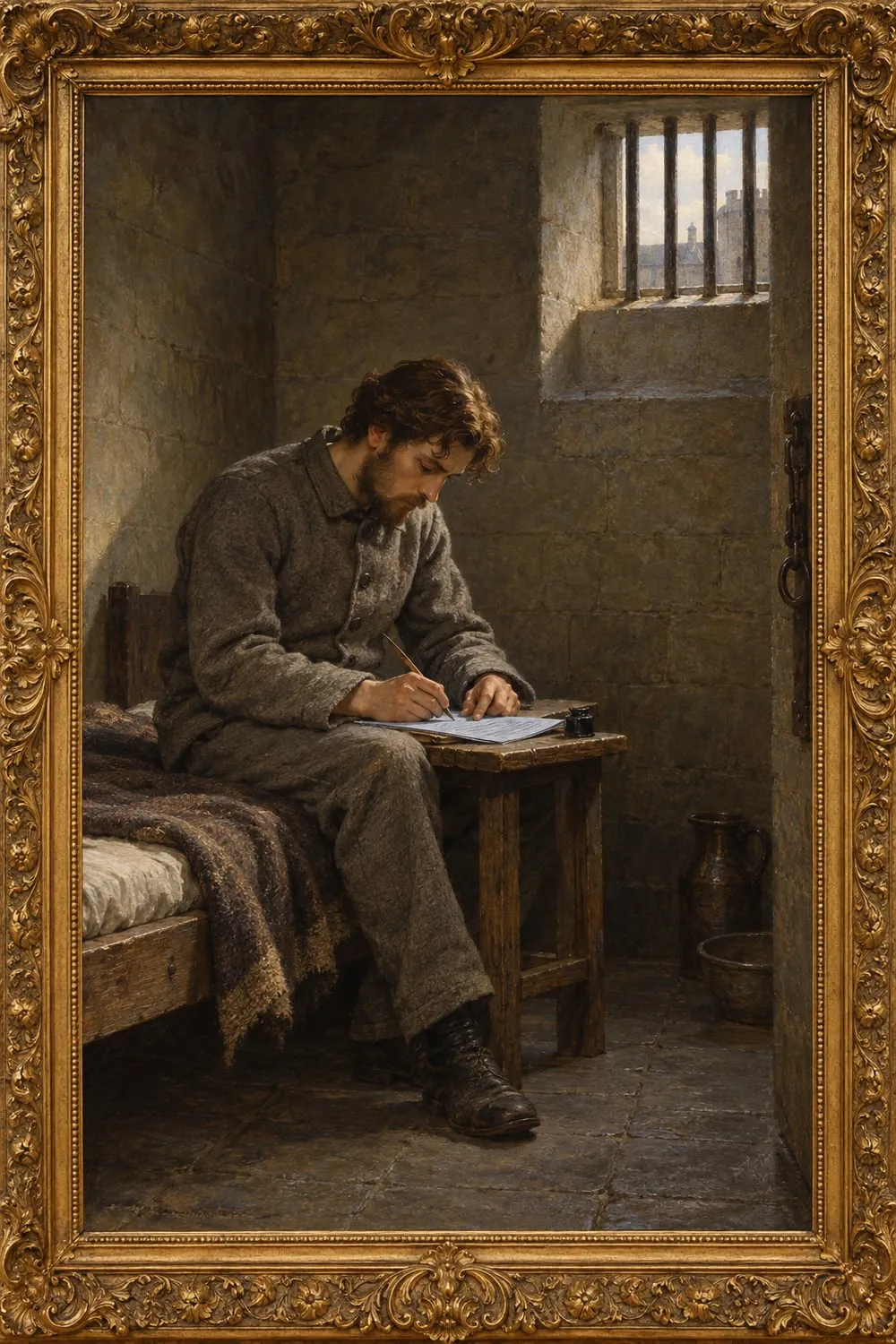 De ProfundisWritten in his cell at Reading, Wilde's account of how suffering and prison changed him, and of the figure of Christ as the supreme artist. This is the abridged text of 1905.Read more
  Lord Arthur Savile's CrimeA palm reader tells a young aristocrat that he is destined to commit a murder, so he decides to get it over with before his wedding. A comic crime story.Read more
  The Canterville GhostAn American family buys an English country house with a resident ghost, and refuses to be frightened by him. The ghost takes it very badly.Read more
 Context
Wilde was released from prison on 19 May 1897 after two years' hard labour, much of it in Reading Gaol, and left for France. The first letter is dated from France, 27 May 1897, and appeared in the Daily Chronicle on 28 May; it was reprinted as a pamphlet, Children in Prison and Other Cruelties of Prison Life, in 1898. The Ballad of Reading Gaol was published in February 1898 under the name C.3.3., which is why the second letter is signed 'The Author of the Ballad of Reading Gaol'.
The second letter appeared on 24 March 1898, when a prison reform bill was before Parliament; it became the Prison Act 1898. Both letters were printed with De Profundis in the Methuen edition of 1915.
First published in the Daily Chronicle on 28 May 1897 and 24 March 1898.
About this edition
- Text: The first letter: Children in Prison and Other Cruelties of Prison Life, Murdoch & Co., 1898. The second: De Profundis, Methuen & Co., 1915. Public domain. We change only the layout.
- Every quotation and glossary word in these notes is checked against the text.