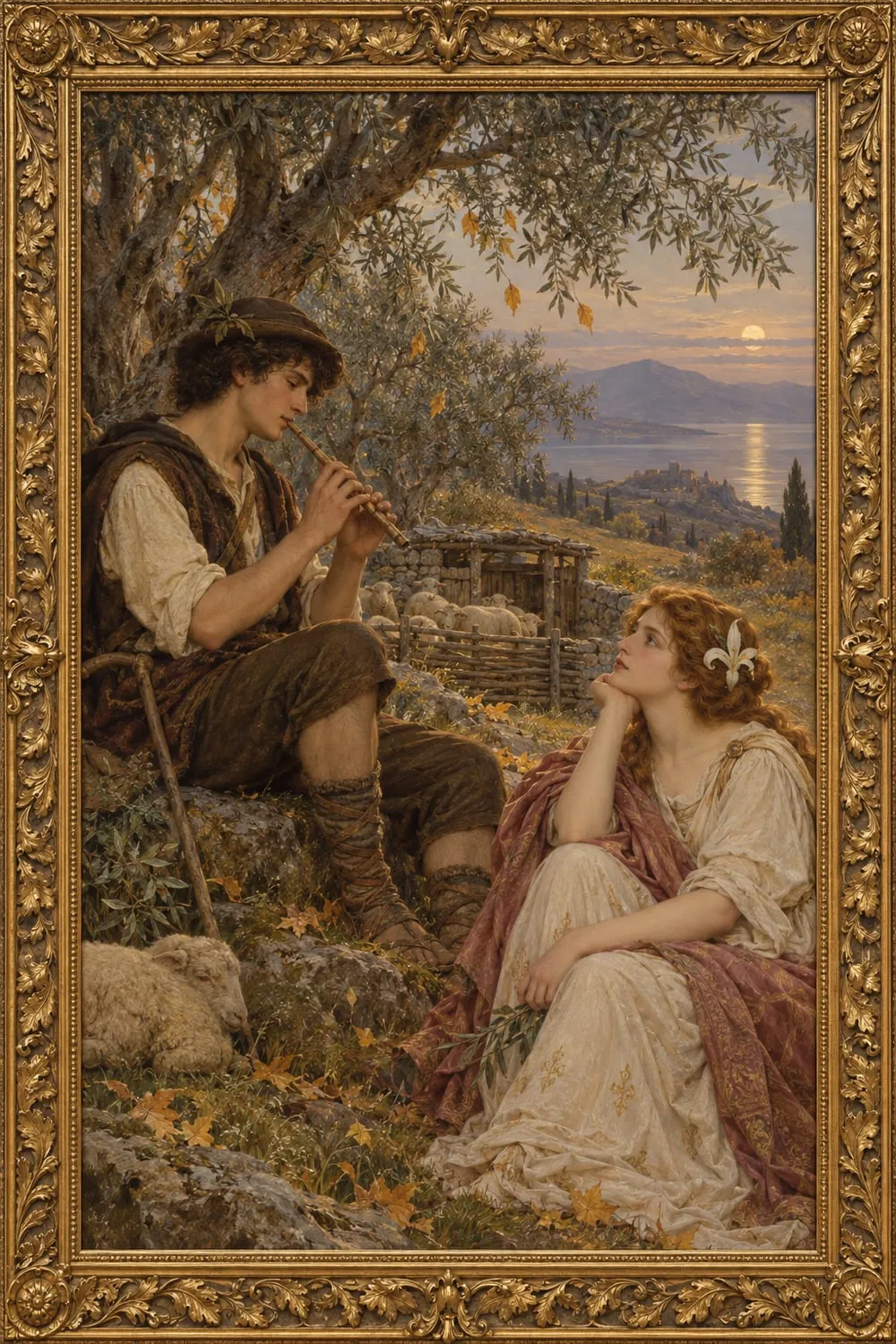
A shepherd's song in a godless autumn
Canzonet
"Sinks the sad autumn day."
Poem
I have no storeOf gryphon-guarded gold;Now, as before,Bare is the shepherd’s fold.Rubies nor pearlsHave I to gem thy throat;Yet woodland girlsHave loved the shepherd’s note.
Then, pluck a reedAnd bid me sing to thee,For I would feedThine ears with melody,Who art more fairThan fairest fleur-de-lys,More sweet and rareThan sweetest ambergris.
What dost thou fear?Young Hyacinth is slain,Pan is not here,And will not come again.No hornèd FaunTreads down the yellow leas,No God at dawnSteals through the olive trees.
Hylas is dead,Nor will he e’er divineThose little redRose-petalled lips of thine.On the high hillNo ivory dryads play,Silver and stillSinks the sad autumn day.
In brief
SummaryA poor singer, who speaks as a shepherd, woos the one he loves with the only gift he has: song. He owns no 'gryphon-guarded gold' and no jewels for the beloved's throat, but 'woodland girls / Have loved the shepherd's note', so he asks to be bidden to sing. Then he asks what the beloved fears, and answers with a list of absences. The gods and fair youths of the old stories are gone: Hyacinth is slain, Pan will not come again, no Faun or god walks the fields, and Hylas is dead. The song ends as a still, sad autumn day sinks.
Key themes
"Young Hyacinth is slain"
Related works
Explore more of Wilde's writing The Ballad of Reading GaolWritten after his release from prison, a long ballad about the hanging of a fellow prisoner, a trooper who had killed his wife. Wilde's last work, and his most read poem.Read more
  The SphinxA student in his room questions the ancient sphinx that has watched from its corner for a thousand years, and is frightened by what she knows.Read more
  Chorus of Cloud MaidensRead more
 Summary
In the first stanza the speaker admits his poverty. He has 'no store / Of gryphon-guarded gold', his fold is bare, and he has neither rubies nor pearls 'to gem thy throat'. Yet 'woodland girls / Have loved the shepherd's note'. In the second stanza he asks the beloved to 'pluck a reed / And bid me sing to thee', for he would 'feed / Thine ears with melody'. The beloved is fairer than 'fairest fleur-de-lys' and sweeter than 'sweetest ambergris'.
The third stanza asks, 'What dost thou fear?', and answers with what is no longer there. 'Young Hyacinth is slain', and 'Pan is not here, / And will not come again'. No horned Faun 'Treads down the yellow leas', and no God 'Steals through the olive trees' at dawn.
The fourth stanza completes the list. 'Hylas is dead', and will never see 'Those little red / Rose-petalled lips of thine'. No 'ivory dryads' play on the high hill. The song closes on the season: 'Silver and still / Sinks the sad autumn day.' The old world of gods is gone, leaving the shepherd free to sing, but in a quieter and sadder time.
Characters
The shepherd
A poor singer in love
The speaker, a shepherd with a bare fold and no gold or jewels to give. He offers his song instead, and tells the beloved there is nothing to fear, since the gods and fair youths of the old stories are all gone.
The beloved
Fairer than the fleur-de-lys
The one the shepherd sings to, 'more fair / Than fairest fleur-de-lys' and 'More sweet and rare / Than sweetest ambergris', with 'Rose-petalled lips'. The beloved seems to be afraid, for the shepherd asks 'What dost thou fear?', but never speaks.
Themes
Song as the only wealth
The speaker offers what he has in place of what he lacks. He has no 'gryphon-guarded gold', no 'Rubies nor pearls', but he can 'feed / Thine ears with melody'. The request that the beloved 'pluck a reed / And bid me sing' turns the reed pipe, the shepherd's instrument, into his gift. Poetry stands in for riches.
The vanished gods
The second half is a roll-call of what has gone from the pastoral world: Hyacinth, Pan, the 'hornèd Faun', the God at dawn, Hylas and the 'ivory dryads'. The speaker offers their absence as comfort, since there is no divine rival left to fear, but the list reads as mourning too. 'Pan is not here, / And will not come again' sounds more like a loss than a reassurance.
Autumn
The season sets the mood. The fields are 'yellow leas', and the last lines settle into dusk: 'Silver and still / Sinks the sad autumn day.' The run of soft 's' sounds slows the ending. The love song is sung at the close of a year and at the close of an age of gods.
Context
The title marks the poem as a canzonet, a short, light song. It has four stanzas of eight very short lines, rhyming in alternate lines, so that the rhymes fall close together as in a song lyric. Its world is the pastoral one of Greek myth, with shepherds, reed pipes, Pan, Fauns and dryads, and it names Hyacinth and Hylas, two youths of Greek legend whom the poem calls slain and dead.
About this edition
- Text: the complete work from Standard Ebooks, released into the public domain (CC0 1.0). We change only the layout.
- Download the EPUB of the whole book it comes from, free, for any e-reader.
- Every quotation and glossary word in these notes is checked against the text.