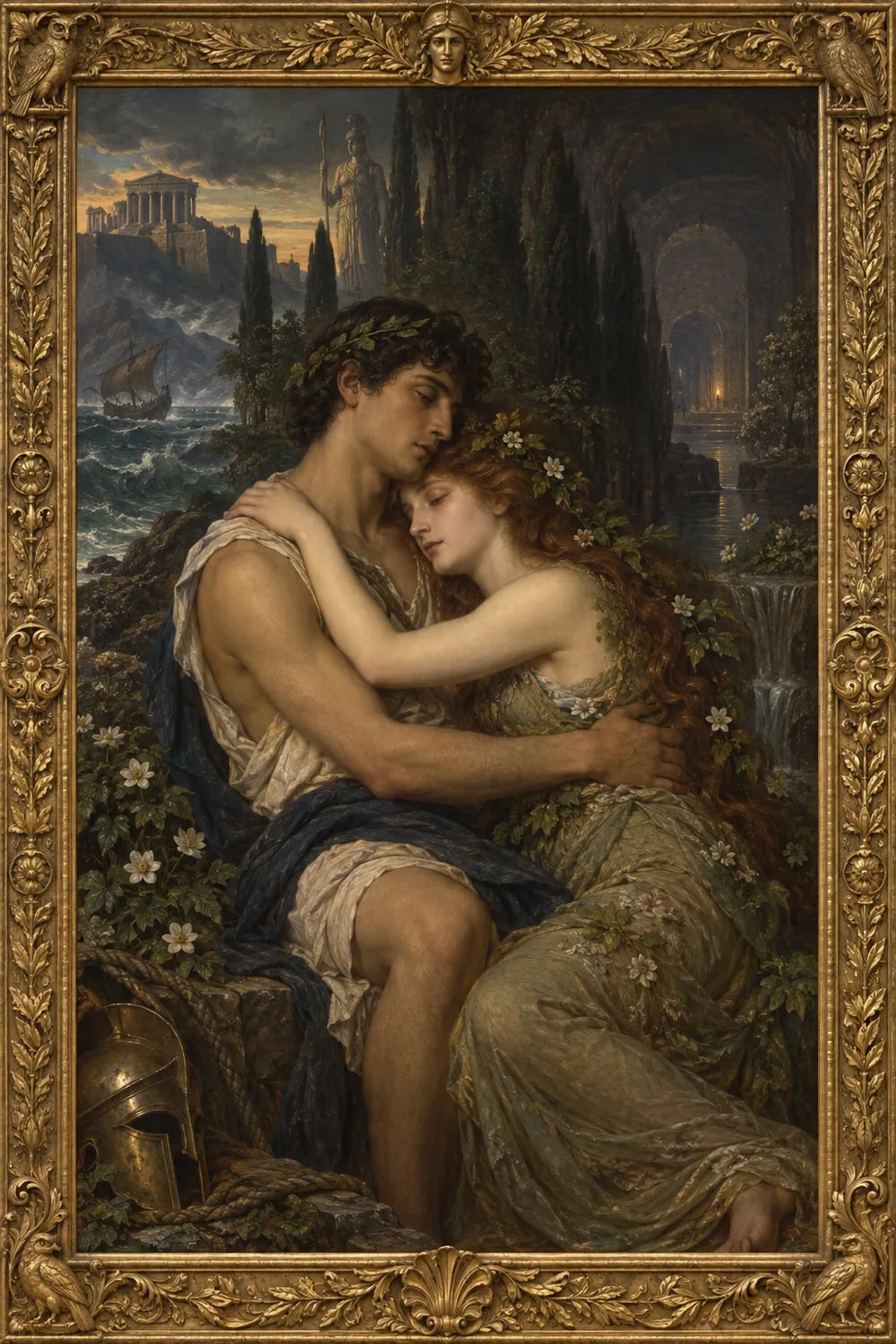
A Greek boy who loved a goddess
Charmides
"He was a Grecian lad, who coming home"
Poem
I
He was a Grecian lad, who coming homeWith pulpy figs and wine from SicilyStood at his galley’s prow, and let the foamBlow through his crisp brown curls unconsciously,And holding wave and wind in boy’s despitePeered from his dripping seat across the wet and stormy night.
Till with the dawn he saw a burnished spearLike a thin thread of gold against the sky,And hoisted sail, and strained the creaking gear,And bade the pilot head her lustilyAgainst the nor’west gale, and all day longHeld on his way, and marked the rowers’ time with measured song.
And when the faint Corinthian hills were redDropped anchor in a little sandy bay,And with fresh boughs of olive crowned his head,And brushed from cheek and throat the hoary spray,And washed his limbs with oil, and from the holdBrought out his linen tunic and his sandals brazen-soled,
And a rich robe stained with the fishes’ juiceWhich of some swarthy trader he had boughtUpon the sunny quay at Syracuse,And was with Tyrian broideries inwrought,And by the questioning merchants made his wayUp through the soft and silver woods, and when the labouring day
Had spun its tangled web of crimson cloud,Clomb the high hill, and with swift silent feetCrept to the fane unnoticed by the crowdOf busy priests, and from some dark retreatWatched the young swains his frolic playmates bringThe firstling of their little flock, and the shy shepherd fling
The crackling salt upon the flame, or hangHis studded crook against the temple wallTo Her who keeps away the ravenous fangOf the base wolf from homestead and from stall;And then the clear-voiced maidens ’gan to sing,And to the altar each man brought some goodly offering,
A beechen cup brimming with milky foam,A fair cloth wrought with cunning imageryOf hounds in chase, a waxen honey-combDripping with oozy gold which scarce the beeHad ceased from building, a black skin of oilMeet for the wrestlers, a great boar the fierce and white-tusked spoil
Stolen from Artemis that jealous maidTo please Athena, and the dappled hideOf a tall stag who in some mountain gladeHad met the shaft; and then the herald cried,And from the pillared precinct one by oneWent the glad Greeks well pleased that they their simple vows had done.
And the old priest put out the waning firesSave that one lamp whose restless ruby glowedFor ever in the cell, and the shrill lyresCame fainter on the wind, as down the roadIn joyous dance these country folk did pass,And with stout hands the warder closed the gates of polished brass.
Long time he lay and hardly dared to breathe,And heard the cadenced drip of spilt-out wine,And the rose-petals falling from the wreathAs the night breezes wandered through the shrine,And seemed to be in some entrancèd swoonTill through the open roof above the full and brimming moon
Flooded with sheeny waves the marble floor,When from his nook up leapt the venturous lad,And flinging wide the cedar-carven doorBeheld an awful image saffron-cladAnd armed for battle! the gaunt Griffin glaredFrom the huge helm, and the long lance of wreck and ruin flared
Like a red rod of flame, stony and steeledThe Gorgon’s head its leaden eyeballs rolled,And writhed its snaky horrors through the shield,And gaped aghast with bloodless lips and coldIn passion impotent, while with blind gazeThe blinking owl between the feet hooted in shrill amaze.
The lonely fisher as he trimmed his lampFar out at sea off Sunium, or castThe net for tunnies, heard a brazen trampOf horses smite the waves, and a wild blastDivide the folded curtains of the night,And knelt upon the little poop, and prayed in holy fright.
And guilty lovers in their veneryForgat a little while their stolen sweets,Deeming they heard dread Dian’s bitter cry;And the grim watchmen on their lofty seatsRan to their shields in haste precipitate,Or strained black-bearded throats across the dusky parapet.
For round the temple rolled the clang of arms,And the twelve Gods leapt up in marble fear,And the air quaked with dissonant alarumsTill huge Poseidon shook his mighty spear,And on the frieze the prancing horses neighed,And the low tread of hurrying feet rang from the cavalcade.
Ready for death with parted lips he stood,And well content at such a price to seeThat calm wide brow, that terrible maidenhood,The marvel of that pitiless chastity,Ah! well content indeed, for never wightSince Troy’s young shepherd prince had seen so wonderful a sight.
Ready for death he stood, but lo! the airGrew silent, and the horses ceased to neigh,And off his brow he tossed the clustering hair,And from his limbs he throw the cloak away;For whom would not such love make desperate?And nigher came, and touched her throat, and with hands violate
Undid the cuirass, and the crocus gown,And bared the breasts of polished ivory,Till from the waist the peplos falling downLeft visible the secret mysteryWhich to no lover will Athena show,The grand cool flanks, the crescent thighs, the bossy hills of snow.
Those who have never known a lover’s sinLet them not read my ditty, it will beTo their dull ears so musicless and thinThat they will have no joy of it, but yeTo whose wan cheeks now creeps the lingering smile,Ye who have learned who Eros is—O listen yet awhile.
A little space he let his greedy eyesRest on the burnished image, till mere sightHalf swooned for surfeit of such luxuries,And then his lips in hungering delightFed on her lips, and round the towered neckHe flung his arms, nor cared at all his passion’s will to check.
Never I ween did lover hold such tryst,For all night long he murmured honeyed word,And saw her sweet unravished limbs, and kissedHer pale and argent body undisturbed,And paddled with the polished throat, and pressedHis hot and beating heart upon her chill and icy breast.
It was as if Numidian javelinsPierced through and through his wild and whirling brain,And his nerves thrilled like throbbing violinsIn exquisite pulsation, and the painWas such sweet anguish that he never drewHis lips from hers till overhead the lark of warning flew.
They who have never seen the daylight peerInto a darkened room, and drawn the curtain,And with dull eyes and wearied from some dearAnd worshipped body risen, they for certainWill never know of what I try to sing,How long the last kiss was, how fond and late his lingering.
The moon was girdled with a crystal rim,The sign which shipmen say is ominousOf wrath in heaven, the wan stars were dim,And the low lightening east was tremulousWith the faint fluttering wings of flying dawn,Ere from the silent sombre shrine this lover had withdrawn.
Down the steep rock with hurried feet and fastClomb the brave lad, and reached the cave of Pan,And heard the goat-foot snoring as he passed,And leapt upon a grassy knoll and ranLike a young fawn unto an olive woodWhich in a shady valley by the well-built city stood.
And sought a little stream, which well he knew,For oftentimes with boyish careless shoutThe green and crested grebe he would pursue,Or snare in woven net the silver trout,And down amid the startled reeds he layPanting in breathless sweet affright, and waited for the day.
On the green bank he lay, and let one handDip in the cool dark eddies listlessly,And soon the breath of morning came and fannedHis hot flushed cheeks, or lifted wantonlyThe tangled curls from off his forehead, whileHe on the running water gazed with strange and secret smile.
And soon the shepherd in rough woollen cloakWith his long crook undid the wattled cotes,And from the stack a thin blue wreath of smokeCurled through the air across the ripening oats,And on the hill the yellow house-dog bayedAs through the crisp and rustling fern the heavy cattle strayed.
And when the light-foot mower went afieldAcross the meadows laced with threaded dew,And the sheep bleated on the misty weald,And from its nest the waking corncrake flew,Some woodmen saw him lying by the streamAnd marvelled much that any lad so beautiful could seem,
Nor deemed him born of mortals, and one said,“It is young Hylas, that false runawayWho with a Naiad now would make his bedForgetting Herakles,” but others, “Nay,It is Narcissus, his own paramour,Those are the fond and crimson lips no woman can allure.”
And when they nearer came a third one cried,“It is young Dionysos who has hidHis spear and fawnskin by the river sideWeary of hunting with the Bassarid,And wise indeed were we away to fly,They live not long who on the gods immortal come to spy.”
So turned they back, and feared to look behind,And told the timid swain how they had seenAmid the reeds some woodland God reclined,And no man dared to cross the open green,And on that day no olive-tree was slain,Nor rushes cut, but all deserted was the fair domain,
Save when the neat-herd’s lad, his empty pailWell slung upon his back, with leap and boundRaced on the other side, and stopped to hail,Hoping that he some comrade new had found,And gat no answer, and then half afraidPassed on his simple way, or down the still and silent glade
A little girl ran laughing from the farm,Not thinking of love’s secret mysteries,And when she saw the white and gleaming armAnd all his manlihood, with longing eyesWhose passion mocked her sweet virginityWatched him awhile, and then stole back sadly and wearily.
Far off he heard the city’s hum and noise,And now and then the shriller laughter whereThe passionate purity of brown-limbed boysWrestled or raced in the clear healthful air,And now and then a little tinkling bellAs the shorn wether led the sheep down to the mossy well.
Through the grey willows danced the fretful gnat,The grasshopper chirped idly from the tree,In sleek and oily coat the water-ratBreasting the little ripples manfullyMade for the wild-duck’s nest, from bough to boughHopped the shy finch, and the huge tortoise crept across the slough.
On the faint wind floated the silky seedsAs the bright scythe swept through the waving grass,The ousel-cock splashed circles in the reedsAnd flecked with silver whorls the forest’s glass,Which scarce had caught again its imageryEre from its bed the dusky tench leapt at the dragon-fly.
But little care had he for any thingThough up and down the beech the squirrel played,And from the copse the linnet ’gan to singTo its brown mate its sweetest serenade;Ah! little care indeed, for he had seenThe breasts of Pallas and the naked wonder of the Queen.
But when the herdsman called his straggling goatsWith whistling pipe across the rocky road,And the shard-beetle with its trumpet-notesBoomed through the darkening woods, and seemed to bodeOf coming storm, and the belated cranePassed homeward like a shadow, and the dull big drops of rain
Fell on the pattering fig-leaves, up he rose,And from the gloomy forest went his wayPast sombre homestead and wet orchard-close,And came at last unto a little quay,And called his mates aboard, and took his seatOn the high poop, and pushed from land, and loosed the dripping sheet,
And steered across the bay, and when nine sunsPassed down the long and laddered way of gold,And nine pale moons had breathed their orisonsTo the chaste stars their confessors, or toldTheir dearest secret to the downy mothThat will not fly at noonday, through the foam and surging froth
Came a great owl with yellow sulphurous eyesAnd lit upon the ship, whose timbers creakedAs though the lading of three argosiesWere in the hold, and flapped its wings and shrieked,And darkness straightway stole across the deep,Sheathed was Orion’s sword, dread Mars himself fled down the steep,
And the moon hid behind a tawny maskOf drifting cloud, and from the ocean’s margeRose the red plume, the huge and hornèd casque,The seven-cubit spear, the brazen targe!And clad in bright and burnished panoplyAthena strode across the stretch of sick and shivering sea!
To the dull sailors’ sight her loosened looksSeemed like the jagged storm-rack, and her feetOnly the spume that floats on hidden rocks,And, marking how the rising waters beatAgainst the rolling ship, the pilot criedTo the young helmsman at the stern to luff to windward side.
But he, the overbold adulterer,A dear profaner of great mysteries,An ardent amorous idolater,When he beheld those grand relentless eyesLaughed loud for joy, and crying out “I come”Leapt from the lofty poop into the chill and churning foam.
Then fell from the high heaven one bright star,One dancer left the circling galaxy,And back to Athens on her clattering carIn all the pride of venged divinityPale Pallas swept with shrill and steely clank,And a few gurgling bubbles rose where her boy lover sank.
And the mast shuddered as the gaunt owl flewWith mocking hoots after the wrathful Queen,And the old pilot bade the trembling crewHoist the big sail, and told how he had seenClose to the stern a dim and giant form,And like a dipping swallow the stout ship dashed through the storm.
And no man dared to speak of CharmidesDeeming that he some evil thing had wrought,And when they reached the strait SymplegadesThey beached their galley on the shore, and soughtThe toll-gate of the city hastily,And in the market showed their brown and pictured pottery.
II
But some good Triton-god had ruth, and bareThe boy’s drowned body back to Grecian land,And mermaids combed his dank and dripping hairAnd smoothed his brow, and loosed his clenching hand;Some brought sweet spices from far Araby,And others bade the halcyon sing her softest lullaby.
And when he neared his old Athenian home,A mighty billow rose up suddenlyUpon whose oily back the clotted foamLay diapered in some strange fantasy,And clasping him unto its glassy breastSwept landward, like a white-maned steed upon a venturous quest!
Now where Colonos leans unto the seaThere lies a long and level stretch of lawn,The rabbit knows it, and the mountain beeFor it deserts Hymettus, and the FaunIs not afraid, for never through the dayComes a cry ruder than the shout of shepherd lads at play.
But often from the thorny labyrinthAnd tangled branches of the circling woodThe stealthy hunter sees young HyacinthHurling the polished disk, and draws his hoodOver his guilty gaze, and creeps away,Nor dares to wind his horn, or—else at the first break of day
The Dryads come and throw the leathern ballAlong the reedy shore, and circumventSome goat-eared Pan to be their seneschalFor fear of bold Poseidon’s ravishment,And loose their girdles, with shy timorous eyes,Lest from the surf his azure arms and purple beard should rise.
On this side and on that a rocky cave,Hung with the yellow-belled laburnum, stands,Smooth is the beach, save where some ebbing waveLeaves its faint outline etched upon the sands,As though it feared to be too soon forgotBy the green rush, its playfellow—and yet, it is a spot
So small, that the inconstant butterflyCould steal the hoarded money from each flowerEre it was noon, and still not satisfyIts over-greedy love—within an hourA sailor boy, were he but rude enowTo land and pluck a garland for his galley’s painted prow,
Would almost leave the little meadow bare,For it knows nothing of great pageantry,Only a few narcissi here and thereStand separate in sweet austerity,Dotting the unmown grass with silver stars,And here and there a daffodil waves tiny scimitars.
Hither the billow brought him, and was gladOf such dear servitude, and where the landWas virgin of all waters laid the ladUpon the golden margent of the strand,And like a lingering lover oft returnedTo kiss those pallid limbs which once with intense fire burned,
Ere the wet seas had quenched that holocaust,That self-fed flame, that passionate lustihead,Ere grisly death with chill and nipping frostHad withered up those lilies white and redWhich, while the boy would through the forest range,Answered each other in a sweet antiphonal counter-change.
And when at dawn the wood-nymphs, hand-in-hand,Threaded the bosky dell, their satyr spiedThe boy’s pale body stretched upon the sand,And feared Poseidon’s treachery, and cried,And like bright sunbeams flitting through a gladeEach startled Dryad sought some safe and leafy ambuscade.
Save one white girl, who deemed it would not beSo dread a thing to feel a sea-god’s armsCrushing her breasts in amorous tyranny,And longed to listen to those subtle charmsInsidious lovers weave when they would winSome fencèd fortress, and stole back again, nor thought it sin
To yield her treasure unto one so fair,And lay beside him, thirsty with love’s drouth,Called him soft names, played with his tangled hair,And with hot lips made havoc of his mouthAfraid he might not wake, and then afraidLest he might wake too soon, fled back, and then, fond renegade,
Returned to fresh assault, and all day longSat at his side, and laughed at her new toy,And held his hand, and sang her sweetest song,Then frowned to see how froward was the boyWho would not with her maidenhood entwine,Nor knew that three days since his eyes had looked on Proserpine,
Nor knew what sacrilege his lips had done,But said, “He will awake, I know him well,He will awake at evening when the sunHangs his red shield on Corinth’s citadel,This sleep is but a cruel treacheryTo make me love him more, and in some cavern of the sea
Deeper than ever falls the fisher’s lineAlready a huge Triton blows his horn,And weaves a garland from the crystallineAnd drifting ocean-tendrils to adornThe emerald pillars of our bridal bed,For sphered in foaming silver, and with coral-crownèd head,
We two will sit upon a throne of pearl,And a blue wave will be our canopy,And at our feet the water-snakes will curlIn all their amethystine panoplyOf diamonded mail, and we will markThe mullets swimming by the mast of some storm-foundered bark,
Vermilion-finned with eyes of bossy goldLike flakes of crimson light, and the great deepHis glassy-portaled chamber will unfold,And we will see the painted dolphins sleepCradled by murmuring halcyons on the rocksWhere Proteus in quaint suit of green pastures his monstrous flocks.
And tremulous opal-hued anemonesWill wave their purple fringes where we treadUpon the mirrored floor, and argosiesOf fishes flecked with tawny scales will threadThe drifting cordage of the shattered wreck,And honey-coloured amber beads our twining limbs will deck.”
But when that baffled Lord of War the SunWith gaudy pennon flying passed awayInto his brazen House, and one by oneThe little yellow stars began to strayAcross the field of heaven, ah! then indeedShe feared his lips upon her lips would never care to feed,
And cried, “Awake, already the pale moonWashes the trees with silver, and the waveCreeps grey and chilly up this sandy dune,The croaking frogs are out, and from the caveThe nightjar shrieks, the fluttering bats repass,And the brown stoat with hollow flanks creeps through the dusky grass.
Nay, though thou art a God, be not so coy,For in yon stream there is a little reedThat often whispers how a lovely boyLay with her once upon a grassy mead,Who when his cruel pleasure he had doneSpread wings of rustling gold and soared aloft into the sun.
Be not so coy, the laurel trembles stillWith great Apollo’s kisses, and the firWhose clustering sisters fringe the seaward hillHath many a tale of that bold ravisherWhom men call Boreas, and I have seenThe mocking eyes of Hermes through the poplar’s silvery sheen.
Even the jealous Naiads call me fair,And every morn a young and ruddy swainWoos me with apples and with locks of hair,And seeks to soothe my virginal disdainBy all the gifts the gentle wood-nymphs love;But yesterday he brought to me an iris-plumaged dove
With little crimson feet, which with its storeOf seven spotted eggs the cruel ladHad stolen from the lofty sycamoreAt daybreak, when her amorous comrade hadFlown off in search of berried juniperWhich most they love; the fretful wasp, that earliest vintager
Of the blue grapes, hath not persistencySo constant as this simple shepherd-boyFor my poor lips, his joyous purityAnd laughing sunny eyes might well decoyA Dryad from her oath to Artemis;For very beautiful is he, his mouth was made to kiss,
His argent forehead, like a rising moonOver the dusky hills of meeting brows,Is crescent shaped, the hot and Tyrian noonLeads from the myrtle-grove no goodlier spouseFor Cytheraea, the first silky downFringes his blushing cheeks, and his young limbs are strong and brown:
And he is rich, and fat and fleecy herdsOf bleating sheep upon his meadows lie,And many an earthen bowl of yellow curdsIs in his homestead for the thievish flyTo swim and drown in, the pink clover meadKeeps its sweet store for him, and he can pipe on oaten reed.
And yet I love him not, it was for theeI kept my love, I knew that thou would’st comeTo rid me of this pallid chastity;Thou fairest flower of the flowerless foamOf all the wide Aegean, brightest starOf ocean’s azure heavens where the mirrored planets are!
I knew that thou would’st come, for when at firstThe dry wood burgeoned, and the sap of springSwelled in my green and tender bark or burstTo myriad multitudinous blossomingWhich mocked the midnight with its mimic moonsThat did not dread the dawn, and first the thrushes’ rapturous tunes
Startled the squirrel from its granary,And cuckoo flowers fringed the narrow lane,Through my young leaves a sensuous ecstasyCrept like new wine, and every mossy veinThrobbed with the fitful pulse of amorous blood,And the wild winds of passion shook my slim stem’s maidenhood.
The trooping fawns at evening came and laidTheir cool black noses on my lowest boughs,And on my topmost branch the blackbird madeA little nest of grasses for his spouse,And now and then a twittering wren would lightOn a thin twig which hardly bare the weight of such delight.
I was the Attic shepherd’s trysting place,Beneath my shadow Amaryllis lay,And round my trunk would laughing Daphnis chaseThe timorous girl, till tired out with playShe felt his hot breath stir her tangled hair,And turned, and looked, and fled no more from such delightful snare.
Then come away unto my ambuscadeWhere clustering woodbine weaves a canopyFor amorous pleasaunce, and the rustling shadeOf Paphian myrtles seems to sanctifyThe dearest rites of love; there in the coolAnd green recesses of its farthest depth there is a pool,
The ouzel’s haunt, the wild bee’s pasturage,For round its rim great creamy lilies floatThrough their flat leaves in verdant anchorage,Each cup a white-sailed golden-laden boatSteered by a dragon-fly—be not afraidTo leave this wan and wave-kissed shore, surely the place was made
For lovers such as we; the Cyprian Queen,One arm around her boyish paramour,Strays often there at eve, and I have seenThe moon strip off her misty vestitureFor young Endymion’s eyes; be not afraid,The panther feet of Dian never tread that secret glade.
Nay if thou will’st, back to the beating brine,Back to the boisterous billow let us go,And walk all day beneath the hyalineHuge vault of Neptune’s watery portico,And watch the purple monsters of the deepSport in ungainly play, and from his lair keen Xiphias leap.
For if my mistress find me lying hereShe will not ruth or gentle pity show,But lay her boar-spear down, and with austereRelentless fingers string the cornel bow,And draw the feathered notch against her breast,And loose the archèd cord; aye, even now upon the quest
I hear her hurrying feet—awake, awake,Thou laggard in love’s battle! once at leastLet me drink deep of passion’s wine, and slakeMy parchèd being with the nectarous feastWhich even gods affect! O come, Love, come,Still we have time to reach the cavern of thine azure home.”
Scarce had she spoken when the shuddering treesShook, and the leaves divided, and the airGrew conscious of a God, and the grey seasCrawled backward, and a long and dismal blareBlew from some tasselled horn, a sleuth-hound bayed,And like a flame a barbèd reed flew whizzing down the glade.
And where the little flowers of her breastJust brake into their milky blossoming,This murderous paramour, this unbidden guest,Pierced and struck deep in horrid chambering,And ploughed a bloody furrow with its dart,And dug a long red road, and cleft with wingèd death her heart.
Sobbing her life out with a bitter cryOn the boy’s body fell the Dryad maid,Sobbing for incomplete virginity,And raptures unenjoyed, and pleasures dead,And all the pain of things unsatisfied,And the bright drops of crimson youth crept down her throbbing side.
Ah! pitiful it was to hear her moan,And very pitiful to see her dieEre she had yielded up her sweets, or knownThe joy of passion, that dread mysteryWhich not to know is not to live at all,And yet to know is to be held in death’s most deadly thrall.
But as it hapt the Queen of Cythere,Who with Adonis all night long had lainWithin some shepherd’s hut in Arcady,On team of silver doves and gilded wainWas journeying Paphos-ward, high up afarFrom mortal ken between the mountains and the morning star,
And when low down she spied the hapless pair,And heard the Oread’s faint despairing cry,Whose cadence seemed to play upon the airAs though it were a viol, hastilyShe bade her pigeons fold each straining plume,And dropt to earth, and reached the strand, and saw their dolorous doom.
For as a gardener turning back his headTo catch the last notes of the linnet, mowsWith careless scythe too near some flower bed,And cuts the thorny pillar of the rose,And with the flower’s loosened lonelinessStrews the brown mould; or as some shepherd lad in wantonness
Driving his little flock along the meadTreads down two daffodils, which side by aideHave lured the lady-bird with yellow bredeAnd made the gaudy moth forget its pride,Treads down their brimming golden chalicesUnder light feet which were not made for such rude ravages,
Or as a schoolboy tired of his bookFlings himself down upon the reedy grassAnd plucks two water-lilies from the brook,And for a time forgets the hour glass,Then wearies of their sweets, and goes his way,And lets the hot sun kill them, even so these lovers lay.
And Venus cried, “It is dread ArtemisWhose bitter hand hath wrought this cruelty,Or else that mightier maid whose care it isTo guard her strong and stainless majestyUpon the hill Athenian—alas!That they who loved so well unloved into Death’s house should pass.”
So with soft hands she laid the boy and girlIn the great golden wagon tenderly,Her white throat whiter than a moony pearlJust threaded with a blue vein’s tapestryHad not yet ceased to throb, and still her breastSwayed like a wind-stirred lily in ambiguous unrest.
And then each pigeon spread its milky van,The bright car soared into the dawning sky,And like a cloud the aerial caravanPassed over the Aegean silently,Till the faint air was troubled with the songFrom the wan mouths that call on bleeding Thammuz all night long.
But when the doves had reached their wonted goalWhere the wide stair of orbèd marble dipsIts snows into the sea, her fluttering soulJust shook the trembling petals of her lipsAnd passed into the void, and Venus knewThat one fair maid the less would walk amid her retinue,
And bade her servants carve a cedar chestWith all the wonder of this history,Within whose scented womb their limbs should restWhere olive-trees make tender the blue skyOn the low hills of Paphos, and the faunPipes in the noonday, and the nightingale sings on till dawn.
Nor failed they to obey her hest, and ereThe morning bee had stung the daffodilWith tiny fretful spear, or from its lairThe waking stag had leapt across the rillAnd roused the ouzel, or the lizard creptAthwart the sunny rock, beneath the grass their bodies slept.
And when day brake, within that silver shrineFed by the flames of cressets tremulous,Queen Venus knelt and prayed to ProserpineThat she whose beauty made Death amorousShould beg a guerdon from her pallid Lord,And let Desire pass across dread Charon’s icy ford.
III
In melancholy moonless Acheron,Farm for the goodly earth and joyous day,Where no spring ever buds, nor ripening sunWeighs down the apple trees, nor flowery MayChequers with chestnut blooms the grassy floor,Where thrushes never sing, and piping linnets mate no more,
There by a dim and dark Lethaean wellYoung Charmides was lying; wearilyHe plucked the blossoms from the asphodel,And with its little rifled treasuryStrewed the dull waters of the dusky stream,And watched the white stars founder, and the land was like a dream,
When as he gazed into the watery glassAnd through his brown hair’s curly tangles scannedHis own wan face, a shadow seemed to passAcross the mirror, and a little handStole into his, and warm lips timidlyBrushed his pale cheeks, and breathed their secret forth into a sigh.
Then turned he round his weary eyes and saw,And ever nigher still their faces came,And nigher ever did their young mouths drawUntil they seemed one perfect rose of flame,And longing arms around her neck he cast,And felt her throbbing bosom, and his breath came hot and fast,
And all his hoarded sweets were hers to kiss,And all her maidenhood was his to slay,And limb to limb in long and rapturous blissTheir passion waxed and waned—O why essayTo pipe again of love, too venturous reed!Enough, enough that Eros laughed upon that flowerless mead.
Too venturous poesy, O why essayTo pipe again of passion! fold thy wingsO’er daring Icarus and bid thy laySleep hidden in the lyre’s silent stringsTill thou hast found the old Castalian rill,Or from the Lesbian waters plucked drowned Sappho’s golden quill!
Enough, enough that he whose life had beenA fiery pulse of sin, a splendid shame,Could in the loveless land of Hades gleanOne scorching harvest from those fields of flameWhere passion walks with naked unshod feetAnd is not wounded—ah! enough that once their lips could meet
In that wild throb when all existencesSeemed narrowed to one single ecstasyWhich dies through its own sweetness and the stressOf too much pleasure, ere PersephoneHad bade them serve her by the ebon throneOf the pale God who in the fields of Enna loosed her zone.
In brief
SummaryCharmides, a young Greek sailor, hides in Athena's temple after the evening offerings and at night unrobes her statue and kisses it until dawn. Days later at sea the goddess rises out of a storm; he leaps towards her crying 'I come' and drowns. A sea-god carries his body to a quiet shore near Colonos, where a Dryad falls in love with the beautiful corpse and is killed by an arrow from the woods. Venus lays the pair in one grave at Paphos and prays to Proserpine for them, and in the underworld the two lovers at last meet and embrace.
Key themes
"Which not to know is not to live at all,"
Related works
Explore more of Wilde's writing The Ballad of Reading GaolWritten after his release from prison, a long ballad about the hanging of a fellow prisoner, a trooper who had killed his wife. Wilde's last work, and his most read poem.Read more
  The SphinxA student in his room questions the ancient sphinx that has watched from its corner for a thousand years, and is frightened by what she knows.Read more
  Chorus of Cloud MaidensRead more
 Summary
Charmides, 'a Grecian lad', sails home from Sicily with figs and wine, sees 'a burnished spear' shining against the dawn sky, and anchors in a sandy bay as the Corinthian hills redden. He washes, dresses in a rich robe bought at Syracuse, and climbs to Athena's hilltop temple, where he hides while country people bring their offerings and the gates are shut. When moonlight floods the floor he opens the cedar door on her armed image, with its Gorgon shield and owl. The heavens seem to riot: a fisher off Sunium hears horses on the waves and 'the twelve Gods leapt up in marble fear'. Charmides stands 'Ready for death'; then the noise stops, and he undresses the statue and kisses it all night.
At dawn he runs to a stream in an olive wood and lies there smiling. Woodmen take him for Hylas, Narcissus or Dionysos and flee, and a farm girl watches him with longing, but he cares for nothing, 'for he had seen The breasts of Pallas'. He sails as a storm gathers. Nine days out an owl lands on the ship, darkness falls, and Athena strides across the sea in armour. The sailors see only storm, but Charmides laughs, cries 'I come', and leaps into the waves. Pallas returns to Athens avenged.
In the second part a kindly Triton carries his body home, and a wave lays it on a little meadow near Colonos. A Dryad finds him and, taking him for a sleeping sea-god, stays beside him all day, kissing him and dreaming aloud of a bridal bed beneath the sea. At nightfall she begs him to wake before her mistress Artemis finds her. A horn sounds, a hound bays, and an arrow pierces her breast. She dies on his body, 'Sobbing for incomplete virginity'.
Venus, flying home to Paphos after a night with Adonis, sees the pair and grieves, blaming Artemis or Athena. She lays them in her golden car; the girl's soul leaves her as they reach Paphos. Venus has them buried together in a carved cedar chest and prays to Proserpine that 'Desire' may cross Charon's ford.
In the third part Charmides lies by a Lethaean well in the moonless underworld. A shadow crosses his reflection, a little hand steals into his, and he turns to find the Dryad. They embrace at last. The poet breaks off, scolding his 'too venturous' verse: it is enough that one whose life was 'A fiery pulse of sin, a splendid shame' found one moment of passion in Hades.
Characters
Charmides
The goddess's profaner
A beautiful young Greek sailor with 'crisp brown curls' who hides in Athena's temple and makes love to her statue. Fearless and reckless, he laughs when the goddess rises from the sea and leaps to his death. In the underworld he is at last united with the Dryad who loved his body.
Athena
The virgin goddess avenged
Also called Pallas, the armed goddess whose statue, with its Gorgon shield and owl, Charmides unrobes. She rises from the sea 'in bright and burnished panoply' to claim him, then returns to Athens 'In all the pride of venged divinity'.
The Dryad
The nymph who loves him
A wood-nymph, once a tree and sworn to Artemis, who finds Charmides' body on the shore and takes him for a sleeping sea-god. She has refused a rich young shepherd, kept her love for this stranger, and is killed by an arrow before he can wake. She meets him again in Hades.
Venus
The pitying goddess of love
The Queen of Cythere, flying home to Paphos after a night with Adonis. She sees the dead lovers, grieves for them, carries them in her car drawn by doves, buries them together in a cedar chest and prays to Proserpine to let Desire cross into the underworld.
Proserpine
Queen of the underworld
Also called Persephone, the queen to whom Venus prays for the lovers, 'she whose beauty made Death amorous'. The lovers are allowed their meeting in her realm, before she bids them serve her by the throne of 'the pale God'.
The narrator
The daring poet
The storyteller, who breaks into the tale to warn off readers who have never sinned for love, addresses those 'who have learned who Eros is', and finally scolds his own 'too venturous' verse and brings the poem to a close.
Themes
Sacrilege and desire
Charmides' crime is the heart of the poem: 'with hands violate' he unrobes the statue and lays bare 'the secret mystery Which to no lover will Athena show'. The narrator does not simply condemn him. He calls him 'A dear profaner of great mysteries' and 'An ardent amorous idolater', admiring the daring even as he records the punishment.
Love and death
Every love in the poem is joined to death. Charmides leaps gladly to the goddess and drowns; the Dryad loves a corpse and is killed; the narrator says of passion that 'not to know is not to live at all, And yet to know is to be held in death's most deadly thrall'. Only in the underworld, 'that flowerless mead', do the two lovers finally meet.
Chastity against Venus
Athena and Artemis, the virgin goddesses, punish desire: Athena drowns Charmides, and the Dryad fears the 'austere Relentless fingers' of her mistress. Venus alone pities the lovers. She lifts them into her golden car, buries them with care and prays that 'Desire' may pass into the underworld. The poem takes her side against 'that pitiless chastity'.
The poet's own voice
The narrator keeps stepping into his story. He warns away readers who 'have never known a lover's sin', turns to those 'who have learned who Eros is', and at the close scolds his 'Too venturous poesy' and bids it fold its wings over 'daring Icarus'. These asides make the poem a defence of its own boldness, aware that its subject is dangerous.
Context
Charmides was published in Wilde's Poems (1881), where it is the longest poem in the volume, standing on its own between the Wind Flowers and Flowers of Gold groups. It is divided into three numbered parts and written in six-line stanzas whose final line is longer than the rest. It was attacked at the time as indecent.
About this edition
- Text: the complete work from Standard Ebooks, released into the public domain (CC0 1.0). We change only the layout.
- Download the EPUB of the whole book it comes from, free, for any e-reader.
- Every quotation and glossary word in these notes is checked against the text.