Themes
The dignity of the handicraftsman
Wilde separates the independent artist, who 'has his visions and his dreams to feed on', from the workman, who needs to see 'lovely forms as he goes to his work in the morning.' Good work is 'worked out with the head and the workman's heart', not merely done exactly, which machinery can manage. He wants the salesman removed from between buyer and maker, and describes the South Kensington Museum on Saturday nights as the place where the cultivated man 'comes face to face with the workman who ministers to his joy.'
Colour and harmony at home
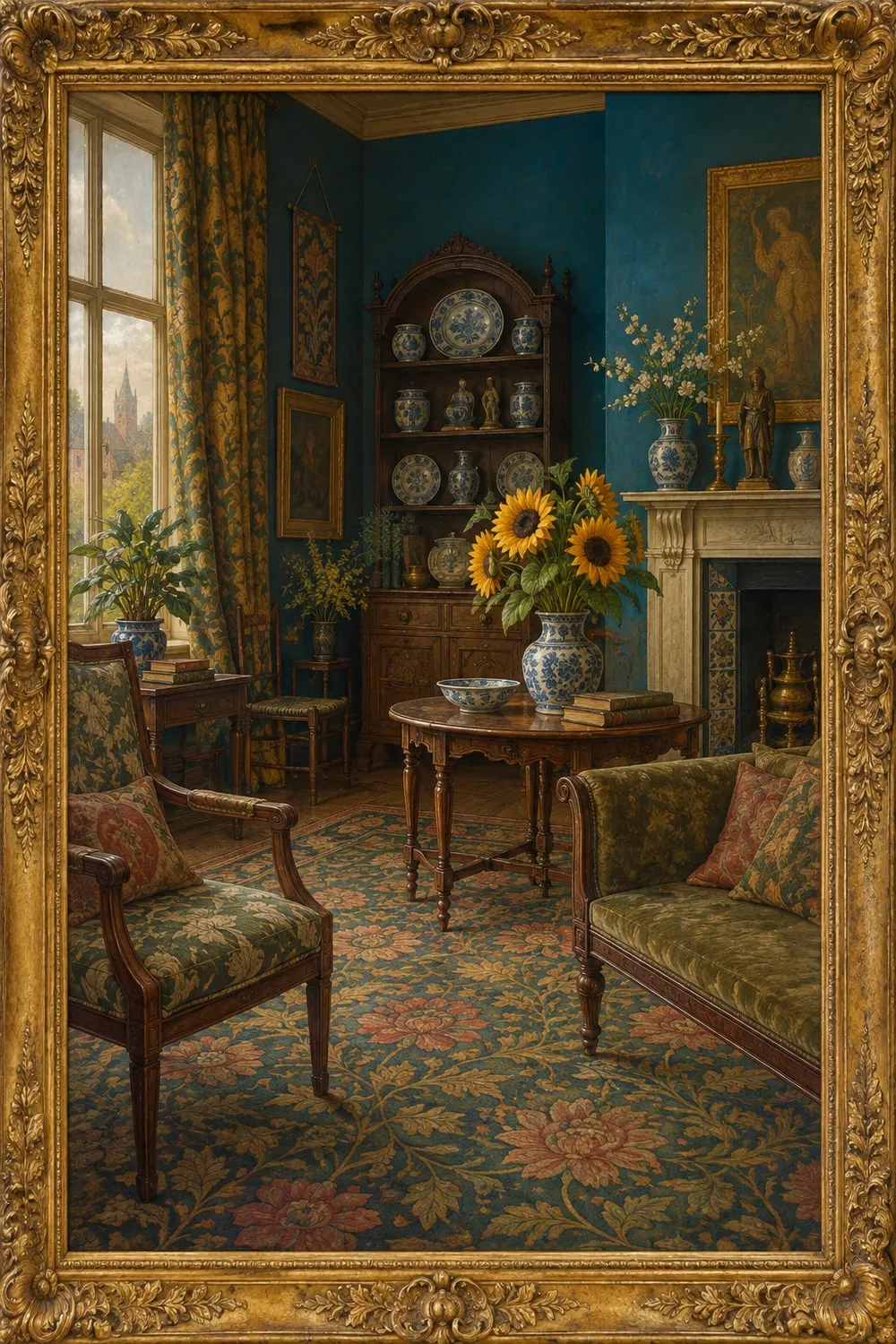
American rooms, Wilde complains, are 'crowded with pretty things which have no relation to one another' and lack any key-note. His remedy is colour, shown through Whistler: the grey and white of the Symphony in White, the Peacock Room, and a breakfast room with a light blue ceiling, yellow wood and blue china, 'at once so simple and so joyous.' The same sense of fitness condemns dinner-plates painted with sunsets and soup-plates 'whose bottom seems to vanish in the distance.'
Dress that is comfortable and beautiful
Dress receives a full passage. Modern clothes have almost destroyed sculpture, since the frock-coat in bronze 'adds a new horror to death.' Wilde looks back to Greek drapery, the age of Charles I and the dresses of the last century, and the old custom of handing an embroidered gown down to one's daughter. His model is unexpected: the Western miners, whose wide hats, cloaks and high boots were worn because they were useful. 'They wore only what was comfortable, and therefore beautiful.'
Educating children through beauty
The lecture closes on children. Those who 'grow up among all fair and lovely things' will love beauty before they know why, and the delicate teacup of a Chinese labourer in San Francisco shows how refinement is learned unconsciously. Wilde proposes a daily workshop hour in every school and displays work made by children of nine to thirteen. Such training is 'a practical school of morals': children learn to 'abhor the liar in art', and a boy who sees a bird carved in wood 'will probably not throw the customary stone.'