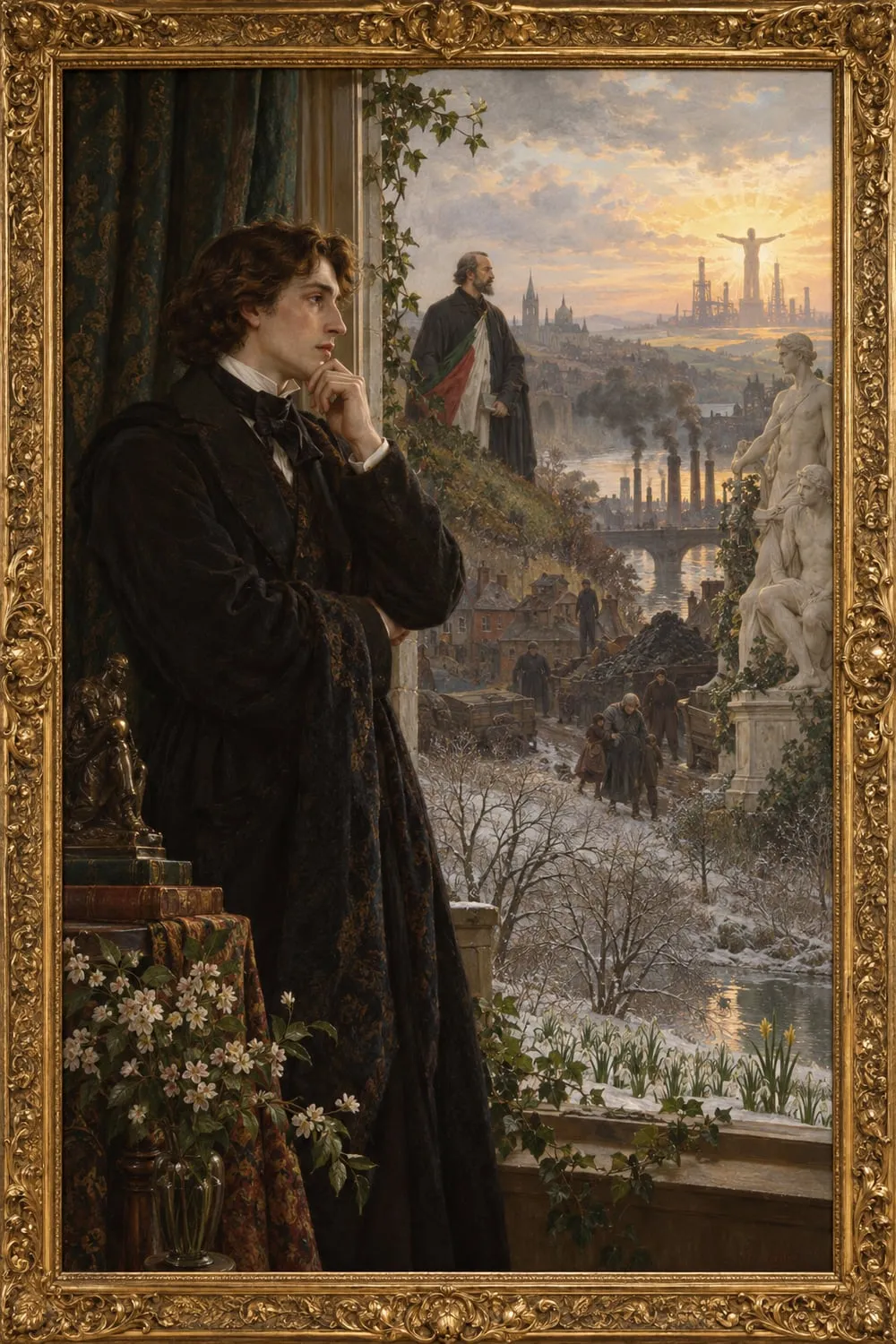
Winter, despair and the divinity of man
Humanitad
"Ah! somehow life is bigger after all"
Poem
It is full winter now: the trees are bare,Save where the cattle huddle from the coldBeneath the pine, for it doth never wearThe autumn’s gaudy livery whose goldHer jealous brother pilfers, but is trueTo the green doublet; bitter is the wind, as though it blew
From Saturn’s cave; a few thin wisps of hayLie on the sharp black hedges, where the wainDragged the sweet pillage of a summer’s dayFrom the low meadows up the narrow lane;Upon the half-thawed snow the bleating sheepPress close against the hurdles, and the shivering house-dogs creep
From the shut stable to the frozen streamAnd back again disconsolate, and missThe bawling shepherds and the noisy team;And overhead in circling listlessnessThe cawing rooks whirl round the frosted stack,Or crowd the dripping boughs; and in the fen the ice-pools crack
Where the gaunt bittern stalks among the reedsAnd flaps his wings, and stretches back his neck,And hoots to see the moon; across the meadsLimps the poor frightened hare, a little speck;And a stray seamew with its fretful cryFlits like a sudden drift of snow against the dull grey sky.
Full winter: and the lusty goodman bringsHis load of faggots from the chilly byre,And stamps his feet upon the hearth, and flingsThe sappy billets on the waning fire,And laughs to see the sudden lightening scareHis children at their play, and yet—the Spring is in the air;
Already the slim crocus stirs the snow,And soon yon blanchèd fields will bloom againWith nodding cowslips for some lad to mow,For with the first warm kisses of the rainThe winter’s icy sorrow breaks to tears,And the brown thrushes mate, and with bright eyes the rabbit peers
From the dark warren where the fir-cones lie,And treads one snowdrop under foot, and runsOver the mossy knoll, and blackbirds flyAcross our path at evening, and the sunsStay longer with us; ah! how good to seeGrass-girdled spring in all her joy of laughing greenery
Dance through the hedges till the early rose,(That sweet repentance of the thorny briar!)Burst from its sheathèd emerald and discloseThe little quivering disk of golden fireWhich the bees know so well, for with it comePale boy’s-love, sops-in-wine, and daffadillies all in bloom.
Then up and down the field the sower goes,While close behind the laughing younker scaresWith shrilly whoop the black and thievish crows,And then the chestnut-tree its glory wears,And on the grass the creamy blossom fallsIn odorous excess, and faint half-whispered madrigals
Steal from the bluebells’ nodding carillonsEach breezy morn, and then white jessamine,That star of its own heaven, snap-dragonsWith lolling crimson tongues, and eglantineIn dusty velvets clad usurp the bedAnd woodland empery, and when the lingering rose hath shed
Red leaf by leaf its folded panoply,And pansies closed their purple-lidded eyes,Chrysanthemums from gilded argosyUnload their gaudy scentless merchandise,And violets getting overbold withdrawFrom their shy nooks, and scarlet berries dot the leafless haw.
O happy field! and O thrice happy tree!Soon will your queen in daisy-flowered smockAnd crown of flower-de-luce trip down the lea,Soon will the lazy shepherds drive their flockBack to the pasture by the pool, and soonThrough the green leaves will float the hum of murmuring bees at noon.
Soon will the glade be bright with bellamour,The flower which wantons love, and those sweet nunsVale-lilies in their snowy vestitureWill tell their beaded pearls, and carnationsWith mitred dusky leaves will scent the wind,And straggling traveller’s-joy each hedge with yellow stars will bind.
Dear Bride of Nature and most bounteous spring,That canst give increase to the sweet-breath’d kine,And to the kid its little horns, and bringThe soft and silky blossoms to the vine,Where is that old nepenthe which of yoreMan got from poppy root and glossy-berried mandragore!
There was a time when any common birdCould make me sing in unison, a timeWhen all the strings of boyish life were stirredTo quick response or more melodious rhymeBy every forest idyll;—do I change?Or rather doth some evil thing through thy fair pleasaunce range?
Nay, nay, thou art the same: ’tis I who seekTo vex with sighs thy simple solitude,And because fruitless tears bedew my cheekWould have thee weep with me in brotherhood;Fool! shall each wronged and restless spirit dareTo taint such wine with the salt poison of his own despair!
Thou art the same: ’tis I whose wretched soulTakes discontent to be its paramour,And gives its kingdom to the rude controlOf what should be its servitor—for sureWisdom is somewhere, though the stormy seaContain it not, and the huge deep answer “ ’Tis not in me.”
To burn with one clear flame, to stand erectIn natural honour, not to bend the kneeIn profitless prostrations whose effectIs by itself condemned, what alchemyCan teach me this? what herb Medea brewedWill bring the unexultant peace of essence not subdued?
The minor chord which ends the harmony,And for its answering brother waits in vainSobbing for incompleted melody,Dies a swan’s death; but I the heir of pain,A silent Memnon with blank lidless eyes,Wait for the light and music of those suns which never rise.
The quenched-out torch, the lonely cypress-gloom,The little dust stored in the narrow urn,The gentle ΧΑΙΡΕ of the Attic tomb—Were not these better far than to returnTo my old fitful restless malady,Or spend my days within the voiceless cave of misery?
Nay! for perchance that poppy-crownèd godIs like the watcher by a sick man’s bedWho talks of sleep but gives it not; his rodHath lost its virtue, and, when all is said,Death is too rude, too obvious a keyTo solve one single secret in a life’s philosophy.
And Love! that noble madness, whose augustAnd inextinguishable might can slayThe soul with honeyed drugs—alas! I mustFrom such sweet ruin play the runaway,Although too constant memory never canForget the archèd splendour of those brows Olympian
Which for a little season made my youthSo soft a swoon of exquisite indolenceThat all the chiding of more prudent TruthSeemed the thin voice of jealousy—O HenceThou huntress deadlier than Artemis!Go seek some other quarry! for of thy too perilous bliss
My lips have drunk enough—no more, no more—Though Love himself should turn his gilded prowBack to the troubled waters of this shoreWhere I am wrecked and stranded, even nowThe chariot wheels of passion sweep too near,Hence! Hence! I pass unto a life more barren, more austere.
More barren—ay, those arms will never leanDown through the trellised vines and draw my soulIn sweet reluctance through the tangled green;Some other head must wear that aureole,For I am hers who loves not any manWhose white and stainless bosom bears the sign Gorgonian.
Let Venus go and chuck her dainty page,And kiss his mouth, and toss his curly hair,With net and spear and hunting equipageLet young Adonis to his tryst repair,But me her fond and subtle-fashioned spellDelights no more, though I could win her dearest citadel.
Ay, though I were that laughing shepherd boyWho from Mount Ida saw the little cloudPass over Tenedos and lofty TroyAnd knew the coming of the Queen, and bowedIn wonder at her feet, not for the sakeOf a new Helen would I bid her hand the apple take.
Then rise supreme Athena argent-limbed!And, if my lips be music-less, inspireAt least my life: was not thy glory hymnedBy One who gave to thee his sword and lyreLike Aeschylos at well-fought Marathon,And died to show that Milton’s England still could bear a son!
And yet I cannot tread the PorticoAnd live without desire, fear and pain,Or nurture that wise calm which long agoThe grave Athenian master taught to men,Self-poised, self-centred, and self-comforted,To watch the world’s vain fantasies go by with unbowed head.
Alas! that serene brow, those eloquent lips,Those eyes that mirrored all eternity,Rest in their own Colonos, an eclipseHath come on Wisdom, and MnemosyneIs childless; in the night which she had madeFor lofty secure flight Athena’s owl itself hath strayed.
Nor much with Science do I care to climb,Although by strange and subtle witcheryShe drew the moon from heaven: the Muse of TimeUnrolls her gorgeous-coloured tapestryTo no less eager eyes; often indeedIn the great epic of Polymnia’s scroll I love to read
How Asia sent her myriad hosts to warAgainst a little town, and panopliedIn gilded mail with jewelled scimitar,White-shielded, purple-crested, rode the MedeBetween the waving poplars and the seaWhich men call Artemisium, till he saw Thermopylae
Its steep ravine spanned by a narrow wall,And on the nearer side a little broodOf careless lions holding festival!And stood amazèd at such hardihood,And pitched his tent upon the reedy shore,And stayed two days to wonder, and then crept at midnight o’er
Some unfrequented height, and coming downThe autumn forests treacherously slewWhat Sparta held most dear and was the crownOf far Eurotas, and passed on, nor knewHow God had staked an evil net for himIn the small bay at Salamis—and yet, the page grows dim,
Its cadenced Greek delights me not, I feelWith such a goodly time too out of tuneTo love it much: for like the Dial’s wheelThat from its blinded darkness strikes the noonYet never sees the sun, so do my eyesRestlessly follow that which from my cheated vision flies.
O for one grand unselfish simple lifeTo teach us what is Wisdom! speak ye hillsOf lone Helvellyn, for this note of strifeShunned your untroubled crags and crystal rills,Where is that Spirit which living blamelesslyYet dared to kiss the smitten mouth of his own century!
Speak ye Rydalian laurels! where is HeWhose gentle head ye sheltered, that pure soulWhose gracious days of uncrowned majestyThrough lowliest conduct touched the lofty goalWhere love and duty mingle! Him at leastThe most high Laws were glad of, He had sat at Wisdom’s feast,
But we are Learning’s changelings, know by roteThe clarion watchword of each Grecian schoolAnd follow none, the flawless sword which smoteThe pagan Hydra is an effete toolWhich we ourselves have blunted, what man nowShall scale the august ancient heights and to old Reverence bow?
One such indeed I saw, but, Ichabod!Gone is that last dear son of Italy,Who being man died for the sake of God,And whose unrisen bones sleep peacefully,O guard him, guard him well, my Giotto’s tower,Thou marble lily of the lily town! let not the lour
Of the rude tempest vex his slumber, orThe Arno with its tawny troubled goldO’er-leap its marge, no mightier conquerorClomb the high Capitol in the days of oldWhen Rome was indeed Rome, for LibertyWalked like a bride beside him, at which sight pale Mystery
Fled shrieking to her farthest sombrest cellWith an old man who grabbled rusty keys,Fled shuddering, for that immemorial knellWith which oblivion buries dynastiesSwept like a wounded eagle on the blast,As to the holy heart of Rome the great triumvir passed.
He knew the holiest heart and heights of Rome,He drave the base wolf from the lion’s lair,And now lies dead by that empyreal domeWhich overtops Valdarno hung in airBy Brunelleschi—O MelpomeneBreathe through thy melancholy pipe thy sweetest threnody!
Breathe through the tragic stops such melodiesThat Joy’s self may grow jealous, and the NineForget awhile their discreet emperies,Mourning for him who on Rome’s lordliest shrineLit for men’s lives the light of Marathon,And bare to sun-forgotten fields the fire of the sun!
O guard him, guard him well, my Giotto’s tower,Let some young Florentine each eventideBring coronals of that enchanted flowerWhich the dim woods of Vallombrosa hide,And deck the marble tomb wherein he liesWhose soul is as some mighty orb unseen of mortal eyes.
Some mighty orb whose cycled wanderings,Being tempest-driven to the farthest rimWhere Chaos meets Creation and the wingsOf the eternal chanting CherubimAre pavilioned on Nothing, passed awayInto a moonless void—and yet, though he is dust and clay,
He is not dead, the immemorial FatesForbid it, and the closing shears refrain.Lift up your heads ye everlasting gates!Ye argent clarions, sound a loftier strainFor the vile thing he hated lurks withinIts sombre house, alone with God and memories of sin.
Still what avails it that she sought her caveThat murderous mother of red harlotries?At Munich on the marble architraveThe Grecian boys die smiling, but the seasWhich wash Aegina fret in lonelinessNot mirroring their beauty; so our lives grow colourless
For lack of our ideals, if one starFlame torch-like in the heavens the unjustSwift daylight kills it, and no trump of warCan wake to passionate voice the silent dustWhich was Mazzini once! rich NiobeFor all her stony sorrows hath her sons; but Italy!
What Easter Day shall make her children rise,Who were not Gods yet suffered? what sure feetShall find their grave-clothes folded? what clear eyesShall see them bodily? O it were meetTo roll the stone from off the sepulchreAnd kiss the bleeding roses of their wounds, in love of Her,
Our Italy! our mother visible!Most blessed among nations and most sad,For whose dear sake the young Calabrian fellThat day at Aspromonte and was gladThat in an age when God was bought and soldOne man could die for Liberty! but we, burnt out and cold,
See Honour smitten on the cheek and gyvesBind the sweet feet of Mercy: PovertyCreeps through our sunless lanes and with sharp knivesCuts the warm throats of children stealthily,And no word said:—O we are wretched menUnworthy of our great inheritance! where is the pen
Of austere Milton? where the mighty swordWhich slew its master righteously? the yearsHave lost their ancient leader, and no wordBreaks from the voiceless tripod on our ears:While as a ruined mother in some spasmBears a base child and loathes it, so our best enthusiasm
Genders unlawful children, AnarchyFreedom’s own Judas, the vile prodigalLicence who steals the gold of LibertyAnd yet has nothing, Ignorance the realOne Fraticide since Cain, Envy the aspThat stings itself to anguish, Avarice whose palsied grasp
Is in its extent stiffened, moneyed GreedFor whose dull appetite men waste awayAmid the whirr of wheels and are the seedOf things which slay their sower, these each daySees rife in England, and the gentle feetOf Beauty tread no more the stones of each unlovely street.
What even Cromwell spared is desecratedBy weed and worm, left to the stormy playOf wind and beating snow, or renovatedBy more destructful hands: Time’s worst decayWill wreathe its ruins with some loveliness,But these new Vandals can but make a rainproof barrenness.
Where is that Art which bade the Angels singThrough Lincoln’s lofty choir, till the airSeems from such marble harmonies to ringWith sweeter song than common lips can dareTo draw from actual reed? ah! where is nowThe cunning hand which made the flowering hawthorn branches bow
For Southwell’s arch, and carved the House of OneWho loved the lilies of the field with allOur dearest English flowers? the same sunRises for us: the seasons naturalWeave the same tapestry of green and grey:The unchanged hills are with us: but that Spirit hath passed away.
And yet perchance it may be better so,For Tyranny is an incestuous Queen,Murder her brother is her bedfellow,And the Plague chambers with her: in obsceneAnd bloody paths her treacherous feet are set;Better the empty desert and a soul inviolate!
For gentle brotherhood, the harmonyOf living in the healthful air, the swiftClean beauty of strong limbs when men are freeAnd women chaste, these are the things which liftOur souls up more than even Agnolo’sGaunt blinded Sibyl poring o’er the scroll of human woes,
Or Titian’s little maiden on the stairWhite as her own sweet lily and as tall,Or Mona Lisa smiling through her hair—Ah! somehow life is bigger after allThan any painted angel could we seeThe God that is within us! The old Greek serenity
Which curbs the passion of that level lineOf marble youths, who with untroubled eyesAnd chastened limbs ride round Athena’s shrineAnd mirror her divine economies,And balanced symmetry of what in manWould else wage ceaseless warfare—this at least within the span
Between our mother’s kisses and the graveMight so inform our lives, that we could winSuch mighty empires that from her caveTemptation would grow hoarse, and pallid SinWould walk ashamed of his adulteries,And Passion creep from out the House of Lust with startled eyes.
To make the Body and the Spirit oneWith all right things, till no thing live in vainFrom morn to noon, but in sweet unisonWith every pulse of flesh and throb of brainThe soul in flawless essence high enthroned,Against all outer vain attack invincibly bastioned,
Mark with serene impartialityThe strife of things, and yet be comforted,Knowing that by the chain causalityAll separate existences are wedInto one supreme whole, whose utteranceIs joy, or holier praise! ah! surely this were governance
Of Life in most august omnipresence,Through which the rational intellect would findIn passion its expression, and mere sense,Ignoble else, lend fire to the mind,And being joined with it in harmonyMore mystical than that which binds the stars planetary,
Strike from their several tones one octave chordWhose cadence being measureless would flyThrough all the circling spheres, then to its LordReturn refreshed with its new emperyAnd more exultant power—this indeedCould we but reach it were to find the last, the perfect creed.
Ah! it was easy when the world was youngTo keep one’s life free and inviolate,From our sad lips another song is rung,By our own hands our heads are desecrate,Wanderers in drear exile, and dispossessedOf what should be our own, we can but feed on wild unrest.
Somehow the grace, the bloom of things has flown,And of all men we are most wretched whoMust live each other’s lives and not our ownFor very pity’s sake and then undoAll that we lived for—it was otherwiseWhen soul and body seemed to blend in mystic symphonies.
But we have left those gentle haunts to passWith weary feet to the new Calvary,Where we behold, as one who in a glassSees his own face, self-slain Humanity,And in the dumb reproach of that sad gazeLearn what an awful phantom the red hand of man can raise.
O smitten mouth! O forehead crowned with thorn!O chalice of all common miseries!Thou for our sakes that loved thee not hast borneAn agony of endless centuries,And we were vain and ignorant nor knewThat when we stabbed thy heart it was our own real hearts we slew.
Being ourselves the sowers and the seeds,The night that covers and the lights that fade,The spear that pierces and the side that bleeds,The lips betraying and the life betrayed;The deep hath calm: the moon hath rest: but weLords of the natural world are yet our own dread enemy.
Is this the end of all that primal forceWhich, in its changes being still the same,From eyeless Chaos cleft its upward course,Through ravenous seas and whirling rocks and flame,Till the suns met in heaven and beganTheir cycles, and the morning stars sang, and the Word was Man!
Nay, nay, we are but crucified, and thoughThe bloody sweat falls from our brows like rain,Loosen the nails—we shall come down I know,Staunch the red wounds—we shall be whole again,No need have we of hyssop-laden rod,That which is purely human, that is Godlike, that is God.
In brief
SummaryThe speaker looks out on a winter landscape and knows that spring is coming, but cannot share in nature's renewal. He has lost the joy of his boyhood and searches for something to live by; death, love, philosophy, science and history all fail him. He finds his ideal in the Italian patriot Mazzini, then condemns the greed, poverty and ugliness of modern England. He imagines a life in which body and spirit are one, like the Greek marbles, but sees humanity crucified by its own hand. The poem ends in hope: the nails will be loosened, for 'That which is purely human, that is Godlike, that is God.'
Key themes
"Death is too rude, too obvious a key"
Related works
Explore more of Wilde's writing The Ballad of Reading GaolWritten after his release from prison, a long ballad about the hanging of a fellow prisoner, a trooper who had killed his wife. Wilde's last work, and his most read poem.Read more
  The SphinxA student in his room questions the ancient sphinx that has watched from its corner for a thousand years, and is frightened by what she knows.Read more
  Chorus of Cloud MaidensRead more
 Summary
The poem opens in 'full winter': bare trees, cattle huddled under the pine, sheep pressed against the hurdles, rooks wheeling round the frosted stack, a bittern in the fen, a frightened hare, a farmer flinging logs on the fire to startle his children. 'And yet', the speaker says, 'the Spring is in the air'. He follows the coming year through a long procession of flowers and farm work, from crocus and cowslip to chestnut blossom, bluebells, the rose, chrysanthemums and scarlet berries, and hails spring as 'Dear Bride of Nature'.
Once any common bird could make him sing; now nature is unchanged but he is not, for his 'wretched soul / Takes discontent to be its paramour'. He longs 'To burn with one clear flame', but death is 'too rude, too obvious a key', and love, 'that noble madness', must be fled: 'Hence! Hence! I pass unto a life more barren, more austere.' He gives himself to Athena, who 'loves not any man', and leaves Venus to her Adonis.
Yet he cannot live by the calm of the Portico, for Wisdom is in eclipse. Science does not tempt him, and even the story in 'Polymnia's scroll' of Thermopylae and Salamis grows dim. He cries out for 'one grand unselfish simple life', calling on Helvellyn and the laurels of Rydal. The one such life he has seen is Mazzini's: Italy's 'last dear son', the 'great triumvir' beside whom 'Liberty / Walked like a bride'. He asks Giotto's tower to guard his tomb, and insists 'He is not dead'.
Modern England, by contrast, is 'burnt out and cold'. Poverty kills children in 'sunless lanes', freedom breeds Anarchy and Licence, and men waste away for moneyed Greed 'Amid the whirr of wheels'. Beauty no longer treads 'each unlovely street', and the art that carved Lincoln's choir and Southwell's hawthorn has passed away. Still, he decides, that is better than Tyranny.
What truly lifts the soul is 'gentle brotherhood' and the clean strength of free men, more than 'Agnolo's' Sibyl, Titian's maiden on the stair or the Mona Lisa: 'somehow life is bigger after all'. The Greek serenity of the marble riders round Athena's shrine might teach us 'To make the Body and the Spirit one', 'the last, the perfect creed'. But that was easy 'when the world was young'. Now men climb 'the new Calvary' to see 'self-slain Humanity', and the speaker cries to the thorn-crowned figure whose heart we stabbed, not knowing it was our own. The poem ends in hope: 'we are but crucified', the wounds will heal, and 'That which is purely human, that is Godlike, that is God.'
Characters
The speaker
The disenchanted seeker
A man who once sang with 'any common bird' but now finds his soul wedded to discontent. He renounces love, finds no peace in philosophy, science or history, praises Mazzini, condemns modern England, and at last finds hope in the divinity of humanity itself.
Mazzini
The hero of liberty
The 'great triumvir' and 'last dear son of Italy', named as the 'silent dust / Which was Mazzini once'. For the speaker he is the one great selfless life he has seen, a man beside whom 'Liberty / Walked like a bride'. The speaker asks Giotto's tower to guard his tomb and insists 'He is not dead'.
Athena
The austere goddess
The virgin goddess of wisdom, 'supreme Athena argent-limbed', to whom the speaker turns after renouncing love, since she 'loves not any man'. He asks her to inspire his life, though he soon finds Wisdom eclipsed and 'Athena's owl itself hath strayed'.
The thorn-crowned figure
Humanity crucified
The sufferer addressed near the end: 'O smitten mouth! O forehead crowned with thorn!' He has borne 'An agony of endless centuries' for those who did not love him, and in him the speaker sees 'self-slain Humanity', which will yet come down from the cross whole again.
Themes
Nature renewed, the self unchanged
The long opening moves from 'full winter' to a spring and summer crowded with flowers, 'Grass-girdled spring in all her joy of laughing greenery'. The speaker cannot join in. 'There was a time when any common bird / Could make me sing', he recalls; now 'Thou art the same', and it is his own soul that has taken 'discontent to be its paramour'. Nature's renewal only sharpens his sense of inner barrenness.
The search for a creed
The speaker tests one answer after another. Death is 'too rude, too obvious a key / To solve one single secret'. Love is a 'noble madness' he must flee. The calm taught under 'the Portico' is beyond him, Science does not tempt him, and history 'grows dim'. What he wants is 'To burn with one clear flame', and he glimpses it in making 'the Body and the Spirit one', which he calls 'the last, the perfect creed'.
Liberty and the modern age
Mazzini stands for the heroic life the age has lost, the 'great triumvir' for whom 'Liberty / Walked like a bride'. Against him the speaker sets modern England, where Poverty 'Cuts the warm throats of children', moneyed Greed wastes men 'Amid the whirr of wheels', and the feet of Beauty 'tread no more the stones of each unlovely street'. Freedom itself has bred 'unlawful children', Anarchy and Licence.
The human made divine
The poem ends by joining the suffering of Christ to the suffering of mankind. At 'the new Calvary' men see 'self-slain Humanity' and learn 'That when we stabbed thy heart it was our own real hearts we slew'. We are 'The spear that pierces and the side that bleeds'. Yet the last stanza promises recovery, 'we shall be whole again', and closes with faith in humanity: 'That which is purely human, that is Godlike, that is God.'
Quotes
Context
'Humanitad' is one of Wilde's longest poems, seventy-three six-line stanzas rhymed ababcc with a lengthened last line, the same form as 'Panthea'. Its title suggests the word 'humanity', and the poem ends by calling the purely human 'Godlike'. Its references run from Herodotus and the Aegina marbles in Munich to Florence, Lincoln and Southwell, and it names Giuseppe Mazzini, the Italian republican who was one of the three triumvirs of the Roman Republic of 1849.
About this edition
- Text: the complete work from Standard Ebooks, released into the public domain (CC0 1.0). We change only the layout.
- Download the EPUB of the whole book it comes from, free, for any e-reader.
- Every quotation and glossary word in these notes is checked against the text.