A night, a dawn and a grave
Lotus Leaves
"That death is but a newer life"
Poem
… νεμεσσῶμαί γε μὲν οὐδένκλαίειν ὅς κε θάνῃσι βροτῶν καὶ πότμον ἐπίσπῃ,τοῦτό νυ καὶ γέρας οἶον ὀϊζυροῖσι βροτοῖσικείρασθαί τε κόμην βαλέειν τ’ ἀπὸ δάκρυ παρειῶν.
I
There is no peace beneath the noon—Ah! in those meadows is there peaceWhere, girdled with a silver fleece,As a bright shepherd, strays the moon?
Queen of the gardens of the sky,Where stars like lilies, white and fair,Shine through the mists of frosty air,Oh, tarry, for the dawn is nigh!
Oh, tarry, for the envious dayStretches long hands to catch thy feet.Alas! but thou art overfleet,Alas! I know thou wilt not stay.
II
Eastward the dawn has broken red,The circling mists and shadows flee;Aurora rises from the sea,And leaves the crocus-flowered bed.
Eastward the silver arrows fall,Splintering the veil of holy night:And a long wave of yellow lightBreaks silently on tower and hall.
And speeding wide across the woldWakes into flight some fluttering bird;And all the chestnut tops are stirred,And all the branches streaked with gold.
III
To outer senses there is peace,A dream-like peace on either hand,Deep silence in the shadowy land,Deep silence where the shadows cease,
Save for a cry that echoes shrillFrom some lone bird disconsolate;A curlew calling to its mate;The answer from the distant hill.
And, herald of my love to HimWho, waiting for the dawn, doth lie,The orbèd maiden leaves the sky,And the white firs grow more dim.
IV
Up sprang the sun to run his race,The breeze blew fair on meadow and lea,But in the west I seemed to seeThe likeness of a human face.
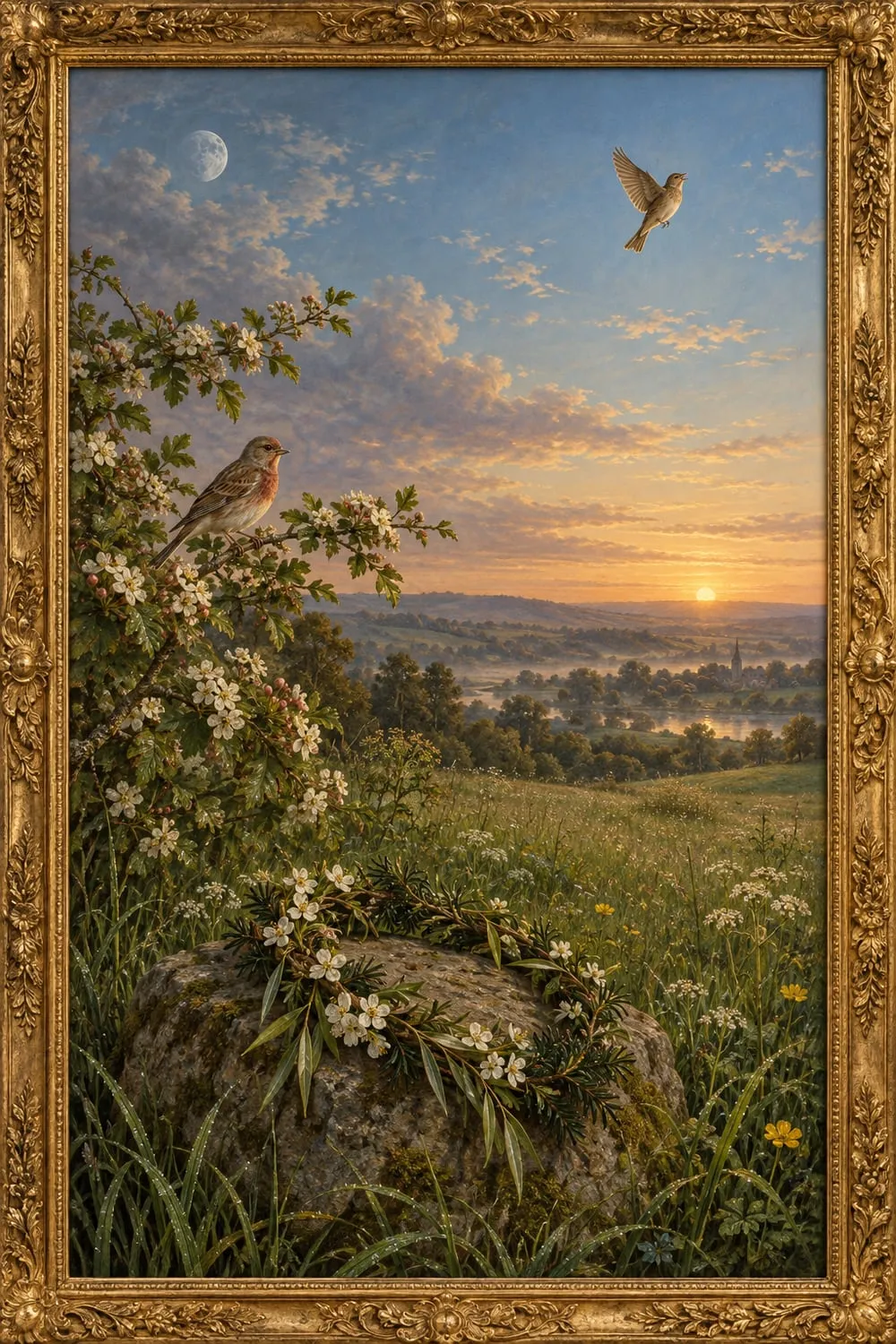
A linnet on the hawthorn spraySang of the glories of the spring,And made the flow’ring copses ringWith gladness for the new-born day.
A lark from out the grass I trodFlew wildly, and was lost to viewIn the great seamless veil of blueThat hangs before the face of God.
The willow whispered overheadThat death is but a newer lifeAnd that with idle words of strifeWe bring dishonour on the dead.
I took a branch from off the tree,And hawthorn branches drenched with dew,I bound them with a sprig of yew,And made a garland fair to see.
I laid the flowers where He lies(Warm leaves and flowers on the stones):What joy I had to sit aloneTill evening broke on tired eyes:
Till all the shifting clouds had spunA robe of gold for God to wearAnd into seas of purple airSank the bright galley of the sun.
V
Shall I be gladdened for the day,And let my inner heart be stirredBy murmuring tree or song of bird,And sorrow at the wild winds’ play?
Not so, such idle dreams belongTo souls of lesser depth than mine;I feel that I am half divine;I know that I am great and strong.
I know that every forest treeBy labour rises from the root;I know that none shall gather fruitBy sailing on the barren sea.
In brief
SummaryA poem in five numbered parts that follows a single night and day, headed by a Greek epigraph on the tears owed to the dead. The speaker begs the setting moon to stay, watches dawn break red over tower and wood, and hears the morning silence broken only by a curlew. In the fourth part, as the lark and linnet sing, the speaker binds willow, hawthorn and yew into a garland, lays it where 'He lies', and sits alone until sunset. The last part rejects such tender feeling as fit only for lesser souls, and ends in a proud resolve to labour and grow.
Key themes
"Oh, tarry, for the dawn is nigh!"
Related works
Explore more of Wilde's writing The Ballad of Reading GaolWritten after his release from prison, a long ballad about the hanging of a fellow prisoner, a trooper who had killed his wife. Wilde's last work, and his most read poem.Read more
  The SphinxA student in his room questions the ancient sphinx that has watched from its corner for a thousand years, and is frightened by what she knows.Read more
  Chorus of Cloud MaidensRead more
 Summary
The Greek epigraph says there is no shame in weeping for a mortal who has died, since cutting the hair and shedding tears is the only tribute the wretched living can give. In part I the speaker finds 'no peace beneath the noon' and wonders whether there is peace in the meadows of the sky, where the moon strays 'As a bright shepherd'. The speaker begs her, 'Queen of the gardens of the sky', to tarry, but knows she will not stay. In part II the dawn breaks red in the east, Aurora rises from the sea, and 'a long wave of yellow light' spreads over tower, hall and wold, waking the birds and streaking the chestnut branches with gold.
Part III finds 'A dream-like peace', broken only by a curlew calling to its mate and the answer from a distant hill, as the moon, 'herald of my love to Him / Who, waiting for the dawn, doth lie', leaves the sky. In part IV the sun rises and the speaker seems to see a human face in the west. A linnet sings, a lark vanishes into 'the great seamless veil of blue', and the willow whispers 'That death is but a newer life'. The speaker binds a branch of it with hawthorn and yew, lays the garland 'where He lies', on the stones, and sits alone until the sun sinks.
Part V turns sharply. The speaker refuses to be gladdened by the day or saddened by the wind: 'such idle dreams belong / To souls of lesser depth than mine'. Declaring 'I feel that I am half divine', the speaker ends with two images of effort, the tree that 'By labour rises from the root' and the sailor who gathers no fruit on 'the barren sea'.
Characters
The speaker
The proud mourner
A watcher through a whole night and day, who begs the moon to stay, greets the dawn, gathers a garland for a grave and sits there alone until sunset. At the end the speaker rejects easy feeling, claiming to be 'half divine' and 'great and strong'.
The one mourned
Waiting for the dawn
Never named, and called only 'Him' and 'He', with capitals. He lies beneath the stones, 'waiting for the dawn', and the setting moon is the 'herald' of the speaker's love to him. The speaker lays a garland where he lies and stays beside him until evening.
Themes
Mourning and its limits
The epigraph grants that tears are the only tribute the living can pay the dead, and part IV pays it with a garland laid 'where He lies'. The willow's whisper, 'That death is but a newer life', offers comfort, and warns that 'idle words of strife' bring dishonour on the dead. Part V then refuses further grief, calling such feelings 'idle dreams' for lesser souls.
Night into day
The poem follows the sky closely. The moon is begged to 'tarry, for the dawn is nigh'; the dawn arrives with 'silver arrows' and 'a long wave of yellow light'; the day ends as the clouds spin 'A robe of gold for God to wear' and 'the bright galley of the sun' sinks into purple air. The passing hours frame the speaker's day at the grave.
Pride and labour
The final part replaces feeling with will. The speaker claims 'I feel that I am half divine; / I know that I am great and strong', and then grounds that pride in work: every forest tree 'By labour rises from the root', while no one shall gather fruit 'By sailing on the barren sea'. Growth, the poem says, comes through effort rather than drifting.
Context
The poem is divided into five numbered parts of quatrains and carries a Greek epigraph on mourning the dead, which says that cutting the hair and shedding tears are the only tribute left to wretched mortals. Some of its images return, reworked, at the close of 'Ravenna': the clouds that spin a golden robe for God to wear, the sun as a galley sinking into 'seas of purple air', and the 'seamless veil of blue'.
About this edition
- Text: the complete work from Standard Ebooks, released into the public domain (CC0 1.0). We change only the layout.
- Download the EPUB of the whole book it comes from, free, for any e-reader.
- Every quotation and glossary word in these notes is checked against the text.