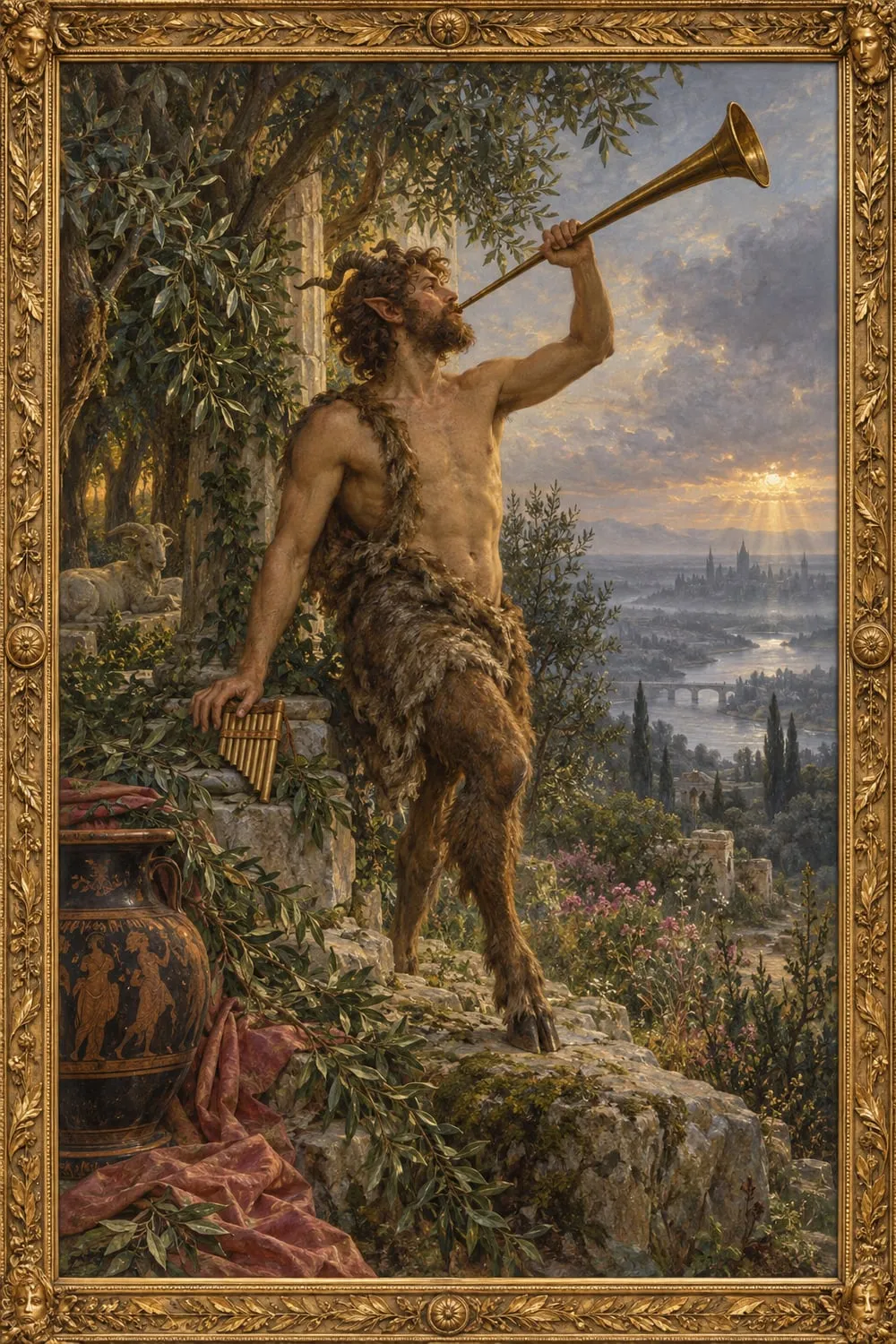
Calling the old god to modern England
Pan
"O goat-foot God of Arcady!"
Poem
Double Villanelle
I
O goat-foot God of Arcady!This modern world is grey and old,And what remains to us of thee?
No more the shepherd lads in gleeThrow apples at thy wattled fold,O goat-foot God of Arcady!
Nor through the laurels can one seeThy soft brown limbs, thy beard of gold,And what remains to us of thee?
And dull and dead our Thames would be,For here the winds are chill and cold,O goat-foot God of Arcady!
Then keep the tomb of Helicé,Thine olive-woods, thy vine-clad wold,And what remains to us of thee?
Though many an unsung elegySleeps in the reeds our rivers hold,O goat-foot God of Arcady!Ah, what remains to us of thee?
II
Ah, leave the hills of Arcady,Thy satyrs and their wanton play,This modern world hath need of thee.
No nymph or Faun indeed have we,For Faun and nymph are old and grey,Ah, leave the hills of Arcady!
This is the land where libertyLit grave-browed Milton on his way,This modern world hath need of thee!
A land of ancient chivalryWhere gentle Sidney saw the day,Ah, leave the hills of Arcady!
This fierce sea-lion of the sea,This England lacks some stronger lay,This modern world hath need of thee!
Then blow some trumpet loud and free,And give thine oaten pipe away,Ah, leave the hills of Arcady!This modern world hath need of thee!
In brief
SummaryThe speaker addresses Pan, the 'goat-foot God of Arcady', in two linked villanelles. In the first he laments that 'This modern world is grey and old': no shepherd lads play at Pan's fold, no one glimpses his brown limbs among the laurels, and English winds are chill. He lets Pan keep to his Greek woods, asking only what remains of him. In the second he reverses himself and begs Pan to leave Arcady, for 'This modern world hath need of thee'. England, the land of Milton's liberty and Sidney's chivalry, lacks a stronger song, and Pan should trade his oaten pipe for a trumpet.
Key themes
"O goat-foot God of Arcady!"
Related works
Explore more of Wilde's writing The Ballad of Reading GaolWritten after his release from prison, a long ballad about the hanging of a fellow prisoner, a trooper who had killed his wife. Wilde's last work, and his most read poem.Read more
  The SphinxA student in his room questions the ancient sphinx that has watched from its corner for a thousand years, and is frightened by what she knows.Read more
  Chorus of Cloud MaidensRead more
 Summary
Part I is built on two refrains, 'O goat-foot God of Arcady!' and 'And what remains to us of thee?' Between them the speaker lists what has been lost. 'This modern world is grey and old'. No more do shepherd lads in glee 'Throw apples at thy wattled fold', and no one can see through the laurels 'Thy soft brown limbs, thy beard of gold'. 'Dull and dead our Thames would be', he says, 'For here the winds are chill and cold'. So he tells Pan to 'keep the tomb of Helicé, / Thine olive-woods, thy vine-clad wold'. Many an 'unsung elegy / Sleeps in the reeds our rivers hold', and the part ends by asking once more what remains of him.
Part II changes the refrains to 'Ah, leave the hills of Arcady!' and 'This modern world hath need of thee!' Pan should leave his satyrs and 'their wanton play'. England has no nymph or Faun, 'For Faun and nymph are old and grey', but it has a history of its own: it is 'the land where liberty / Lit grave-browed Milton on his way', and 'A land of ancient chivalry / Where gentle Sidney saw the day'.
The appeal gathers force. 'This fierce sea-lion of the sea, / This England lacks some stronger lay'. The poem ends by asking Pan to 'blow some trumpet loud and free, / And give thine oaten pipe away', trading the shepherd's reed for a louder, public music, and closes on both refrains together.
Characters
Pan
The goat-foot god
The 'goat-foot God of Arcady', with 'soft brown limbs' and a 'beard of gold', once honoured by shepherd lads who threw apples at his fold. He never answers. The speaker first leaves him to his Greek woods, then begs him to leave Arcady and bring a stronger song to England.
The speaker
A voice of modern England
He speaks for 'this modern world', grey, old and chill, and for England, the land of Milton and Sidney. In Part I he mourns what is lost of Pan; in Part II he changes his mind and calls on the god to come and play a louder, freer music.
Themes
Pagan beauty and the modern world
Both parts start from the same complaint: 'This modern world is grey and old'. Pan's world was young, full of shepherd lads 'in glee', laurels and olive-woods, and a god with a 'beard of gold'. Against it stand the chill winds and a Thames that would be 'dull and dead'. The refrain 'what remains to us of thee?' asks whether any of that beauty can survive in the present.
From pipe to trumpet
The two parts want different things of Pan. The first is content to mourn and leave him in Arcady. The second asks him to change his music: England 'lacks some stronger lay', so he should 'blow some trumpet loud and free, / And give thine oaten pipe away'. The shepherd's reed becomes a martial instrument, and the pastoral god is asked to become a national one.
England's heroes
The second villanelle grounds its appeal in English history. England is 'the land where liberty / Lit grave-browed Milton on his way' and 'A land of ancient chivalry / Where gentle Sidney saw the day', and it is 'This fierce sea-lion of the sea'. Milton and Sidney stand for liberty and chivalry, and the speaker hopes the old god might inspire a song worthy of them.
Context
The subtitle, 'Double Villanelle', names the form: two villanelles, each of nineteen lines on only two rhymes, in which two refrains alternate at the ends of the stanzas and come together at the close. The second villanelle answers the first, changing its refrains from 'O goat-foot God of Arcady!' and 'And what remains to us of thee?' to 'Ah, leave the hills of Arcady!' and 'This modern world hath need of thee!'
About this edition
- Text: the complete work from Standard Ebooks, released into the public domain (CC0 1.0). We change only the layout.
- Download the EPUB of the whole book it comes from, free, for any e-reader.
- Every quotation and glossary word in these notes is checked against the text.