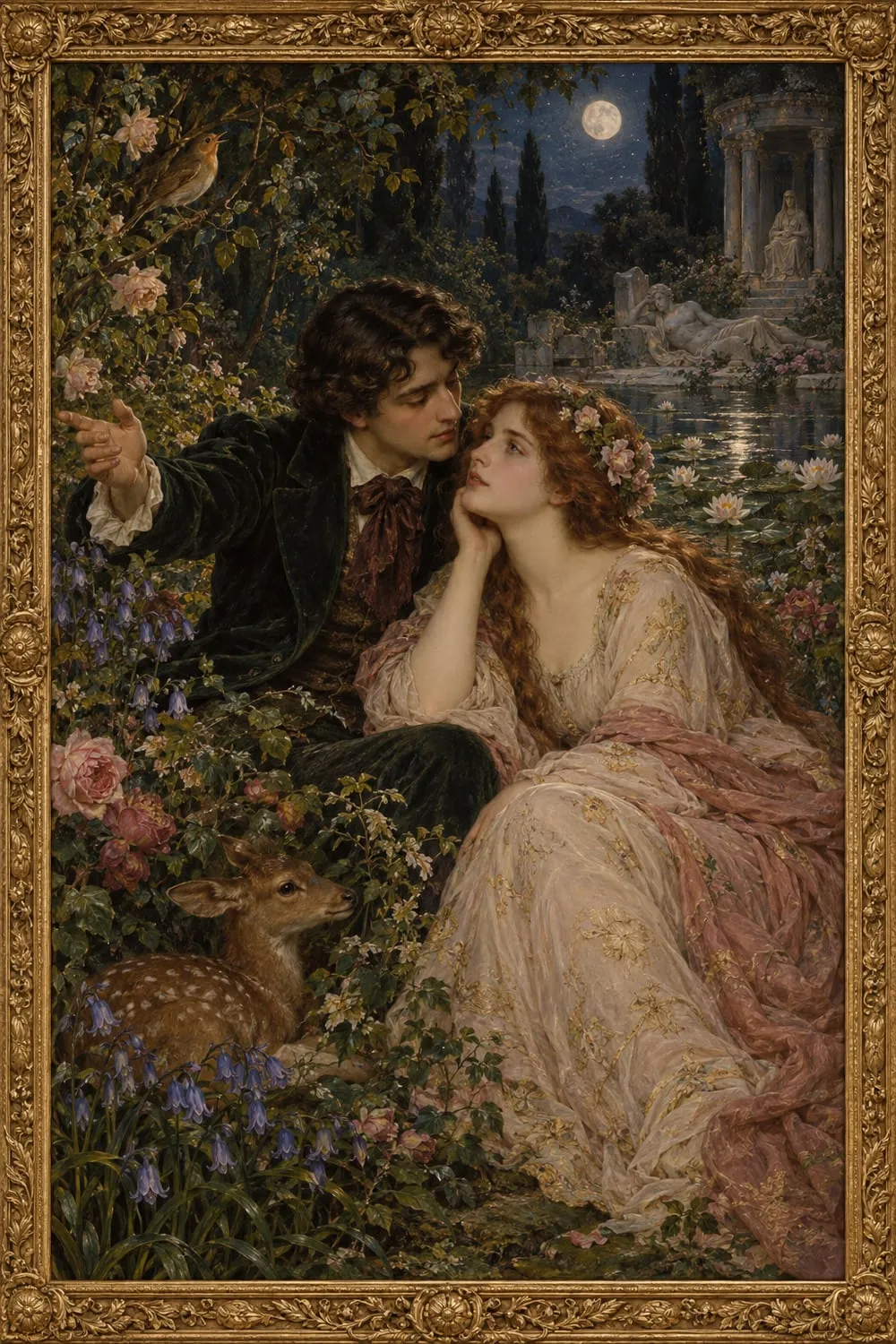
Lovers, sleeping gods and the universal soul
Panthea
"For, sweet, to feel is better than to know,"
Poem
Nay, let us walk from fire unto fire,From passionate pain to deadlier delight—I am too young to live without desire,Too young art thou to waste this summer nightAsking those idle questions which of oldMan sought of seer and oracle, and no reply was told.
For, sweet, to feel is better than to know,And wisdom is a childless heritage,One pulse of passion—youth’s first fiery glow—Are worth the hoarded proverbs of the sage:Vex not thy soul with dead philosophy,Have we not lips to kiss with, hearts to love and eyes to see!
Dost thou not hear the murmuring nightingale,Like water bubbling from a silver jar,So soft she sings the envious moon is pale,That high in heaven she is hung so farShe cannot hear that love-enraptured tune—Mark how she wreathes each horn with mist, yon late and labouring moon.
White lilies, in whose cups the gold bees dream,The fallen snow of petals where the breezeScatters the chestnut blossom, or the gleamOf boyish limbs in water—are not theseEnough for thee, dost thou desire more?Alas! the Gods will give nought else from their eternal store.
For our high Gods have sick and wearied grownOf all our endless sins, our vain endeavourFor wasted days of youth to make atoneBy pain or prayer or priest, and never, never,Hearken they now to either good or ill,But send their rain upon the just and the unjust at will.
They sit at ease, our Gods they sit at ease,Strewing with leaves of rose their scented wine,They sleep, they sleep, beneath the rocking treesWhere asphodel and yellow lotus twine,Mourning the old glad days before they knewWhat evil things the heart of man could dream, and dreaming do.
And far beneath the brazen floor they seeLike swarming flies the crowd of little men,The bustle of small lives, then wearilyBack to their lotus-haunts they turn againKissing each others’ mouths, and mix more deepThe poppy-seeded draught which brings soft purple-lidded sleep.
There all day long the golden-vestured sun,Their torch-bearer, stands with his torch ablaze,And, when the gaudy web of noon is spunBy its twelve maidens, through the crimson hazeFresh from Endymion’s arms comes forth the moon,And the immortal Gods in toils of mortal passions swoon.
There walks Queen Juno through some dewy mead,Her grand white feet flecked with the saffron dustOf wind-stirred lilies, while young GanymedeLeaps in the hot and amber-foaming must,His curls all tossed, as when the eagle bareThe frightened boy from Ida through the blue Ionian air.
There in the green heart of some garden closeQueen Venus with the shepherd at her side,Her warm soft body like the briar roseWhich would be white yet blushes at its pride,Laughs low for love, till jealous SalmacisPeers through the myrtle-leaves and sighs for pain of lonely bliss.
There never does that dreary north-wind blowWhich leaves our English forests bleak and bare,Nor ever falls the swift white-feathered snow,Nor ever doth the red-toothed lightning dareTo wake them in the silver-fretted nightWhen we lie weeping for some sweet sad sin, some dead delight.
Alas! they know the far Lethaean spring,The violet-hidden waters well they know,Where one whose feet with tired wanderingAre faint and broken may take heart and go,And from those dark depths cool and crystallineDrink, and draw balm, and sleep for sleepless souls, and anodyne.
But we oppress our natures, God or FateIs our enemy, we starve and feedOn vain repentance—O we are born too late!What balm for us in bruisèd poppy seedWho crowd into one finite pulse of timeThe joy of infinite love and the fierce pain of infinite crime.
O we are wearied of this sense of guilt,Wearied of pleasure’s paramour despair,Wearied of every temple we have built,Wearied of every right, unanswered prayer,For man is weak; God sleeps: and heaven is high:One fiery-coloured moment: one great love; and lo! we die.
Ah! but no ferry-man with labouring poleNears his black shallop to the flowerless strand,No little coin of bronze can bring the soulOver Death’s river to the sunless land,Victim and wine and vow are all in vain,The tomb is sealed; the soldiers watch; the dead rise not again.
We are resolved into the supreme air,We are made one with what we touch and see,With our heart’s blood each crimson sun is fair,With our young lives each spring-impassioned treeFlames into green, the wildest beasts that rangeThe moor our kinsmen are, all life is one, and all is change.
With beat of systole and of diastoleOne grand great life throbs through earth’s giant heart,And mighty waves of single Being rollFrom nerveless germ to man, for we are partOf every rock and bird and beast and hill,One with the things that prey on us, and one with what we kill.
From lower cells of waking life we passTo full perfection; thus the world grows old:We who are godlike now were once a massOf quivering purple flecked with bars of gold,Unsentient or of joy or misery,And tossed in terrible tangles of some wild and wind-swept sea.
This hot hard flame with which our bodies burnWill make some meadow blaze with daffodil,Ay! and those argent breasts of thine will turnTo water-lilies; the brown fields men tillWill be more fruitful for our love to-night,Nothing is lost in nature, all things live in Death’s despite.
The boy’s first kiss, the hyacinth’s first bell,The man’s last passion, and the last red spearThat from the lily leaps, the asphodelWhich will not let its blossoms blow for fearOf too much beauty, and the timid shameOf the young bridegroom at his lover’s eyes—these with the same
One sacrament are consecrate, the earthNot we alone hath passions hymeneal,The yellow buttercups that shake for mirthAt daybreak know a pleasure not less realThan we do, when in some fresh-blossoming wood,We draw the spring into our hearts, and feel that life is good.
So when men bury us beneath the yewThy crimson-stainèd mouth a rose will be,And thy soft eyes lush bluebells dimmed with dew,And when the white narcissus wantonlyKisses the wind its playmate some faint joyWill thrill our dust, and we will be again fond maid and boy.
And thus without life’s conscious torturing painIn some sweet flower we will feel the sun,And from the linnet’s throat will sing again,And as two gorgeous-mailèd snakes will runOver our graves, or as two tigers creepThrough the hot jungle where the yellow-eyed huge lions sleep
And give them battle! How my heart leaps upTo think of that grand living after deathIn beast and bird and flower, when this cup,Being filled too full of spirit, bursts for breath,And with the pale leaves of some autumn dayThe soul earth’s earliest conqueror becomes earth’s last great prey.
O think of it! We shall inform ourselvesInto all sensuous life, the goat-foot Faun,The Centaur, or the merry bright-eyed ElvesThat leave their dancing rings to spite the dawnUpon the meadows, shall not be more nearThan you and I to nature’s mysteries, for we shall hear
The thrush’s heart beat, and the daisies grow,And the wan snowdrop sighing for the sunOn sunless days in winter, we shall knowBy whom the silver gossamer is spun,Who paints the diapered fritillaries,On what wide wings from shivering pine to pine the eagle flies.
Ay! had we never loved at all, who knowsIf yonder daffodil had lured the beeInto its gilded womb, or any roseHad hung with crimson lamps its little tree!Methinks no leaf would ever bud in spring,But for the lovers’ lips that kiss, the poets’ lips that sing.
Is the light vanished from our golden sun,Or is this daedal-fashioned earth less fair,That we are nature’s heritors, and oneWith every pulse of life that beats the air?Rather new suns across the sky shall pass,New splendour come unto the flower, new glory to the grass.
And we two lovers shall not sit afar,Critics of nature, but the joyous seaShall be our raiment, and the bearded starShoot arrows at our pleasure! We shall bePart of the mighty universal whole,And through all aeons mix and mingle with the Kosmic Soul!
We shall be notes in that great SymphonyWhose cadence circles through the rhythmic spheres,And all the live World’s throbbing heart shall beOne with our heart, the stealthy creeping yearsHave lost their terrors now, we shall not die,The Universe itself shall be our Immortality!
In brief
SummaryOn a summer night a young lover urges his beloved to stop asking the old questions of seers and oracles and to live by the senses, since 'to feel is better than to know'. The gods, he says, are weary of human sin and sleep at ease among lotus and asphodel, deaf to prayer, while mortals, 'born too late', are crushed by guilt and cannot hope to rise from the dead. Then he finds a new faith. All life is one and nothing is lost in nature: after death the lovers will live on in roses, bluebells, birdsong and beasts, until 'The Universe itself shall be our Immortality!'
Key themes
"One fiery-coloured moment: one great love; and lo! we die."
Related works
Explore more of Wilde's writing The Ballad of Reading GaolWritten after his release from prison, a long ballad about the hanging of a fellow prisoner, a trooper who had killed his wife. Wilde's last work, and his most read poem.Read more
  The SphinxA student in his room questions the ancient sphinx that has watched from its corner for a thousand years, and is frightened by what she knows.Read more
  Chorus of Cloud MaidensRead more
 Summary
The speaker opens with a plea: 'Nay, let us walk from fire unto fire'. He and his beloved are too young to waste a summer night on 'idle questions' that seer and oracle never answered, for 'to feel is better than to know' and 'wisdom is a childless heritage'. He points to the nightingale, whose song makes the moon pale with envy, to white lilies, falling chestnut blossom and 'the gleam / Of boyish limbs in water', and asks whether these are not enough, since 'the Gods will give nought else'.
The gods, he explains, have grown 'sick and wearied' of human sins and prayers, and now 'send their rain upon the just and the unjust at will'. He pictures them at ease in their lotus-haunts, strewing rose leaves in their wine, glancing down at 'the crowd of little men' like swarming flies, then drinking the poppy draught of sleep. The sun is their torch-bearer, the moon comes 'Fresh from Endymion's arms', Juno walks through a dewy meadow, Ganymede leaps in the new wine, and Venus laughs with her shepherd while Salmacis watches in jealousy. No north wind troubles them, and they know the way to Lethe's healing spring.
Mortals have no such comfort. 'We oppress our natures', feeding on 'vain repentance'; 'O we are born too late!' They are wearied of guilt, of despair, of every temple and unanswered prayer: 'For man is weak; God sleeps: and heaven is high'. No ferryman carries the soul over Death's river, no offering helps, and 'the dead rise not again'.
Then the poem turns. 'We are resolved into the supreme air', made one with all we touch and see: 'all life is one, and all is change'. One great life throbs through the earth, and humans have risen 'From lower cells of waking life' out of a primeval mass tossed in 'some wild and wind-swept sea'. The lovers' passion tonight will make a meadow blaze with daffodils and the fields more fruitful, for 'Nothing is lost in nature'.
When they are buried beneath the yew, her mouth will become a rose and her eyes bluebells, and some faint joy will make them 'fond maid and boy' again. They will sing from a linnet's throat, run as two snakes over their graves, or creep as two tigers to give lions battle. 'How my heart leaps up', he cries. Closer to nature than any faun or centaur, they will no longer be 'Critics of nature' but notes in 'that great Symphony', and 'The Universe itself shall be our Immortality!'
Characters
The speaker
The young lover
A passionate young man who says he is 'too young to live without desire'. He dismisses philosophy, describes the idle gods with envy and resentment, laments mankind's guilt, and then builds his own creed: that he and his beloved will live on in flowers, birds and beasts, part of 'the Kosmic Soul'.
The beloved
The silent listener
The 'sweet' to whom the whole poem is spoken. She never answers, but seems drawn to the 'idle questions' the speaker asks her to give up. He imagines her 'argent breasts' turning to water-lilies, her mouth to a rose and her eyes to bluebells after death.
The Gods
Idle immortals
The Olympian gods who 'sit at ease' among lotus and asphodel, drinking scented wine and sleeping. The speaker glimpses Juno in a dewy meadow, Ganymede leaping in the wine and Venus with her shepherd. Weary of human sin, they no longer listen to prayer.
Themes
Feeling against knowledge
The poem begins by dismissing philosophy. The speaker tells his beloved that 'to feel is better than to know', that 'wisdom is a childless heritage', and that 'One pulse of passion' is worth 'the hoarded proverbs of the sage'. 'Vex not thy soul with dead philosophy,' he urges, and points instead to 'lips to kiss with, hearts to love and eyes to see'. The rest of the poem looks for a comfort the senses can supply.
The sleeping gods
The Olympians are beautiful but indifferent. 'They sit at ease, our Gods they sit at ease', drinking scented wine and sleeping among lotus and asphodel, and they see humanity only 'Like swarming flies'. Grown 'sick and wearied' of human sin, they heed neither good nor ill. The line 'For man is weak; God sleeps: and heaven is high' sums up a world in which prayer goes unanswered.
No resurrection
The speaker denies any afterlife of the traditional kind. No ferryman brings the soul 'Over Death's river to the sunless land', and 'Victim and wine and vow are all in vain'. The line 'The tomb is sealed; the soldiers watch; the dead rise not again' borrows the sealed and guarded tomb of the Easter story in the Gospels, only to deny its outcome.
Immortality in nature
Against that denial the speaker sets his own creed. Humans rose 'From lower cells of waking life', and at death they return to the life of the world: 'Thy crimson-stainèd mouth a rose will be', and the lovers will 'from the linnet's throat' sing again. 'Nothing is lost in nature, all things live in Death's despite', and the last line makes 'The Universe itself' their immortality.
Context
'Panthea' is one of the longer poems in Wilde's collected poems: thirty six-line stanzas rhymed ababcc, each ending on a longer line that slows the close of the stanza. It is spoken throughout to a silent beloved on a summer night. The Greek-formed title combines the words for 'all' and 'god', the same roots as 'pantheism', which suits the poem's closing faith that the lovers will become part of 'the mighty universal whole'.
About this edition
- Text: the complete work from Standard Ebooks, released into the public domain (CC0 1.0). We change only the layout.
- Download the EPUB of the whole book it comes from, free, for any e-reader.
- Every quotation and glossary word in these notes is checked against the text.