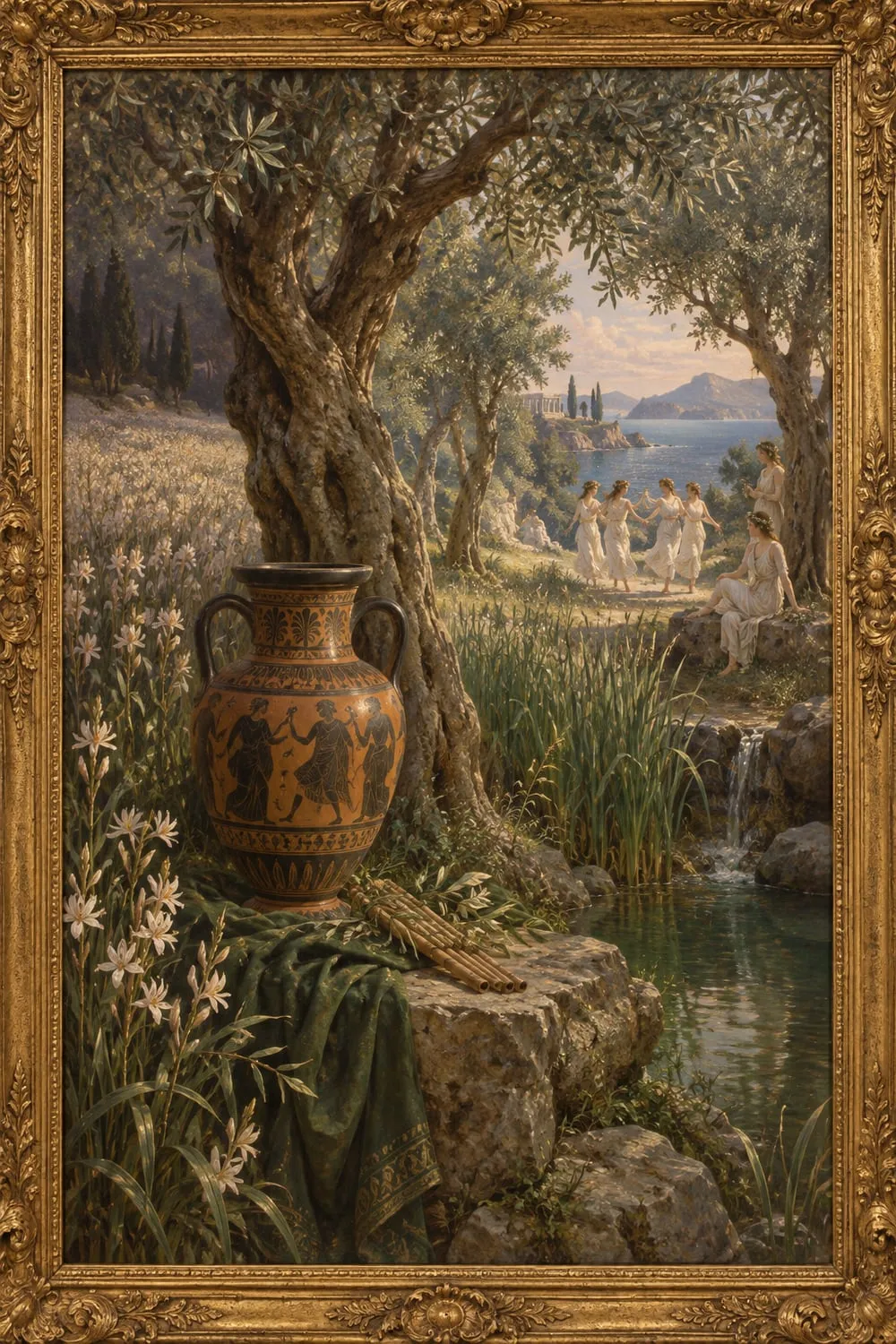
A soul returned from ancient Greece
Phèdre
"The loveless lips with which men kiss in Hell."
Poem
How vain and dull this common world must seemTo such a One as thou, who should’st have talkedAt Florence with Mirandola, or walkedThrough the cool olives of the Academe:Thou should’st have gathered reeds from a green streamFor Goat-foot Pan’s shrill piping, and have playedWith the white girls in that Phaeacian gladeWhere grave Odysseus wakened from his dream.
Ah! surely once some urn of Attic clayHeld thy wan dust, and thou hast come againBack to this common world so dull and vain,For thou wert weary of the sunless day,The heavy fields of scentless asphodel,The loveless lips with which men kiss in Hell.
In brief
SummaryA sonnet addressed to one who seems too rare for the modern world. The speaker says that this 'common world' must seem vain and dull to such a person, who should have talked with Mirandola in Renaissance Florence, walked in Plato's Academe, gathered reeds for Pan or played with the girls in the Phaeacian glade where Odysseus woke. Then he offers an explanation: the addressee's dust once lay in an Attic urn, and this soul has come back from the dead, weary of the sunless fields of asphodel and of the loveless kisses of Hell.
Key themes
"How vain and dull this common world must seem"
Related works
Explore more of Wilde's writing Fabien Dei FranchiRead more
  The Ballad of Reading GaolWritten after his release from prison, a long ballad about the hanging of a fellow prisoner, a trooper who had killed his wife. Wilde's last work, and his most read poem.Read more
  The SphinxA student in his room questions the ancient sphinx that has watched from its corner for a thousand years, and is frightened by what she knows.Read more
 Summary
The octave begins, 'How vain and dull this common world must seem / To such a One as thou'. The speaker lists the places where this person belongs instead: talking 'At Florence with Mirandola', walking 'Through the cool olives of the Academe', gathering reeds from a green stream 'For Goat-foot Pan's shrill piping', or playing 'With the white girls in that Phaeacian glade / Where grave Odysseus wakened from his dream'.
The sestet answers why this soul seems out of place. 'Ah! surely once some urn of Attic clay / Held thy wan dust, and thou hast come again / Back to this common world so dull and vain'. The reason for the return is weariness with the underworld: 'the sunless day, / The heavy fields of scentless asphodel, / The loveless lips with which men kiss in Hell.'
Characters
The one addressed
A soul from antiquity
The 'One' spoken to as 'thou', whom the poem's title links to Racine's tragic heroine Phèdre. The speaker imagines this person as belonging with philosophers, Pan and the girls of Homer's Phaeacia, and as a soul that once lay in an Attic urn and has come back from Hell.
The speaker
The admiring onlooker
The voice who finds the modern world 'vain and dull' beside the addressee, and explains that person's strangeness by imagining a former life in ancient Greece and a return from the underworld.
Themes
Out of place in the present
The poem passes the same judgement twice: this is a 'common world', 'vain and dull', and later 'so dull and vain'. Against it the speaker sets a gallery of better settings, from Mirandola's Florence to the Academe and the Phaeacian shore. The person addressed is imagined as belonging to Greece and the Renaissance, never to the present, which is why the octave is full of 'should'st have'.
Return from the dead
The sestet turns admiration into a myth of rebirth. The addressee's 'wan dust' once filled 'some urn of Attic clay', and has 'come again'. The Greek underworld is pictured as colourless and cold, 'the sunless day', 'scentless asphodel', and 'The loveless lips with which men kiss in Hell'. Even a dull world is preferable to that, so the return becomes a choice for life and love.
Quotes
Context
'Phèdre' appears in the 'Impressions de Théâtre' section of Wilde's collected poems. Its title is the name of the heroine of Racine's tragedy Phèdre, and the poem, a sonnet, speaks to 'such a One as thou' without naming the person addressed. Its allusions range from Pico della Mirandola in Renaissance Florence to Plato's Academy in Athens and the Phaeacian shore of Homer's Odyssey.
About this edition
- Text: the complete work from Standard Ebooks, released into the public domain (CC0 1.0). We change only the layout.
- Download the EPUB of the whole book it comes from, free, for any e-reader.
- Every quotation and glossary word in these notes is checked against the text.