Themes
Old World and New World
The story sets English tradition against American confidence and laughs at both. Mr. Otis comes 'from a modern country, where we have everything that money can buy', and insists that the laws of Nature will not be suspended for the British aristocracy. Yet the narrator notes that Mrs. Otis is in many respects 'quite English', and that the two nations have everything in common 'except, of course, language'. The ending reconciles them: Virginia wins a ducal coronet, 'the reward of all good little American girls', and her republican father walks her up the aisle, the proudest man in England.
The ghost as performer
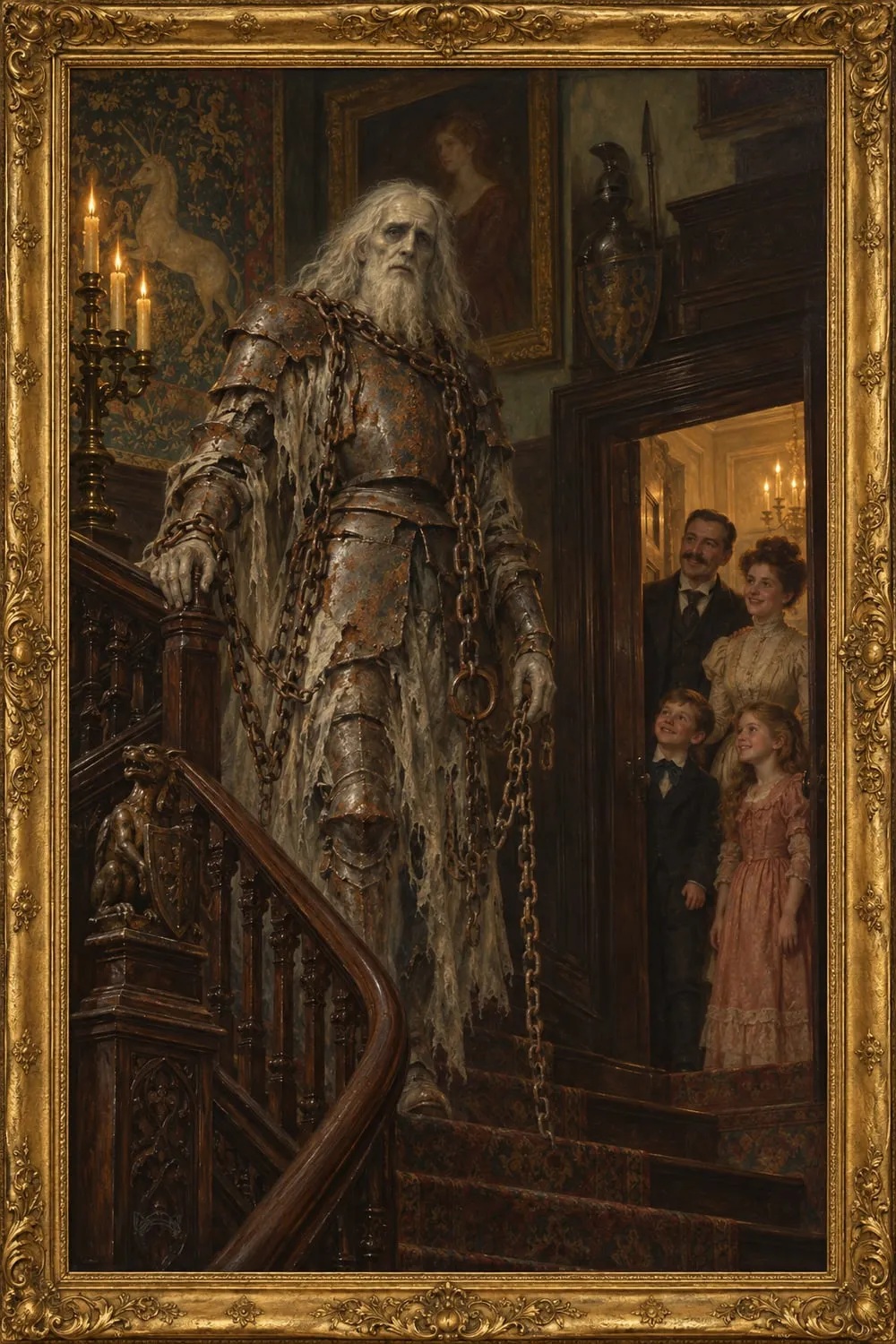
Sir Simon is less a spirit than an actor with a repertoire. He remembers his roles by title, from 'Reckless Rupert, or the Headless Earl' to 'Jonas the Graveless, or the Corpse-Snatcher of Chertsey Barn', spends three hours on a difficult 'makeup', and recalls old triumphs 'with the enthusiastic egotism of the true artist'. His tragedy is an audience that will not play along. The Otises answer his groans with patent medicines, and someone stages a rival show with a turnip. Wilde turns the gothic ghost story into a comedy about an artist who has lost his public.
Materialism and modern science
The Otises meet the supernatural with products and procedures. Washington uses Pinkerton's Paragon Detergent on the bloodstain, Mr. Otis offers the Rising Sun Lubricator with its testimonials 'from some of our most eminent native divines', and Mrs. Otis prescribes Dr. Dobell's tincture. The ghost scorns them as people 'on a low, material plane of existence'. Wilde also teases the psychical research of the day through Washington's letter on 'the Permanence of Sanguineous Stains when connected with Crime'. Yet the ending turns on something no product can explain: an almond tree blossoming in the moonlight.
Pity and forgiveness
The story turns from farce to fairy tale when Virginia, the only Otis who never mocks the ghost, finds him alone and says, 'I am so sorry for you.' She does not excuse him, telling him plainly that 'It is very wrong to kill anyone', but she offers him her sandwich and then her tears and prayers. The prophecy on the library window promises peace when 'a little child gives away its tears'. Her courage in following him through the wall is rewarded when the barren almond blossoms and she can say, 'God has forgiven him.'
Love and death
Sir Simon's longing for the Garden of Death, with its long grass, white hemlock flowers and singing nightingale, is the most lyrical passage in the story, and it makes death a place of rest rather than terror. He asks Virginia for help because 'Love is stronger than Death is.' The funeral echoes his words, with moonlight flooding the churchyard and a nightingale singing from a distant copse. In the last scene Virginia tells her husband that the ghost made her see 'what Life is, and what Death signifies, and why Love is stronger than both'.