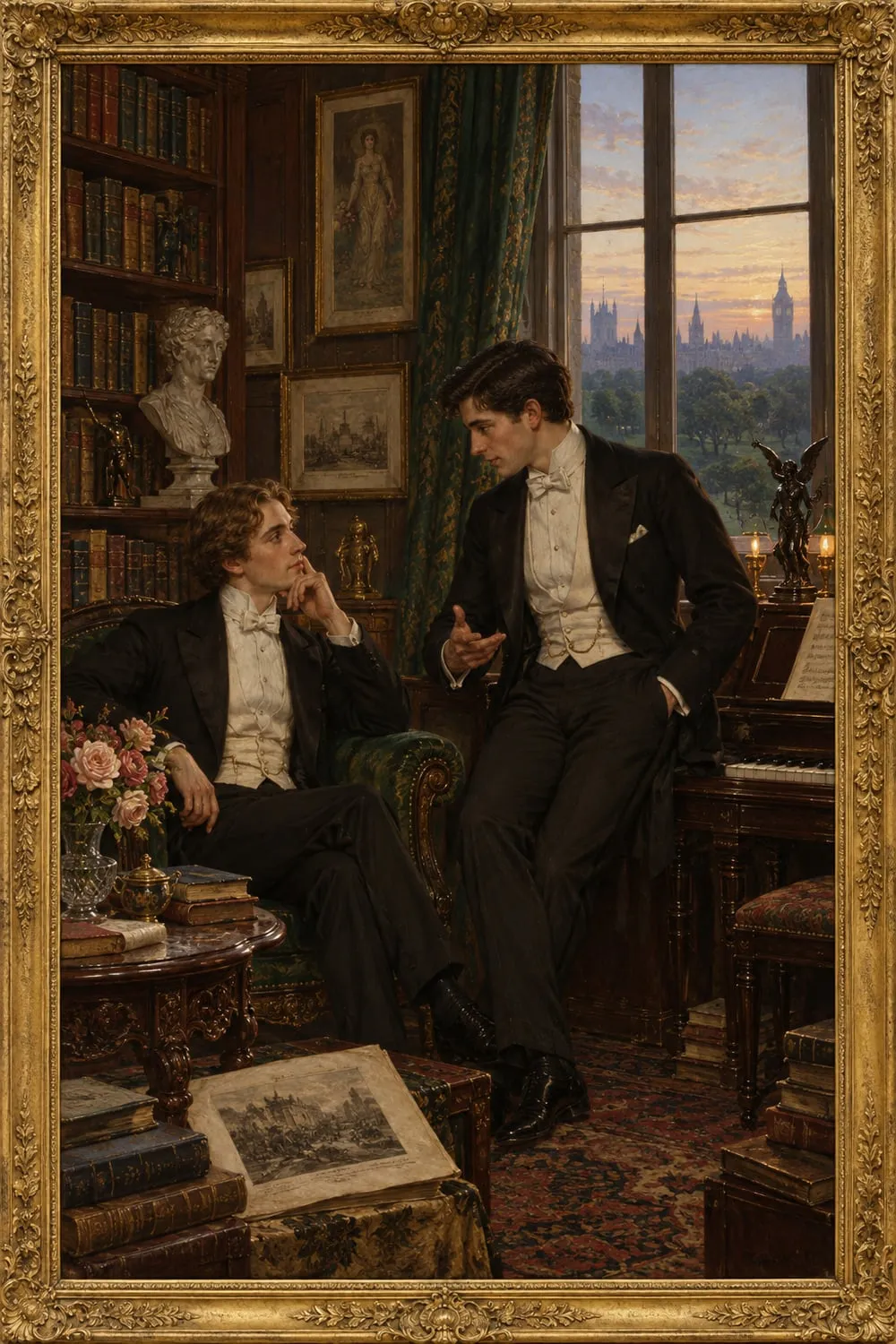
Why criticism is itself a creative art
The Critic as Artist
"There is no sin except stupidity."
The story in brief
SummaryOver one long night in a library in Piccadilly, Gilbert defends criticism against his friend Ernest, who thinks artists should be left alone and that in the best days of art there were no critics. Gilbert argues the opposite at every turn: the Greeks were a nation of art-critics, all fine creation depends on the critical faculty, and the highest criticism is itself an art, 'the record of one's own soul', which treats a work as a starting-point for something new.
The dialogue is in two parts, divided by supper. In the first, Gilbert makes the case that criticism is creative and independent; in the second, he describes the critic as an interpreter who reveals a work through his own personality, praises contemplation over action, and lists the critic's qualities, which turn out to be neither fairness, reason nor sincerity but temperament.
Gilbert ends by claiming that the future belongs to criticism, which alone can make the mind 'a fine instrument', bind nations together through understanding, and give the age its serene philosophic temper. When Ernest calls him a dreamer, he accepts the name, and the two go out at dawn to look at the roses in Covent Garden.
Key themes
"Oh! journalism is unreadable, and literature is not read."
Related works
Explore more of Wilde's writing The Truth of MasksAn essay on costume and setting in Shakespeare's plays, arguing that archaeological accuracy on stage serves the drama.Read more
  Pen, Pencil and PoisonA portrait of Thomas Griffiths Wainewright, a Regency artist and critic who was also a forger and a poisoner, and what his crimes did to his art.Read more
  The Decay of LyingTwo friends in a country library argue that life imitates art far more than art imitates life. Wilde's wittiest statement of his ideas, written as a dialogue.Read more
 Context
The Critic as Artist first appeared in The Nineteenth Century in July and September 1890, in two parts, under the title The True Function and Value of Criticism. Wilde revised it and gave it its present title for Intentions in 1891, where it is the longest of the four essays.
Like The Decay of Lying, it is a dialogue, and Gilbert defends the form within it: dialogue lets a thinker 'both reveal and conceal himself' and show an idea 'in the round'. The talk ranges across the critics and artists of Wilde's day, among them Browning, Meredith, Ruskin, Pater and Kipling, and Gilbert quotes Pater's description of the Mona Lisa at length as his model of the highest criticism.
First published in The Nineteenth Century in 1890 as The True Function and Value of Criticism; revised for Intentions in 1891.
About this edition
- Text: Intentions. Methuen & Co., 1913. Public domain. We change only the layout.
- Every quotation and glossary word in these notes is checked against the text.