Summary
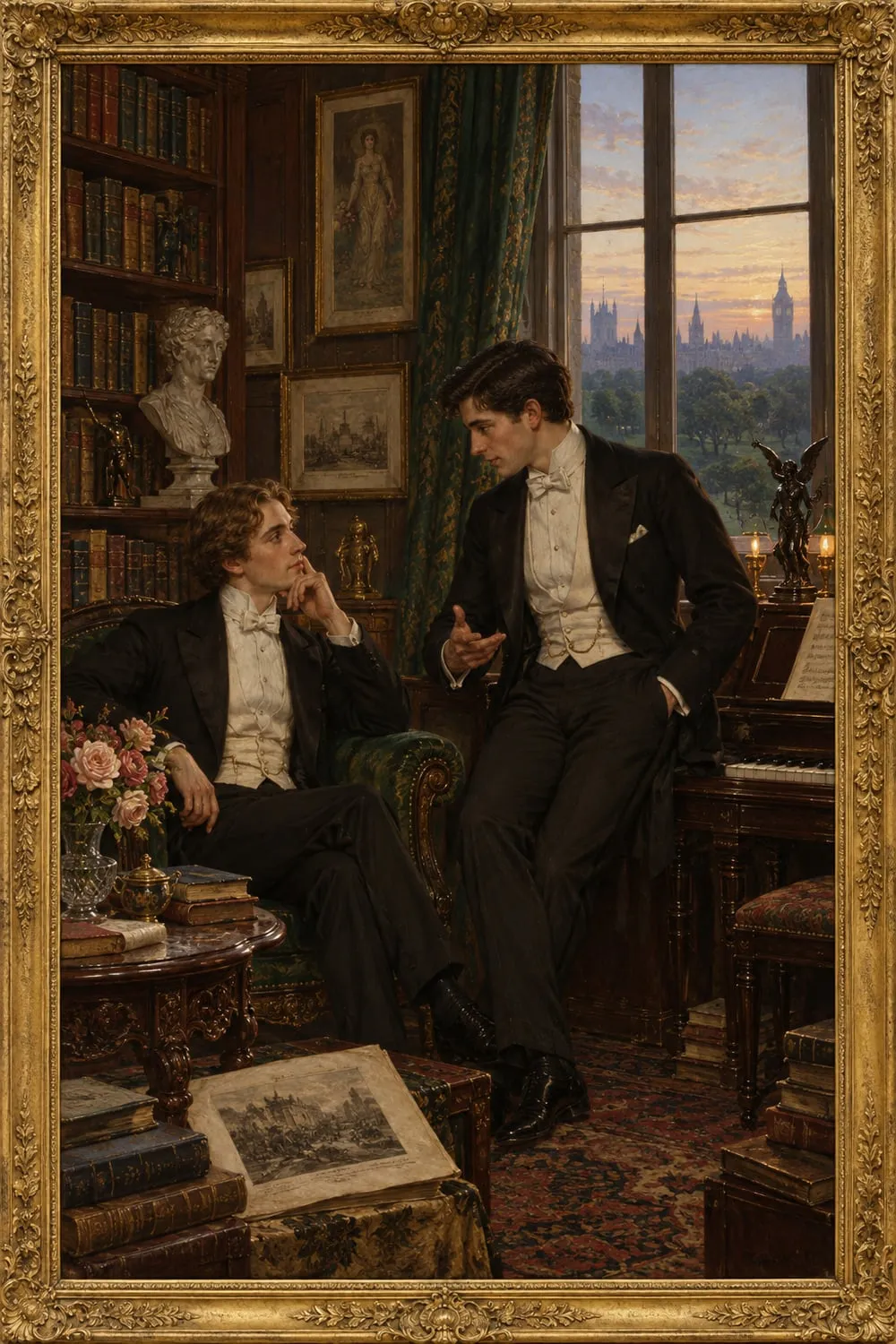
Gilbert is at the piano and Ernest is laughing over a volume of memoirs. Gilbert defends autobiography, from Cellini and Rousseau to Pepys, but mocks the biographers who arrive with the undertaker: 'it is always Judas who writes the biography.' Ernest then asks what use art-criticism is. Why should those who cannot create judge those who can? In the best days of art there were no art-critics, and he paints a picture of the Greek sculptor, painter and potter working undisturbed, since 'The Greeks had no art-critics.'
Gilbert replies that the Greeks were 'a nation of art-critics', who gave us the critical spirit itself. They criticised language with a subtlety we have lost, because since printing we write for the eye rather than the ear; Milton's verse grew grander when blindness made him compose aloud. Aristotle's treatise on poetry treats art from a purely aesthetic point of view, and Alexandria was full of critics, schools and quarrels about plagiarism. Ernest concedes the point but insists that creation is higher than criticism. Gilbert answers that the antithesis is false: the artist's 'spirit of choice' is the critical faculty at work, 'all fine imaginative work is self-conscious and deliberate', and every form art uses, from the epic to the essay, came from the critical spirit of the Greeks.
When Ernest objects that it is harder to do a thing than to talk about it, Gilbert reverses him. 'Anybody can make history. Only a great man can write it.' Action is blind and easy; what lasts is Homer's Troy, where every morning the warriors still go out to fight. Literature alone can show movement and growth, which painting and sculpture must freeze into a single moment. Criticism, Gilbert continues, stands to the work of art as the artist stands to life: it is 'a creation within a creation', and the highest criticism, being the purest form of personal impression, is more creative than creation. It is 'the record of one's own soul' and 'the only civilised form of autobiography'.
Gilbert rejects the view that the aim of criticism is 'to see the object as in itself it really is'. Ruskin's prose on Turner matters whether or not his views are sound, and Pater's famous description of the Mona Lisa, which Gilbert quotes, puts into the painting what Leonardo never intended, and is criticism 'of the highest kind' for that reason. 'Beauty has as many meanings as man has moods.' Pictures that tell a story from history or literature bore the critic because they leave nothing to the imagination; music, which can never reveal its final secret, is the perfect type of art. They break off for supper.
After supper Ernest asks whether the critic is ever an interpreter. He is, says Gilbert, but only by intensifying his own personality. The actor is the critic of the drama and the pianist the critic of music: when Rubinstein plays Beethoven he gives us Beethoven and himself, and 'there are as many Hamlets as there are melancholies'. The critic will turn more and more from life, which is 'terribly deficient in form', to Art, which can give us any emotion at will. Gilbert's evidence is a long imaginary journey through Dante's Inferno, Purgatorio and Paradiso, followed by Baudelaire and Meleager. Art's emotions are 'sterile': we weep but are not wounded.
Ernest finds this immoral, and Gilbert agrees that 'all art is immoral', since its aim is emotion for its own sake while society demands action. Contemplation, which society thinks the gravest of sins, is 'the proper occupation of man', and to do nothing is the hardest thing in the world. Heredity has shown that we are never less free than when we act, but it also gives us the imagination, 'concentrated race-experience', through which we live the lives of Leopardi, Abelard and Villon. Gilbert attacks philanthropists and those who spend their lives educating others rather than themselves, and declares that 'an idea that is not dangerous is unworthy of being called an idea at all'.
Ernest suggests that the critic should be fair, rational and sincere, and Gilbert rejects all three. An unbiassed opinion is valueless, the love of art is beyond reason, and 'what people call insincerity is simply a method by which we can multiply our personalities'. The critic's true requisite is temperament, trained, as Plato recommended, by beautiful surroundings and by the decorative arts, which touch us rather than teach us. Form comes first in art and in life: 'All bad poetry springs from genuine feeling.' A great artist cannot judge the work of others, because 'creation limits, while contemplation widens, the vision'.
Finally Gilbert claims that 'it is to criticism that the future belongs'. Creation is running out of subjects while criticism's material grows daily. Criticism makes culture possible by distilling the mass of books, recovers prehistory through philology, and will make Europe cosmopolitan by showing that to make war on another nation is to destroy part of our own culture. Darwin and Renan, critics of the Book of Nature and of the books of God, have made the century. Ernest sums up the night's paradoxes and calls Gilbert a dreamer. Gilbert accepts it, draws back the curtains on the dawn, and proposes they go to Covent Garden to look at the roses.
Part by part
SummaryErnest argues that critics are useless and that the Greeks had none. Gilbert replies that the Greeks were a nation of art-critics, that all fine creation depends on the critical faculty, and that it is harder to talk about a thing than to do it. The highest criticism, he says, is itself a creative art, the record of the critic's own soul, and seeks to see a work as it really is not.
After supper Gilbert describes the critic as an interpreter who reveals a work through his own personality. He praises Art over life, contemplation over action, and argues that all art is immoral and all real thought dangerous. The true critic needs temperament rather than fairness, reason or sincerity, and the future belongs to criticism, which will make the age cosmopolitan. At dawn the friends set out for Covent Garden.