Summary
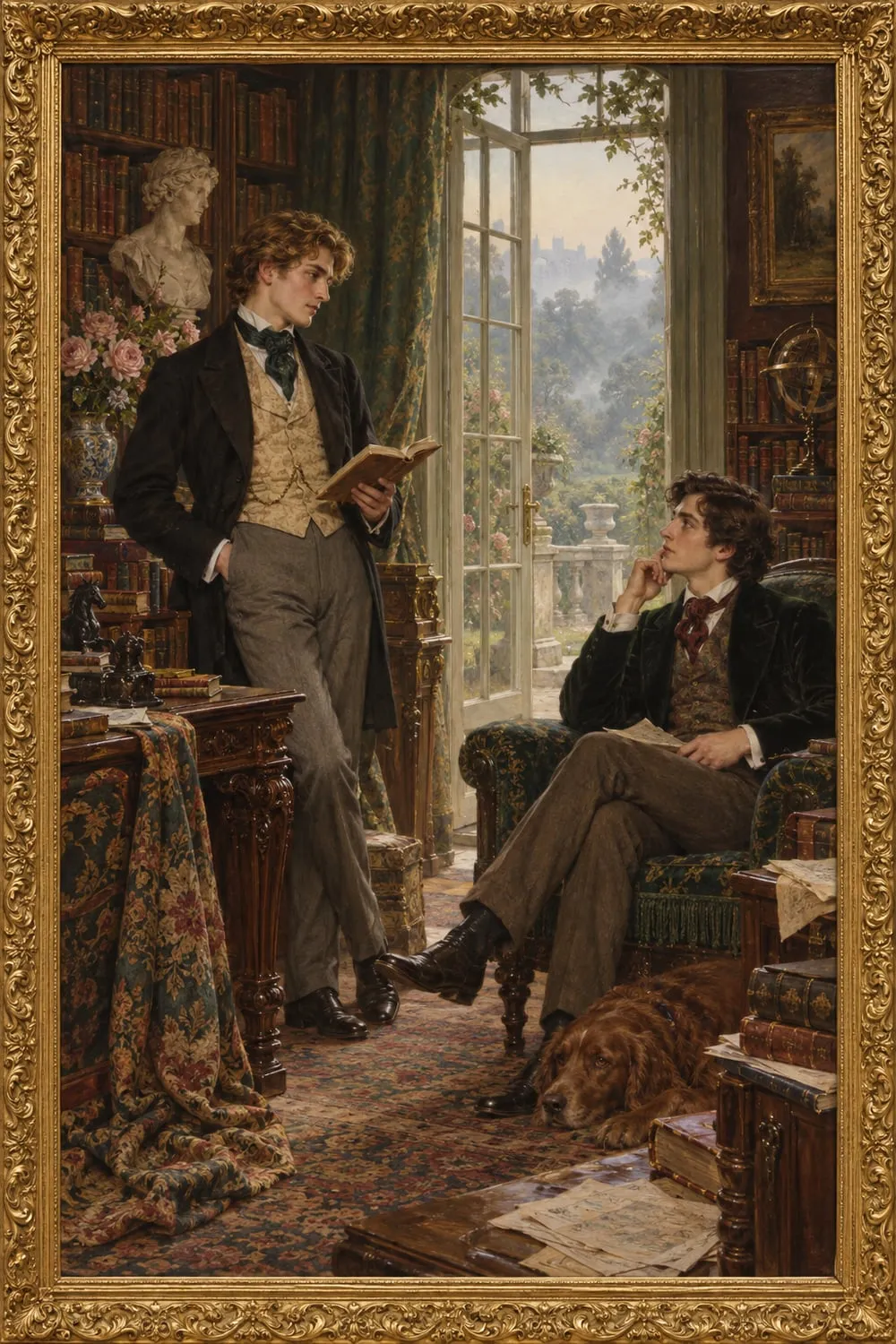
Cyril comes in from the terrace and urges Vivian to come and lie on the grass. Vivian replies that the more he studies Art, the less he cares for Nature, which shows only 'her curious crudities, her extraordinary monotony'. Grass is damp, and egotism is the result of indoor life. He is correcting the proofs of an article for the Retrospective Review, revived by his club, the Tired Hedonists, whose members wear faded roses and have a cult for Domitian. Politicians and lawyers, he says, are poor liars because they stoop to prove and argue. What he pleads for is Lying in art.
He reads the opening of 'The Decay of Lying: A Protest'. The ancient historians gave us delightful fiction in the form of fact; the modern novelist gives us dull facts in the guise of fiction, researching his subject at the British Museum. A young man with a gift for exaggeration falls into 'careless habits of accuracy' and ends by writing novels 'so lifelike that no one can possibly believe in their probability'. Vivian then runs through the novelists of the day: Stevenson's The Black Arrow lacks a single anachronism, Rider Haggard props up his marvels with footnotes, Henry James writes fiction as if it were a painful duty, and Zola is truthful and dull. Cyril defends his favourites and asks about Balzac and Meredith. Vivian answers that Meredith is 'a child of realism who is not on speaking terms with his father', and that Balzac created life rather than copying it: the death of Lucien de Rubempré is one of the great tragedies of Vivian's own life.
Modernity of form and of subject are both wrong, Vivian goes on, because 'the only beautiful things' are the things that do not concern us; it is because Hecuba is nothing to us that her sorrows suit a tragedy. Charles Reade wrote one beautiful book and wasted the rest of his life on prisons and asylums. Nature is 'always behind the age': Wordsworth found in stones the sermons he had already hidden there. Art passes through three stages, beginning with abstract decoration, then taking Life as rough material, and finally letting Life drive it into the wilderness. English drama shows the pattern: the Elizabethans created a new race of beings, but even Shakespeare went too directly to life, and the end is modern melodrama, whose characters 'would pass unnoticed in a third-class railway carriage'. In the decorative arts, Eastern convention beats Western imitation. The proper school to learn art in is not Life but Art.
The great liars of the past, from Herodotus to Cellini, Casanova and Carlyle, kept facts in their place. Now facts are usurping the kingdom of Romance, and America suffers because it chose as its hero a man who could not tell a lie. Vivian foresees a change: society will return to 'its lost leader, the cultured and fascinating liar', the first of whom told cavemen how he had slain the Mammoth. Critics who quote Hamlet on holding the mirror up to Nature forget that Hamlet says it to convince the bystanders of his madness. Art 'is a veil, rather than a mirror'.
Cyril asks whether Vivian truly believes that Life imitates Art. He does. A type of beauty invented by two painters now fills every private view, and the Greeks set statues in the bride's chamber so that she would bear lovely children. Boys who read about Dick Turpin go out with black masks and unloaded revolvers; Hamlet invented modern pessimism, and the nineteenth century is largely an invention of Balzac. Vivian tells three stories: a governess who lived out Becky Sharp's career after Vanity Fair appeared; a friend called Mr. Hyde who trampled a child in a London street, fled into a surgery and found the name Jekyll on the door; and a woman who followed the heroine of a French serial step by step, even to running away with a man who deserted her.
Nature, too, imitates Art. The brown fogs of London exist because the Impressionists taught people to see them, and 'where the cultured catch an effect, the uncultured catch cold'. Sunsets are old-fashioned: the one Mrs. Arundel made him admire was 'a very second-rate Turner'. Cyril says Vivian has proved it 'to my dissatisfaction, which is better', but insists that art at least expresses its age. Vivian denies it. The imitative arts show only an artist's style: the Japanese of Hokusai's prints do not exist, and Aristophanes shows that Athenian women rouged their faces and dyed their hair yellow, unlike the figures of the Parthenon frieze.
Vivian also mocks the dull dreams recorded by the Psychical Society and an English Church in which a man succeeds 'through his capacity for disbelief'. The last passage surveys the kinds of lying, from Cretan dinner-parties to Fleet Street, and holds that only lying for its own sake is beyond reproach, above all Lying in Art. When Romance returns, the Hippogriff will stand in our stalls. Asked for a summary, Vivian gives four doctrines: Art expresses only itself; all bad art comes from returning to Life and Nature; Life and Nature imitate Art; and lying is the proper aim of Art. Then he leads Cyril out onto the terrace, where at twilight Nature is at least useful for illustrating quotations from the poets.