Themes
Money and romance
The opening paragraph states the rules of Hughie's world: 'Unless one is wealthy there is no use in being a charming fellow.' Colonel Merton likes Hughie but sets a price on his daughter, and Hughie's failures in stocks, tea and sherry show that charm cannot earn it. The joke of the ending is that romance does triumph, but only because a millionaire pays for it. Wilde presents his cynical maxims as 'the great truths of modern life', then lets the story both prove and mock them.
Kindness rewarded
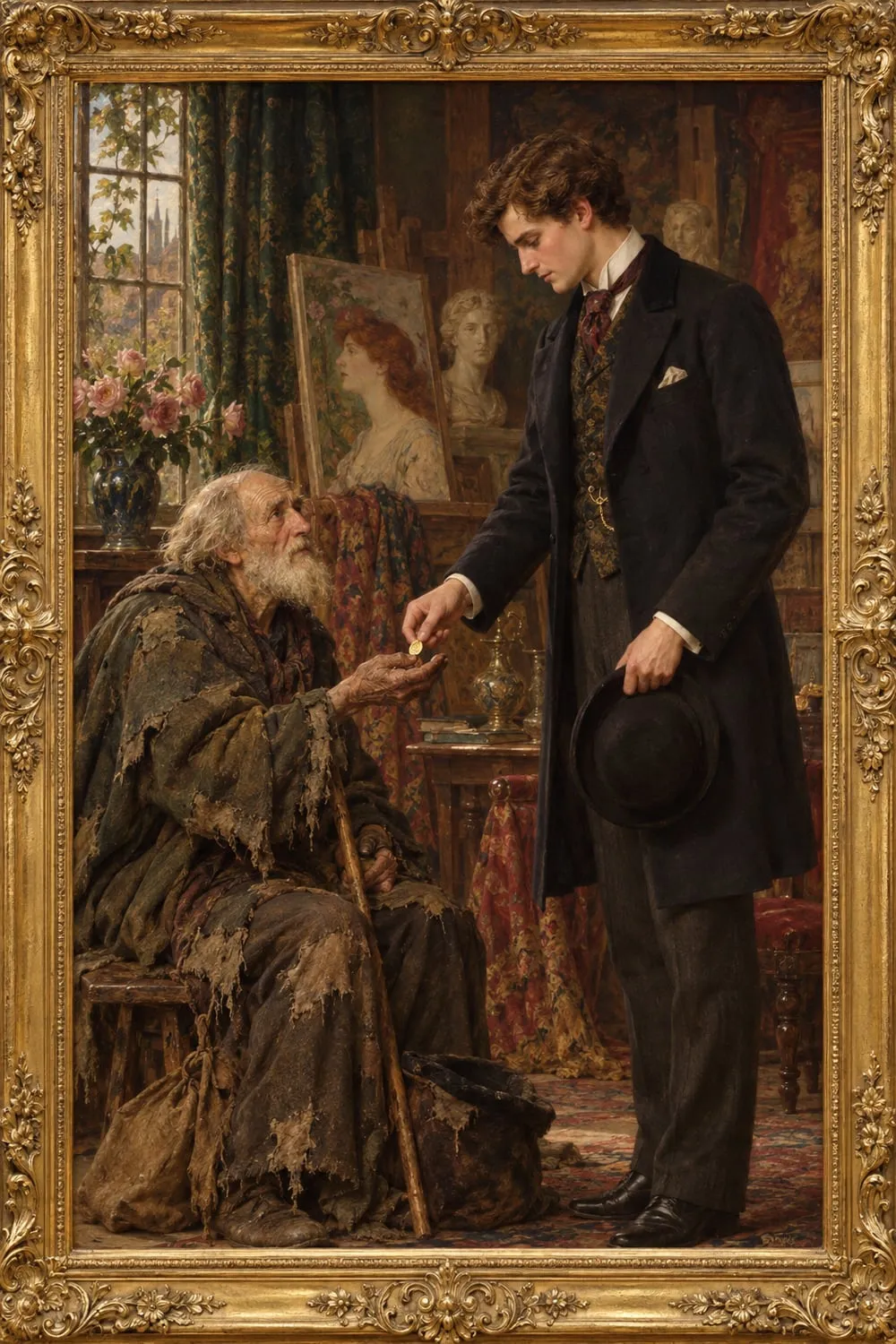
Hughie 'never said a brilliant or even an ill-natured thing in his life', and the narrator treats him as 'a delightful, ineffectual young man'. His one decisive act is an impulse of pity: seeing the model rest wretchedly on a bench, he gives away his only sovereign, thinking 'he wants it more than I do'. The gift costs him real comfort, a fortnight of walking home, and he blushes at it afterwards. The story works like a moral fable, in which a small, unselfish act done without hope of return is repaid ten thousand times over.
Art and poverty
Alan Trevor sees the beggar as a subject, not a man. 'What you call rags I call romance,' he tells Hughie, and he declares that the painter's business is 'to realise the world as we see it, not to reform it as we know it'. His model earns a shilling an hour while the picture sells for two thousand guineas, and Hughie's suggestion that models deserve a percentage is laughed away. The rags themselves are an old suit Trevor bought in Spain. Wilde lets the painter speak for art for art's sake, while quietly showing its indifference to real want.
Disguise and appearance
Nothing in the studio is what it seems. The 'amazing model', with a face 'like wrinkled parchment' and a battered hat held out for alms, is one of the richest men in Europe, a man who 'can prevent Russia going to war when he chooses'. Trevor is a 'strange rough fellow' who is also a true artist, and Hughie, the handsome idler, turns out to be the story's moral hero. The title turns on a pun: the Baron is both a millionaire who is a model and a model of what a millionaire should be.