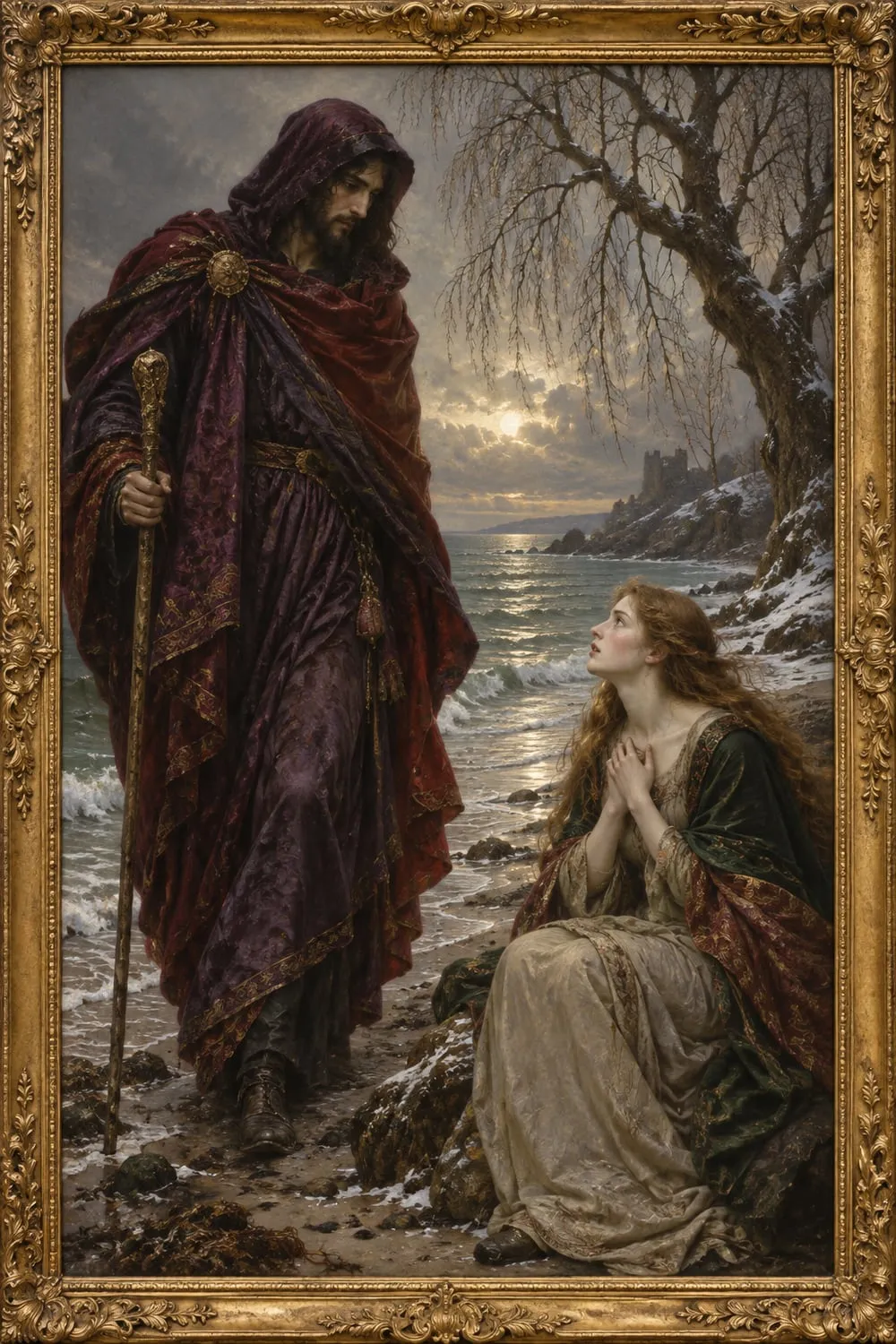
Remorse, winter and a new rival
The New Remorse
"The sin was mine; I did not understand."
Poem
The sin was mine; I did not understand.So now is music prisoned in her cave,Save where some ebbing desultory waveFrets with its restless whirls this meagre strand.And in the withered hollow of this landHath Summer dug herself so deep a grave,That hardly can the leaden willow craveOne silver blossom from keen Winter’s hand.But who is this who cometh by the shore?(Nay, love, look up and wonder!) Who is thisWho cometh in dyed garments from the South?It is thy new-found Lord, and he shall kissThe yet unravished roses of thy mouth,And I shall weep and worship, as before.
In brief
SummaryThe speaker confesses a fault he did not understand at the time, and pictures its cost as a barren shore in winter: music is 'prisoned in her cave', Summer lies buried, and the willow can hardly beg a single blossom from Winter. Then, in the sestet, a figure approaches along the shore 'in dyed garments from the South'. The speaker bids his love look up and wonder, for this is the beloved's 'new-found Lord', who will kiss those still unravished lips, while the speaker is left to 'weep and worship, as before'.
Key themes
"The sin was mine; I did not understand."
Related works
Explore more of Wilde's writing The Ballad of Reading GaolWritten after his release from prison, a long ballad about the hanging of a fellow prisoner, a trooper who had killed his wife. Wilde's last work, and his most read poem.Read more
  The SphinxA student in his room questions the ancient sphinx that has watched from its corner for a thousand years, and is frightened by what she knows.Read more
  Chorus of Cloud MaidensRead more
 Summary
The octave opens with a bare confession: 'The sin was mine; I did not understand.' The sin is never named; only its result is shown. Music is 'prisoned in her cave', and nothing sounds except where 'some ebbing desultory wave / Frets with its restless whirls this meagre strand'. In 'the withered hollow of this land' Summer has dug herself 'so deep a grave' that the 'leaden willow' can hardly crave 'One silver blossom from keen Winter's hand'.
The sestet changes direction with a question: 'But who is this who cometh by the shore?' In a parenthesis the speaker urges the one he loves, '(Nay, love, look up and wonder!)', and asks again who comes 'in dyed garments from the South'. The answer is 'thy new-found Lord', who 'shall kiss / The yet unravished roses of thy mouth'. The speaker's own part is already fixed: 'And I shall weep and worship, as before.'
Characters
The speaker
The remorseful lover
He confesses a sin he did not understand when he committed it, and sees its consequence in a barren, wintry shore where music is silent. When a new lord arrives for the one he loves, he does not resist, but resolves to 'weep and worship, as before'.
The beloved
Addressed as 'love'
Addressed only in a parenthesis, '(Nay, love, look up and wonder!)', and told that a 'new-found Lord' has come. The beloved's mouth holds 'The yet unravished roses' that the newcomer will kiss. The beloved never speaks or answers.
The new-found Lord
The stranger from the South
A figure who comes along the shore 'in dyed garments from the South', announced by the solemn question 'Who is this / Who cometh'. He is the beloved's new master, and the speaker expects him to kiss the beloved's lips while he himself looks on in worship.
Themes
Guilt and its aftermath
The first line takes the blame completely: 'The sin was mine; I did not understand.' The poem never says what the sin was; it shows only the consequence. Music is shut in a cave, Summer lies in 'so deep a grave', and the willow can hardly crave one blossom from Winter. The barren landscape stands for the speaker's inner state after his failure.
The rival as a god
The newcomer arrives like a figure of scripture. 'Who is this / Who cometh in dyed garments from the South?' echoes the Book of Isaiah, where the prophet asks who comes from Edom in dyed garments, and the answer names him 'thy new-found Lord'. The speaker responds with devotion, not jealousy: 'And I shall weep and worship, as before.' Love has become a religion in which he is the worshipper, never the one worshipped.
Winter and the South
The poem sets a cold shore against a warm arrival. The octave is all scarcity: an 'ebbing desultory wave', a 'meagre strand', a 'leaden willow' and 'keen Winter's hand'. The stranger comes 'from the South' in coloured robes, bringing kisses for 'The yet unravished roses' of the beloved's mouth. Warmth and colour return to the world, but not to the speaker.
Context
The New Remorse is a sonnet in the Italian form. Its octave, rhyming ABBAABBA, describes the barren aftermath of a confessed sin, and its sestet, rhyming CDEDEC, turns on the arrival of a stranger from the South. The archaic forms 'hath', 'cometh' and 'thy', and the biblical phrasing of the sestet, give the close the air of a scene from scripture.
About this edition
- Text: the complete work from Standard Ebooks, released into the public domain (CC0 1.0). We change only the layout.
- Download the EPUB of the whole book it comes from, free, for any e-reader.
- Every quotation and glossary word in these notes is checked against the text.