Themes
Vanity
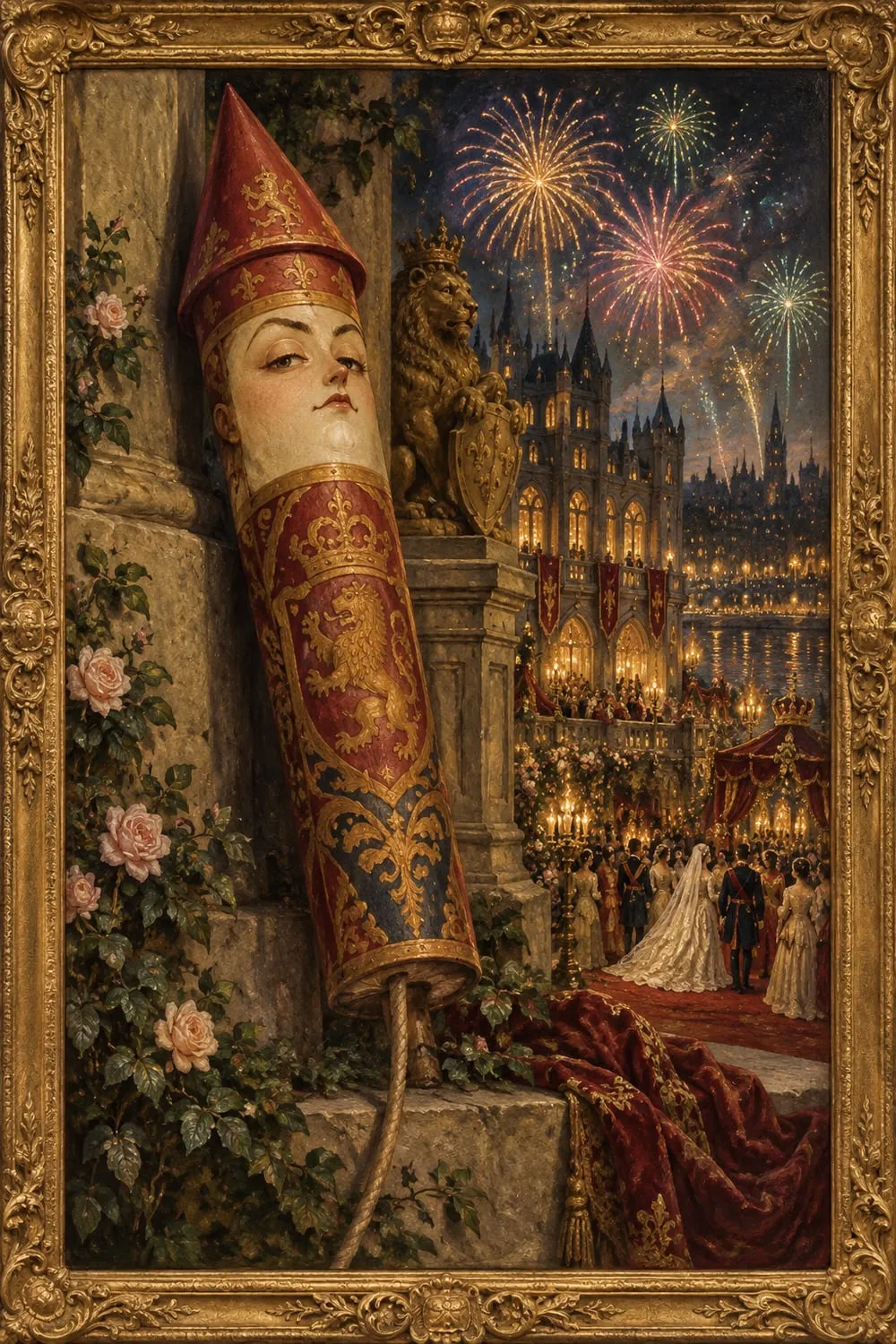
The Rocket believes the royal wedding revolves around him, and later tells the Frog that the Prince and Princess were married 'in my honour'. He defines sympathy as everyone thinking about him, sneers at his poor relations and treats every listener as a chance to talk about himself. The ending is the fullest statement of his vanity: he explodes unseen and unheard in broad daylight, his stick lands on a Goose, and he dies still believing that he has created a great sensation.
Self-deception
The Rocket never lets facts disturb his opinion of himself. He claims that his imagination lies in never thinking of things 'as they really are'. When he fails to go off, he decides he is being reserved for a grand occasion. The workmen become a 'deputation', 'bad rocket' becomes 'Grand Rocket', the ditch becomes a fashionable watering-place, and 'old stick' becomes 'Gold Stick', a Court dignitary. Each mishearing is a small comic proof that vanity can turn any humiliation into praise.
False feeling
The Rocket calls himself extremely sensitive, but his feeling is all for show. He weeps over a son the Prince and Princess do not have, drowned in a river that does not exist, and when the Roman Candle points this out he replies that he hates people who cry over spilt milk. The Bengal Light calls him 'the most affected person I ever met'. The Catherine Wheel, proud of her broken heart, is a gentler version of the same fault. And the tears are what ruin him: they soak his gunpowder.
Flattery at Court
The human world of the tale is a court where no one tells the truth. The King plays the flute badly, but because he is the King everyone cries 'Charming! charming!'. The Page's salary is doubled twice as an honour, though he receives no salary at all, and the King answers questions addressed to other people. This court of flatterers is mirrored on the fireworks' stand, where the Rocket expects the same deference and only the Roman Candle and the Bengal Light dare to call his behaviour 'Humbug!'.
Talking without listening
Nearly everyone in the tale loves the sound of their own voice. The Frog explains that 'Somebody must listen', but prefers to do all the talking himself, since it 'saves time, and prevents arguments'. The Rocket complains of this, then admits that he likes hearing himself talk so much that he sometimes does not understand a word he is saying. The White Duck once chaired a meeting that passed resolutions condemning everything it disliked. Conversation becomes a string of monologues, and the Rocket ends as he lived, talking to nobody.