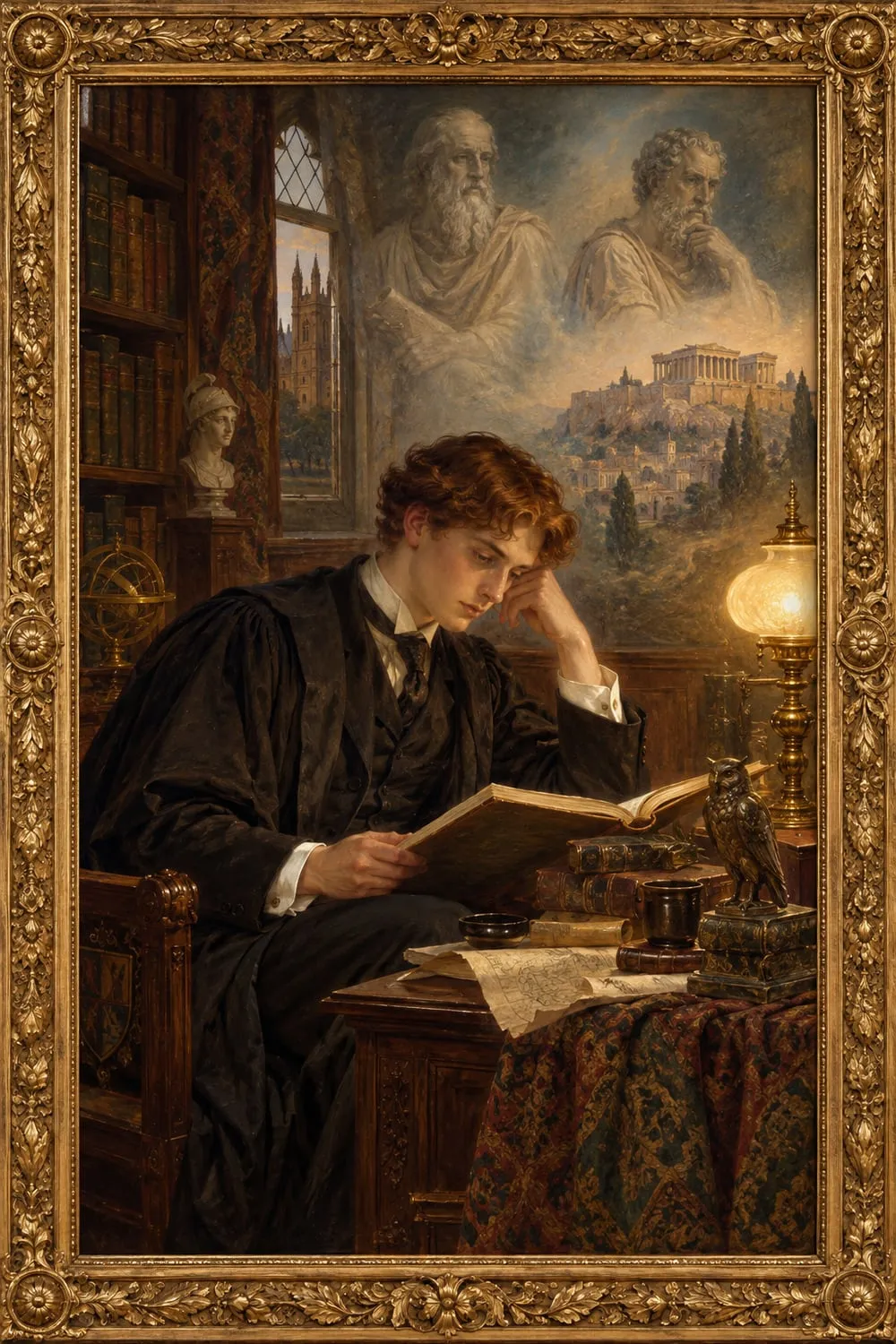
How the Greeks learned to doubt their own past
The Rise of Historical Criticism
"It is so hard to use facts, so easy to accumulate them."
The story in brief
SummaryWilde argues that historical criticism is less a technique than a frame of mind: one face of the revolt against authority that also produces democracy, philosophy and physical science. It needs a free and questioning people, so he finds none of it in Egypt, Assyria, China or India, and traces its whole rise in Greece, where men first began to doubt their myths and then to test the stories told about their own past.
The essay is a long academic survey in four parts. Wilde follows the treatment of sacred legend through allegory, Plato's moral tests and the rationalising of Euhemeros, then the secular historians from Herodotus to Thucydides, then the ancient theories of primitive society and of law in history set out by Plato, Aristotle and Polybius. Polybius is its hero, the historian who turns rationalism into a stated method and calls chance a word for ignorance.
The close widens out. Plutarch restores a sense of mystery to a world ruled by law, Rome is judged to have had no critical spirit at all, and the Renaissance becomes a return to Greek thought. Wilde ends by declaring the Greek spirit essentially modern and honouring those who first lit the torch of free inquiry.
Key themes
"Free criticism is as unknown as free trade."
Related works
Explore more of Wilde's writing The Decay of LyingTwo friends in a country library argue that life imitates art far more than art imitates life. Wilde's wittiest statement of his ideas, written as a dialogue.Read more
  The Soul of Man under SocialismWilde's case that socialism would free people from poverty and from living for others, so that each could develop a full individual life. His one political essay.Read more
 Context
Wilde wrote The Rise of Historical Criticism at Oxford in 1879 as an entry for the Chancellor's English Essay prize. It was not published in his lifetime and appeared in print only after his death.
The essay reads like the work of a classical student steeped in the scientific thought of his day. Alongside Herodotus, Thucydides, Plato, Aristotle and Polybius, Wilde calls on Comte, Hegel, Tocqueville, Herbert Spencer, Sir Henry Maine, Tylor and Lubbock. Its remark that art aims only at 'the creation of beauty' points ahead to the lectures he gave in America in 1882, where he told his audience that one should never talk of a moral or an immoral poem.
Written at Oxford in 1879 for the Chancellor's English Essay prize; first published after his death.
About this edition
- Text: Essays and Lectures. Methuen & Co., 1913. Public domain. We change only the layout.
- Every quotation and glossary word in these notes is checked against the text.