Themes
Criticism as revolt
Wilde defines historical criticism as 'part of that complex working towards freedom which may be described as the revolt against authority.' It borrows its impatience with dogma from democracy and its sense of law from science, which is why it cannot appear in Egypt or among the Chinese, where 'free criticism is as unknown as free trade.' The argument comes full circle with Rome, whose 'conservative respect for tradition' and fondness for ritual were fatal to any spirit of revolt, leaving it with abundant records and no historians.
Method over results
Wilde returns again and again to one claim: what matters in a great writer is the method, not the conclusion. Of Thucydides he says the important thing 'is not the results he arrived at, but the method by which he works', and of Polybius that 'a scientific method is a gain for all time.' The contest between Plato's deductive 'Cloud City' and Aristotle's appeal to how constitutions actually change dramatises the point: truth is reached through the facts, not laid over them.
The retreat of the supernatural
The essay charts a steady progression. Herodotus believes in providence but asks how a dove could speak with a human voice; Thucydides simply explains history without the gods; Polybius argues that admitting miracles would make history impossible, and treats a supposed divine judgment on childless Greece as a matter of economics. Wilde sums up the sequence in the case of Scipio's dream. Then Plutarch turns it again, seeing law itself as divine: Greek philosophy began and ended in scepticism, but 'the first and the last word of Greek history was Faith.'
History, art and the moral aim
Wilde insists that history, like art, is spoiled when made to preach. Herodotus wrote to show 'the nemesis that falls on sin', which proves 'that nothing can dispense with criticism so much as a moral aim.' The aim of art is 'the creation of beauty', of history 'the discovery of the laws' of progress. The same division ends Part IV, where Wilde contrasts the historian, who loves truth for its use, with Plato's philosopher, who loves it for its beauty.
The modern Greek mind
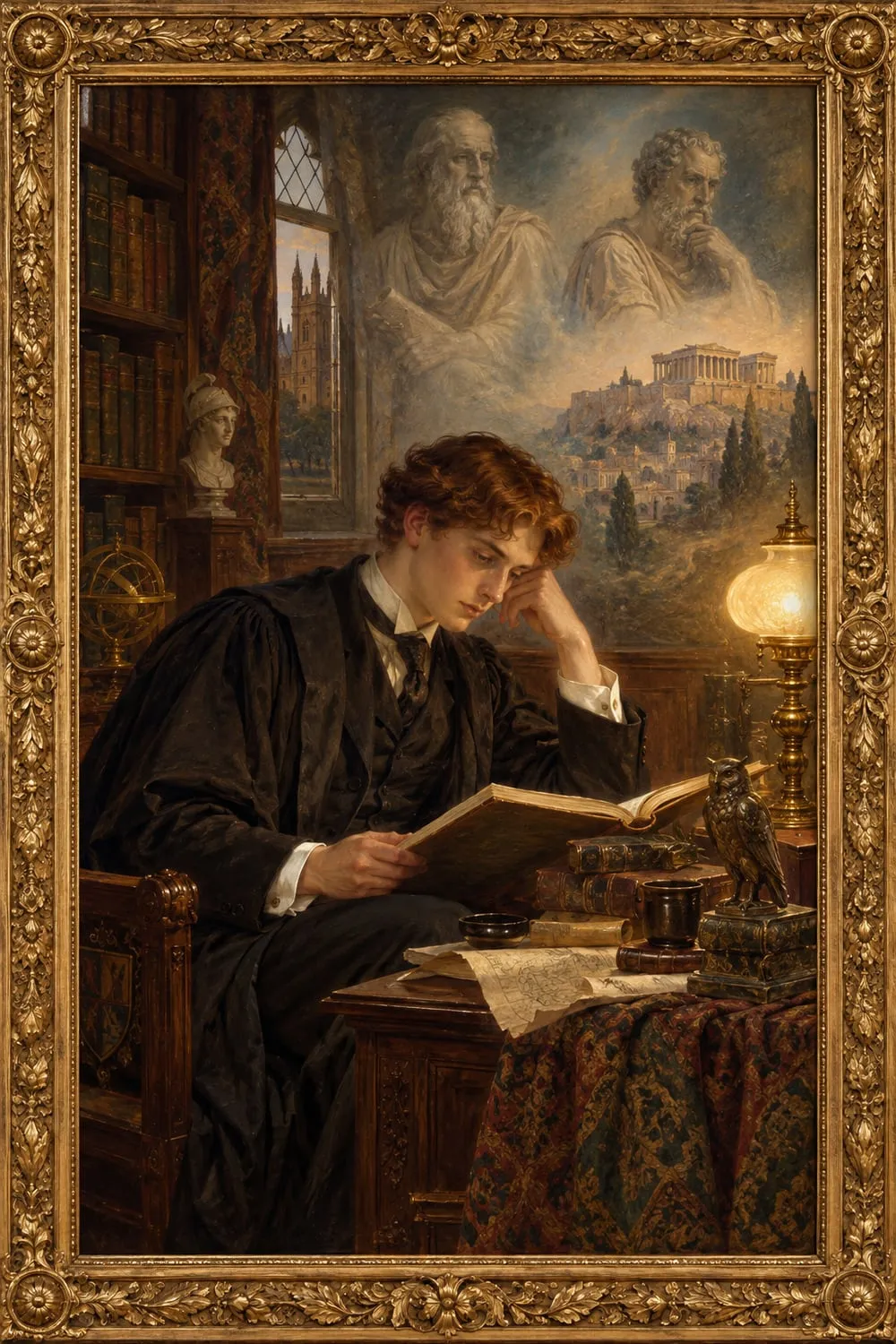
For all its ancient subject, the essay argues that the Greeks are closer to the present than the Middle Ages are. Wilde keeps finding Victorian science in Greek texts: Aristotle anticipates the 'Survival of the Fittest', Thucydides the comparative method, Polybius the study of health before disease. The Renaissance is described as a return to Greek ways of thinking, and the conclusion is plain: 'the Greek spirit is essentially modern', and only a handful of new methods have been added since.