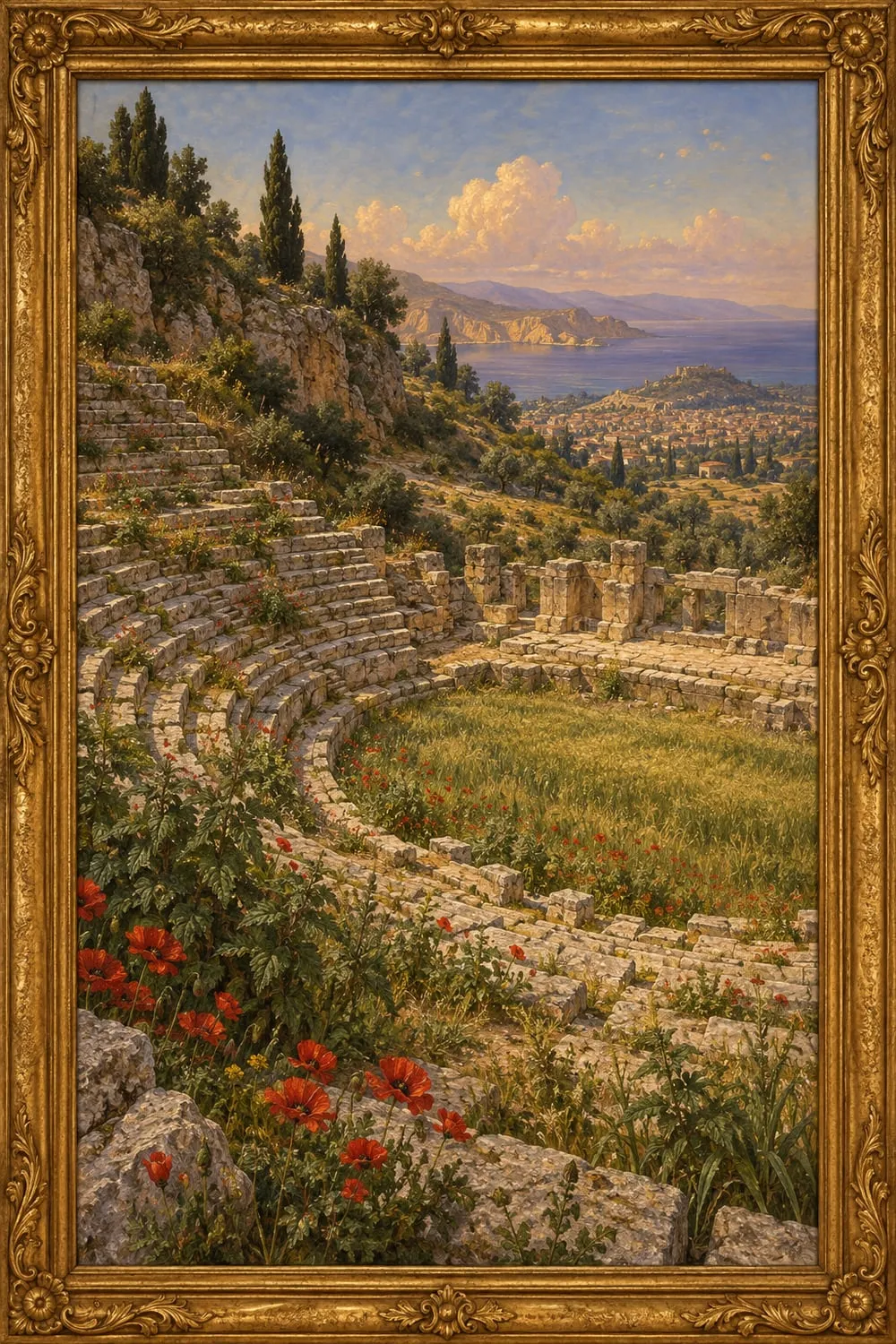
A ruined theatre, a troubled age
The Theatre at Argos
"And desecrated Argos at my feet."
Poem
Nettles and poppy mar each rock-hewn seaNo poet crowned with olive deathlesslyChants his glad song, nor clamorous TragedyStartles the air; green corn is waving sweetWhere once the Chorus danced to measures fleet;Far to the East a purple sea,The cliffs of gold that prisoned Danae;And desecrated Argos at my feet.
No season now to mourn the days of old,A nation’s shipwreck on the rocks of Time,Or the dread storms of all-devouring Fate.For now the peoples clamor at our gate,The world is full of plague and sin and crime,And God Himself is half-dethroned for Gold!
Argos, 1877
In brief
SummaryA fourteen-line poem dated at its close 'Argos, 1877'. The first eight lines survey the ruined theatre: nettles and poppies spread over the rock-hewn stone, no poet sings and no Tragedy 'Startles the air', and green corn waves where the Chorus once danced. Beyond lie a purple sea and the golden cliffs 'that prisoned Danae', with 'desecrated Argos' below. The last six lines refuse to mourn the ancient past: this is no time for it, when 'the peoples clamor at our gate', the world is full of plague and crime, and God is 'half-dethroned for Gold'.
Key themes
"Where once the Chorus danced to measures fleet;"
Related works
Explore more of Wilde's writing The Ballad of Reading GaolWritten after his release from prison, a long ballad about the hanging of a fellow prisoner, a trooper who had killed his wife. Wilde's last work, and his most read poem.Read more
  The SphinxA student in his room questions the ancient sphinx that has watched from its corner for a thousand years, and is frightened by what she knows.Read more
  Chorus of Cloud MaidensRead more
 Summary
The speaker stands in the old theatre at Argos. 'Nettles and poppy' mar the rock-hewn stone; no poet 'crowned with olive' chants there now, 'nor clamorous Tragedy / Startles the air', and green corn waves sweetly 'Where once the Chorus danced to measures fleet'. Looking out, the speaker sees a purple sea far to the east and 'The cliffs of gold that prisoned Danae', with 'desecrated Argos' below.
The last six lines turn from the ruin to the present. This is 'No season now to mourn the days of old', nor to grieve over 'A nation's shipwreck on the rocks of Time' or the storms of 'all-devouring Fate'. The speaker's own age has troubles enough: 'the peoples clamor at our gate', the world is 'full of plague and sin and crime', 'And God Himself is half-dethroned for Gold!' The lament for ancient Greece gives way to alarm at a modern world ruled by money.
Characters
The speaker
The traveller at Argos
A visitor standing in the ruined theatre with 'desecrated Argos at my feet'. The speaker looks over the ruins, the sea and the cliffs, then turns from mourning ancient Greece to a troubled present in which God is 'half-dethroned for Gold'.
Themes
The ruined stage
The first eight lines are a list of absences: no poet, no Tragedy, no Chorus. Nature has taken the place of art, with 'Nettles and poppy' on the stone and 'green corn' waving 'Where once the Chorus danced to measures fleet'. The word 'desecrated' treats the theatre and the city as holy places that have been violated.
The present over the past
The closing lines refuse nostalgia. The speaker will not mourn 'A nation's shipwreck on the rocks of Time' because the present has more urgent troubles: plague, sin, crime and restless peoples 'at our gate'. The last line names the root of them, 'God Himself is half-dethroned for Gold!', setting modern greed against the old devotion to gods and art.
Context
The poem closes with a place and a date, 'Argos, 1877', presenting it as written at the ruined theatre it describes. Its fourteen lines divide into a group of eight on the ruins, with their memories of poets, Tragedy and the dancing Chorus, and a group of six that turns from the ancient world to the troubles of the poet's own time.
About this edition
- Text: the complete work from Standard Ebooks, released into the public domain (CC0 1.0). We change only the layout.
- Download the EPUB of the whole book it comes from, free, for any e-reader.
- Every quotation and glossary word in these notes is checked against the text.