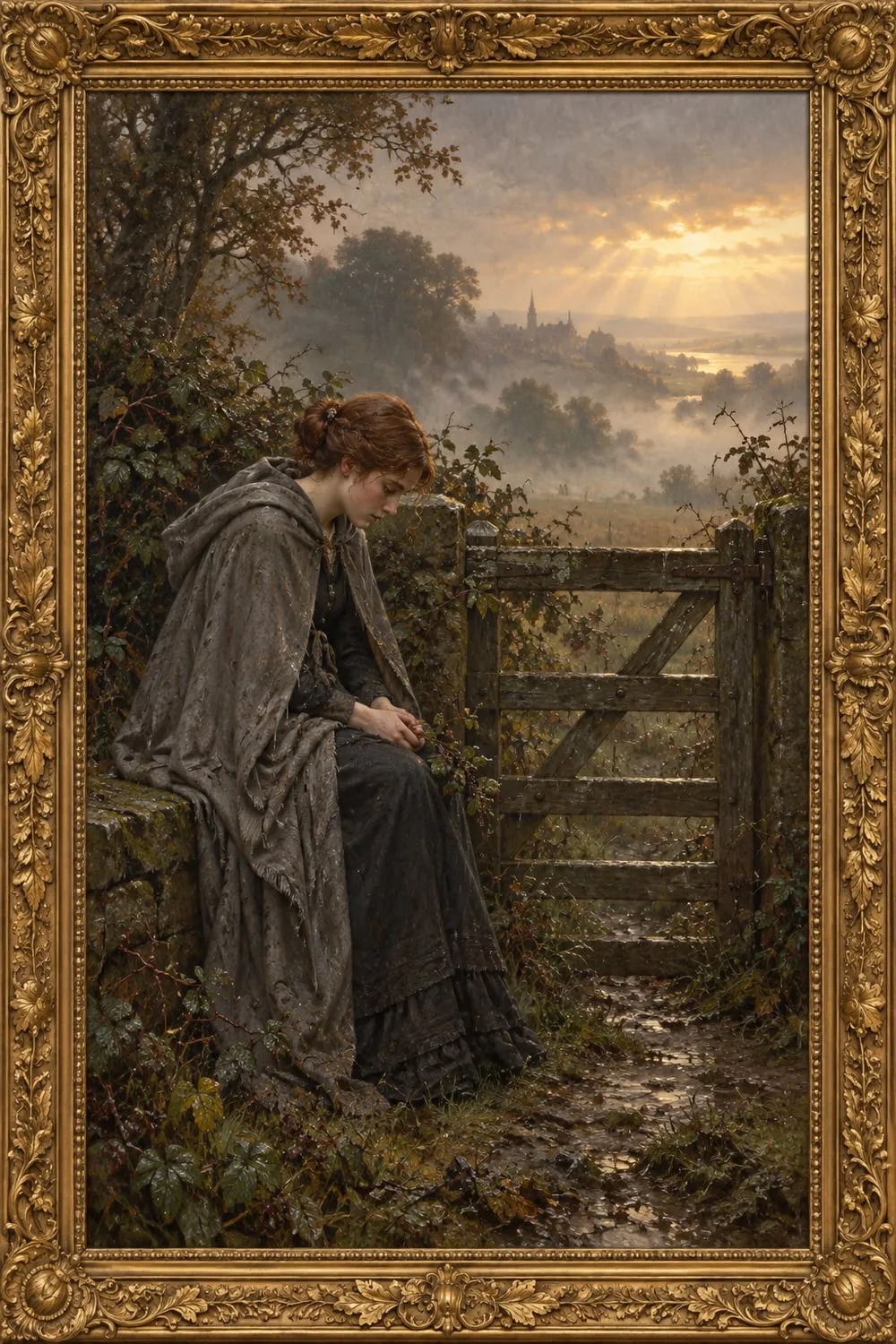
Trust in the face of not knowing
The True Knowledge
"Thou knowest all; I cannot see."
Poem
… ἀναγκαίως δ’ ἔχειΒίον θερίζειν ὥστε κάρπιμον στάχυν,καὶ τὸν μὲν εἶναι τὸν δὲ μή.
Thou knowest all—I seek in vainWhat lands to till or sow with seed—The land is black with briar and weed,Nor cares for falling tears or rain.
Thou knowest all—I sit and waitWith blinded eyes and hands that fail,Till the last lifting of the veilAnd the first opening of the gate.
Thou knowest all; I cannot see.I trust I shall not live in vain,I know that we shall meet againIn some divine eternity.
In brief
SummaryThree quatrains addressed to an unnamed 'Thou' who knows all, while the speaker knows nothing. The speaker cannot tell what land to till in a world 'black with briar and weed', and sits waiting 'With blinded eyes and hands that fail' for the veil to lift and the gate to open. The last stanza turns from helplessness to trust: though unable to see, the speaker believes life will not be lived in vain and that 'we shall meet again / In some divine eternity'. A Greek epigraph, likening human life to corn that must be reaped, sets the poem among thoughts of death.
Key themes
"And the first opening of the gate."
Related works
Explore more of Wilde's writing The Ballad of Reading GaolWritten after his release from prison, a long ballad about the hanging of a fellow prisoner, a trooper who had killed his wife. Wilde's last work, and his most read poem.Read more
  The SphinxA student in his room questions the ancient sphinx that has watched from its corner for a thousand years, and is frightened by what she knows.Read more
  Chorus of Cloud MaidensRead more
 Summary
A Greek epigraph says that life must be reaped like a ripe ear of corn, so that one person lives and another does not. Each of the three stanzas then begins 'Thou knowest all', setting the knowledge of an unnamed listener against the speaker's blindness. In the first, the speaker seeks in vain 'What lands to till or sow with seed'; the land is 'black with briar and weed' and cares nothing for 'falling tears or rain'.
In the second, the speaker sits and waits 'With blinded eyes and hands that fail' until 'the last lifting of the veil / And the first opening of the gate', images of death as both a revelation and an entrance. In the third, the speaker admits 'I cannot see', but trusts that life will not be lived in vain, and ends with the one thing claimed as knowledge: 'I know that we shall meet again / In some divine eternity.'
Characters
The speaker
The one who cannot see
A mourner who can find no land worth tilling and sits 'With blinded eyes and hands that fail', waiting for the veil to lift. By the end the speaker's helplessness becomes trust, and the only certainty claimed is a future meeting 'In some divine eternity'.
The one addressed
The one who knows all
Never named, the listener is greeted in each stanza with the words 'Thou knowest all'. The speaker's hope 'that we shall meet again' suggests someone already beyond this life, who now sees what the speaker cannot.
Themes
Knowledge and blindness
The refrain 'Thou knowest all' is answered each time by the speaker's ignorance: 'I seek in vain', 'With blinded eyes', 'I cannot see'. The true knowledge of the title belongs to the one addressed, not to the speaker. Yet in the last stanza the verbs change from seeking to trusting and knowing, 'I trust' and 'I know that we shall meet again'. Faith takes the place of sight.
Death as harvest and threshold
The Greek epigraph compares life to corn that must be reaped, and the first stanza's untillable land, 'black with briar and weed', continues the farming image. The second stanza gives death two gentler shapes: 'the last lifting of the veil / And the first opening of the gate'. Death is an ending, 'last', and a beginning, 'first', in the same breath.
Context
The poem is written in three rhymed quatrains, each opening with the same words, 'Thou knowest all'. Its Greek epigraph, a saying that human life is reaped like a ripe ear of corn, so that one lives and another does not, places the poem among thoughts of mortality. The one addressed is never named, and the poem leaves the listener's identity to the reader.
About this edition
- Text: the complete work from Standard Ebooks, released into the public domain (CC0 1.0). We change only the layout.
- Download the EPUB of the whole book it comes from, free, for any e-reader.
- Every quotation and glossary word in these notes is checked against the text.