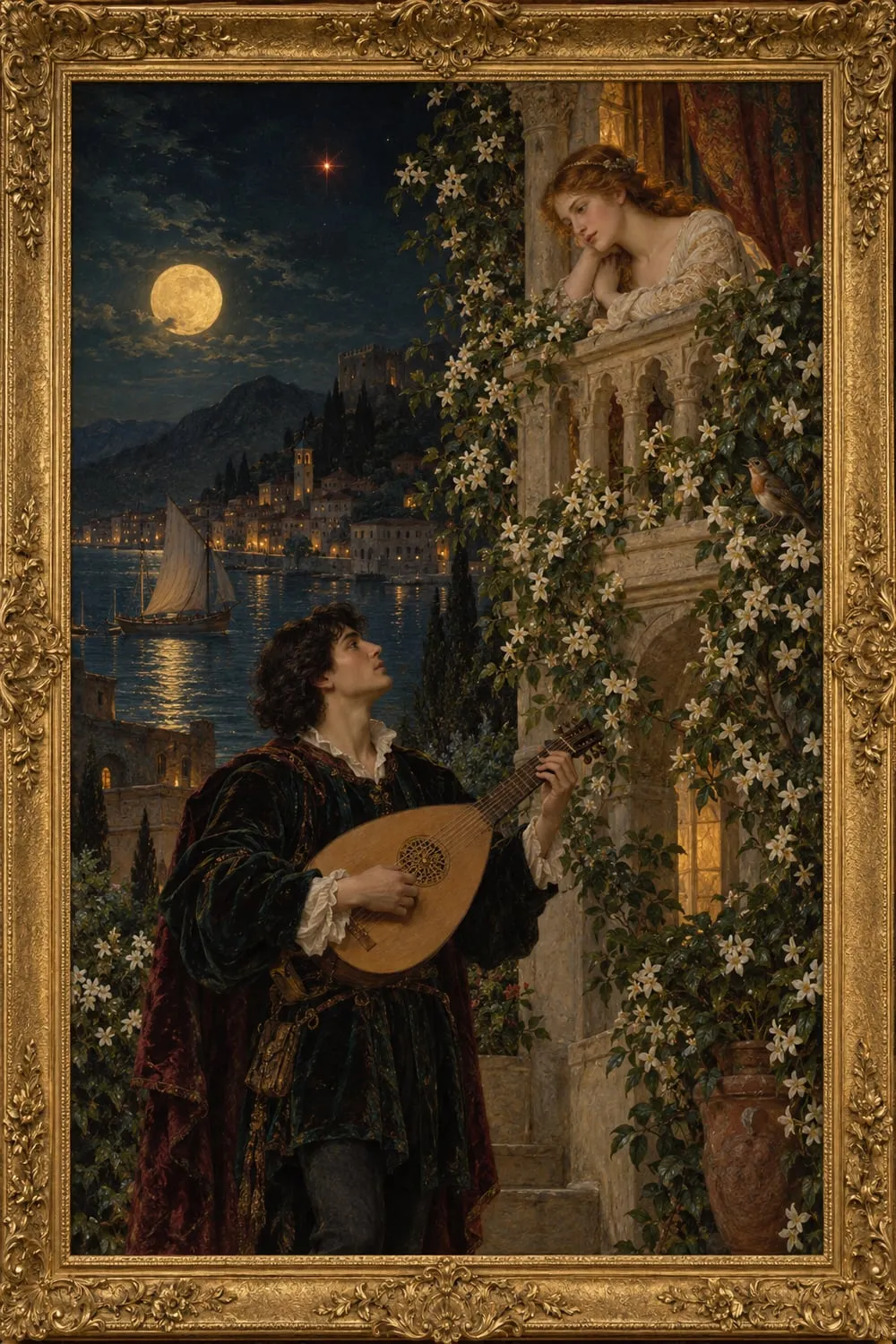
A serenade to star, ship, bird and blossom
Under the Balcony
"O beautiful star with the crimson mouth!"
Poem
O beautiful star with the crimson mouth!O moon with the brows of gold!Rise up, rise up, from the odorous south!And light for my love her way,Lest her little feet should strayOn the windy hill and the wold!O beautiful star with the crimson mouth!O moon with the brows of gold!
O ship that shakes on the desolate sea!O ship with the wet, white sail!Put in, put in, to the port to me!For my love and I would goTo the land where the daffodils blowIn the heart of a violet dale!O ship that shakes on the desolate sea!O ship with the wet, white sail!
O rapturous bird with the low, sweet note!O bird that sits on the spray!Sing on, sing on, from your soft brown throat!And my love in her little bedWill listen, and lift her headFrom the pillow, and come my way!O rapturous bird with the low, sweet note!O bird that sits on the spray!
O blossom that hangs in the tremulous air!O blossom with lips of snow!Come down, come down, for my love to wear!You will die on her head in a crown,You will die in a fold of her gown,To her little light heart you will go!O blossom that hangs in the tremulous air!O blossom with lips of snow!
In brief
SummaryA lover sings beneath his beloved's balcony, though he never speaks to her directly. Instead he calls on four things in turn: the star and the moon to rise and light her way over the hills, a ship to put into port and carry the two of them to a land of daffodils, a bird to sing until she lifts her head from the pillow and comes to him, and a blossom to fall and be worn by her, dying in her hair or in a fold of her gown. Each stanza opens and closes with the same refrain, giving the poem the shape of a song.
Key themes
"O beautiful star with the crimson mouth!"
Related works
Explore more of Wilde's writing The Ballad of Reading GaolWritten after his release from prison, a long ballad about the hanging of a fellow prisoner, a trooper who had killed his wife. Wilde's last work, and his most read poem.Read more
  The SphinxA student in his room questions the ancient sphinx that has watched from its corner for a thousand years, and is frightened by what she knows.Read more
  Chorus of Cloud MaidensRead more
 Summary
Each of the four stanzas follows the same pattern: two lines of address, a doubled command, three lines of hope, and then the opening two lines repeated. In the first the lover calls on the 'beautiful star with the crimson mouth' and the 'moon with the brows of gold' to rise 'from the odorous south' and light his love's way, 'Lest her little feet should stray / On the windy hill and the wold'.
In the second he turns to a ship that 'shakes on the desolate sea', with a 'wet, white sail', and begs it to put into port, for he and his love would go 'To the land where the daffodils blow / In the heart of a violet dale'. In the third he addresses a 'rapturous bird with the low, sweet note', sitting on the spray: if it sings on, his love 'in her little bed / Will listen, and lift her head / From the pillow, and come my way'.
The fourth stanza is the strangest. He calls on a blossom 'that hangs in the tremulous air', with 'lips of snow', to 'Come down, come down, for my love to wear'. Its reward is death: 'You will die on her head in a crown, / You will die in a fold of her gown'. He presents this as a happy fate, since 'To her little light heart you will go!' The song ends with its refrain, and the beloved never answers.
Characters
The lover
Singer beneath the balcony
The speaker, who sings beneath his beloved's window and calls on the star, the moon, a ship, a bird and a blossom to help him. He dreams of carrying her off to 'the land where the daffodils blow', but his song is all invocation: he never speaks to her, and she never replies.
His love
The unseen beloved
The woman the song is sung for, glimpsed only through small details: her 'little feet' that might stray on the hill, her 'little bed' and pillow, the crown and gown she might wear, her 'little light heart'. She stays out of sight throughout, and the poem ends before she answers.
Themes
The serenade as ritual
The poem is built like a song, not an argument. Each stanza opens with a pair of invocations, such as 'O ship that shakes on the desolate sea!', and closes by repeating them, and every command is doubled: 'Rise up, rise up', 'Put in, put in', 'Sing on, sing on', 'Come down, come down'. The repetition gives the lover's longing the sound of a chant sung beneath a window.
Nature as go-between
The lover never addresses his love. He asks the moon to light her way, the ship to carry them off, the bird to wake her and the blossom to adorn her, as though the whole world could be enlisted in his courtship. She stays a distant figure, known only by her 'little feet', her 'little bed' and her 'little light heart'.
Love and death in the blossom
The last stanza darkens the song. The blossom is asked to 'Come down, come down, for my love to wear!', and the lover promises it that 'You will die on her head in a crown'. To be picked is to die, and he offers the flower this as an honour. The beloved's beauty is adorned by what fades on her.
Quotes
Context
Under the Balcony takes the form of a serenade, the song a lover sings beneath a lady's window, as its title suggests. Each of its four eight-line stanzas repeats its first two lines at the end as a refrain, and its short, lilting lines, with a skipping rhythm and exclamations in every stanza, are written to sound like music.
About this edition
- Text: the complete work from Standard Ebooks, released into the public domain (CC0 1.0). We change only the layout.
- Download the EPUB of the whole book it comes from, free, for any e-reader.
- Every quotation and glossary word in these notes is checked against the text.