Summary
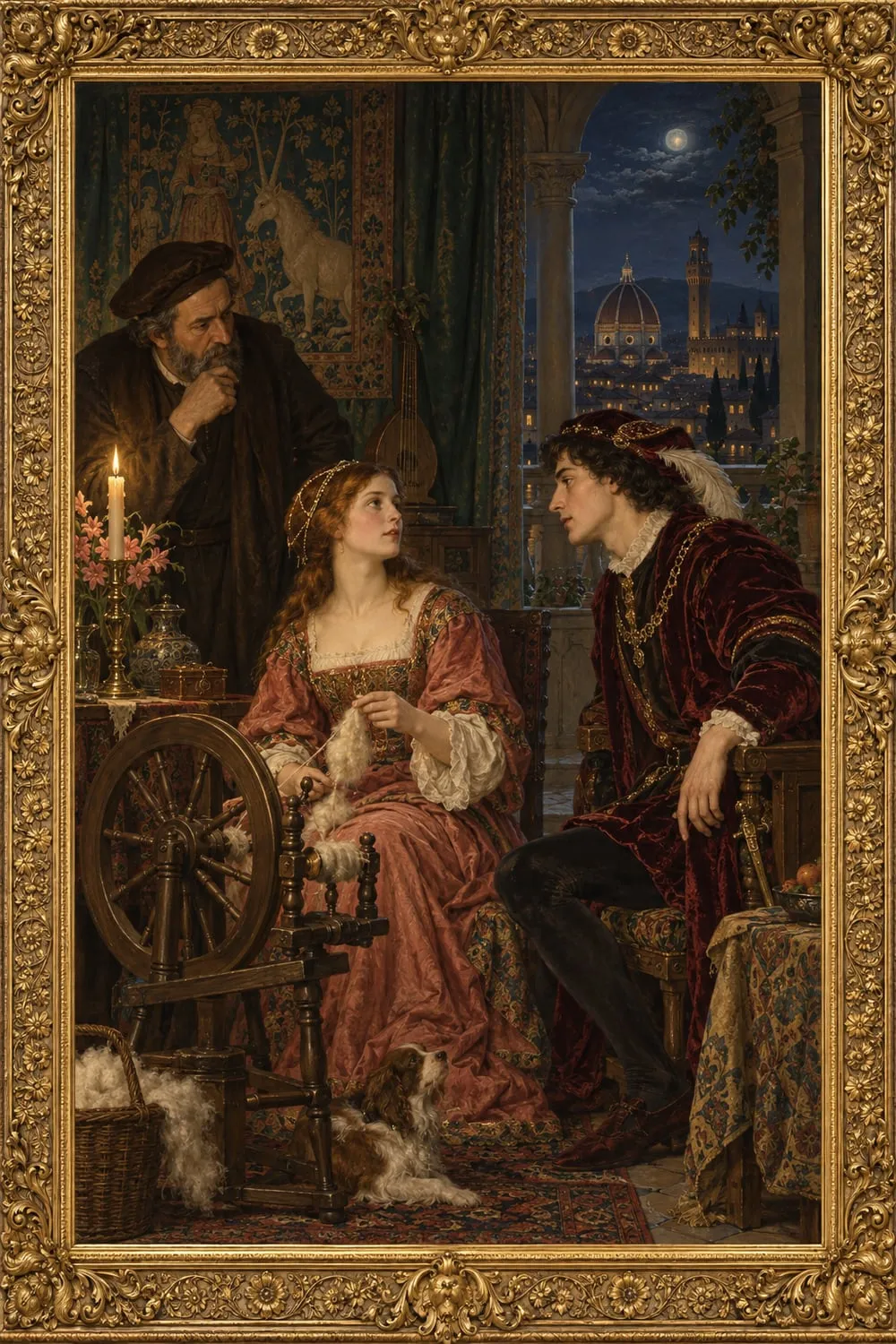
In a tapestried upper room of an old house in Florence, Bianca hears from her servant Maria how the young lord Guido Bardi received her in his palace and asked what sum would buy him Bianca's favour. Maria told him her mistress loved neither her husband nor any man, but might like to be loved. Guido asked to call that night and for Bianca to throw down a favour when he passed. He is in the street below; Bianca throws down a ribbon weighted with a brooch and has Maria let him in. This opening scene is by T. Sturge Moore.
Bianca pretends Guido has come to buy a Lucca damask, and when he says he wants to buy her she answers that she has already been bought and sold once, in marriage, by a husband who spoke to her father of gold. Guido praises her wit and beauty, proposes that they sup together with the moon, and begs her to leave her dismal life and live with him among the roses at Bellosguardo or Fiesole. They trade definitions of love. A sound on the stair interrupts them, and her husband enters.
Wilde's text begins here. Simone, home from a day's trading, affects to take Guido for a kinsman, then, learning his name, welcomes the son of the great Lord of Florence with a stream of flattery. He assumes Guido has come to buy, and makes Bianca kneel to open his pack. He praises a Lucca damask, then a robe of state woven with pearls and fastened with a ruby brooch finer than any Cellini made. Guido promises to send his steward, Antonio Costa, with a hundred thousand crowns, and Simone, dazzled, swears that his house and everything in it is Guido's. Guido asks what he would say if he asked for Bianca. Simone calls it a jest and orders his wife to her spinning, talking of Lucretia, who was found by Tarquin at her distaff, and of husbands that wear horns.
Simone rambles on about English merchants underselling wool at Pisa and the Pope calling the King of France into Italy, then says that the whole world has shrunk to this room and three souls. Bianca tells Guido she hates her husband, soul and body, and wishes Death would take him where he stands. Simone turns round at the word and speaks darkly of wives who betray their husbands. He begs Guido to play his lute, and when he refuses, has Bianca bar the shutters, notices a wine stain like a wound on the cloth, and says he cannot eat or drink. Guido and Bianca arrange to meet at dawn by a silk ladder from the balcony.
As Guido prepares to go, Simone detains him, reminds him that he is his father's only child, whose cousins envy his inheritance, and fetches his cloak and sword. Admiring the blade, he recalls how he once slit the throat of a robber who tried to take his pack-horse, and says that a man who steals what is his dies for it. He asks Guido to test his sword against his own. Guido agrees. Bianca holds the torch and whispers to Guido, 'Oh! kill him, kill him!'
Guido wounds Simone in the arm. Simone makes light of it, has Bianca bind the cut, then tears off the bandage and disarms Guido. He proposes daggers, has Bianca put out the torch, and in the dark overpowers the prince and throws him down across the table. Guido pleads that he is the State's only heir, begs for a priest and calls on Bianca to help him; she does nothing. Simone strangles him and says, 'Now for the other.'
He rises and looks at his wife. Bianca comes towards him with outstretched arms, dazed with wonder, and asks why he never told her he was so strong. Simone asks why she never told him she was beautiful, and kisses her on the mouth.