Themes
Love as a bargain
Everything in this house has a price. In the opening scene Guido offers a purse for Bianca's favour, and she tells him that in her marriage she has already been 'in a market bought and sold'. In Wilde's part Simone turns every exchange into trade: he sells Guido damask and a robe of state, swears that his house and 'everything my house contains' belongs to the buyer, and hears Guido ask for Bianca as though she were one more item. His great speech sums it up: 'How poor a bargain is this life of man'.
Hidden strength
Simone seems a fussy, timid tradesman, and both lovers despise him for it. Bianca sees 'Cowardice' on his brow and shaking hands; Guido calls him 'so eloquent a fool'. But Simone is playing a part. His talk of Lucretia and faithless wives, the barred shutters and the story of the robber whose throat he slit on the road to Padua show that he knows exactly what is happening. When he disarms the prince, the true man appears, and Bianca asks, 'Why Did you not tell me you were so strong?'
Prince and merchant
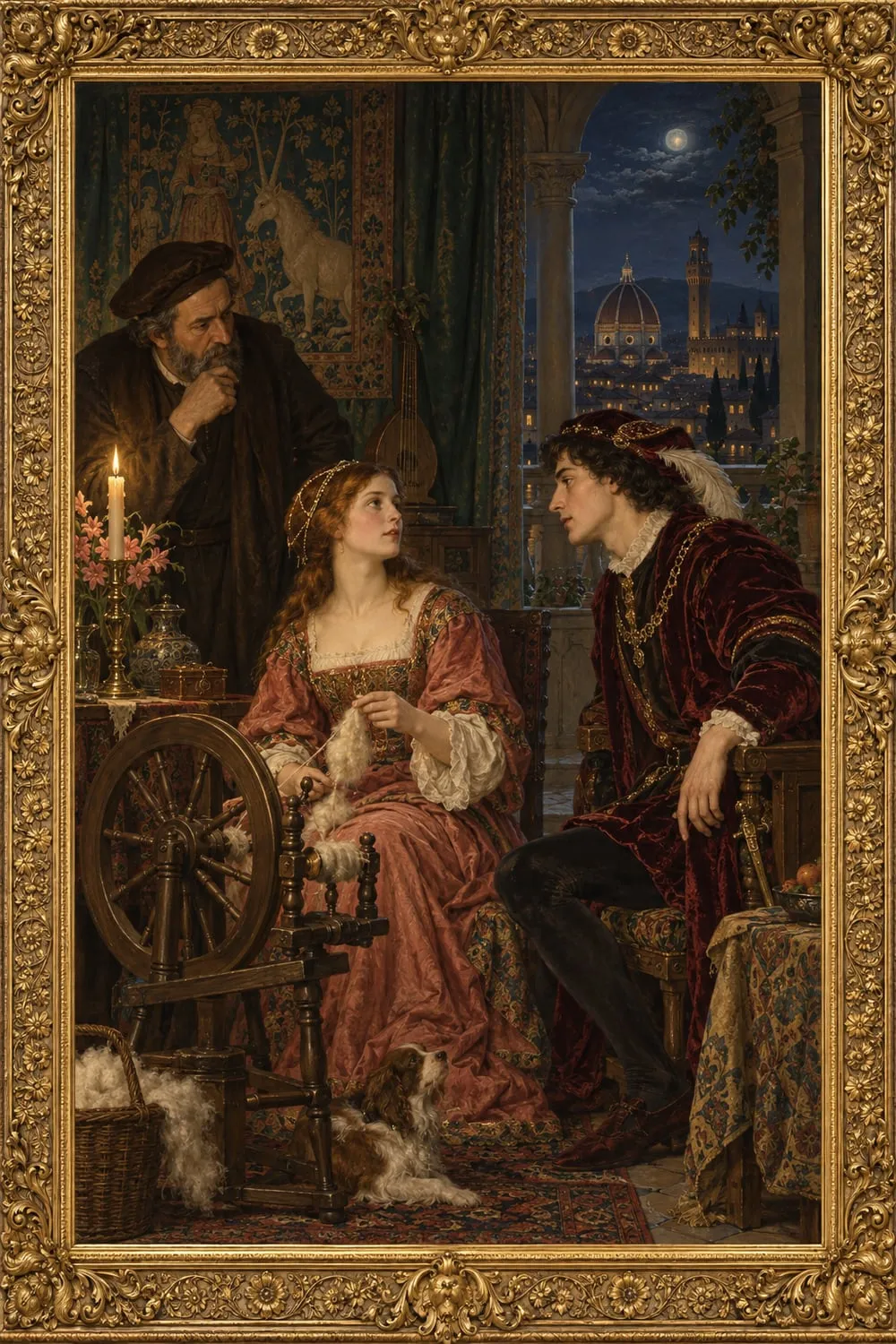
Guido is the heir of the great Lord of Florence, with a steward, a lute and a sword of Ferrara steel; Simone is a burgher who counts the cost of every ell. The play sets their worlds against each other. Guido scorns 'Wool-selling or wool-gathering' and has no interest in merchants' profits, while Simone flatters him as a prince who stoops to visit a burgher's house. The duel settles 'Whether the Prince's or the merchant's steel Is better tempered', and the merchant wins.
Omens of death
Wilde fills the evening with warnings. Simone's horse stumbled three times on the ride home, 'an omen That bodes not good to any'. He sees a wine stain on the cloth 'As purple as a wound upon Christ's side' and recalls that when wine is spilt blood is spilt also. When Bianca wishes Death would take him, he turns and asks 'Who spake of Death?', and his talk of spinning a sheet to wrap a dead man shows where his thoughts are going.
Violence and desire
The ending turns the story inside out. Bianca, who dreamed of escaping with the young prince, watches him die without lifting a hand, although he calls on her by name. Simone, who has just said 'Now for the other', does not kill her. Seeing her husband's strength, Bianca wants him for the first time, and seeing her at last, Simone finds her beautiful. Desire in this play is awakened by violence, not by the lute and fine speeches of the lover.