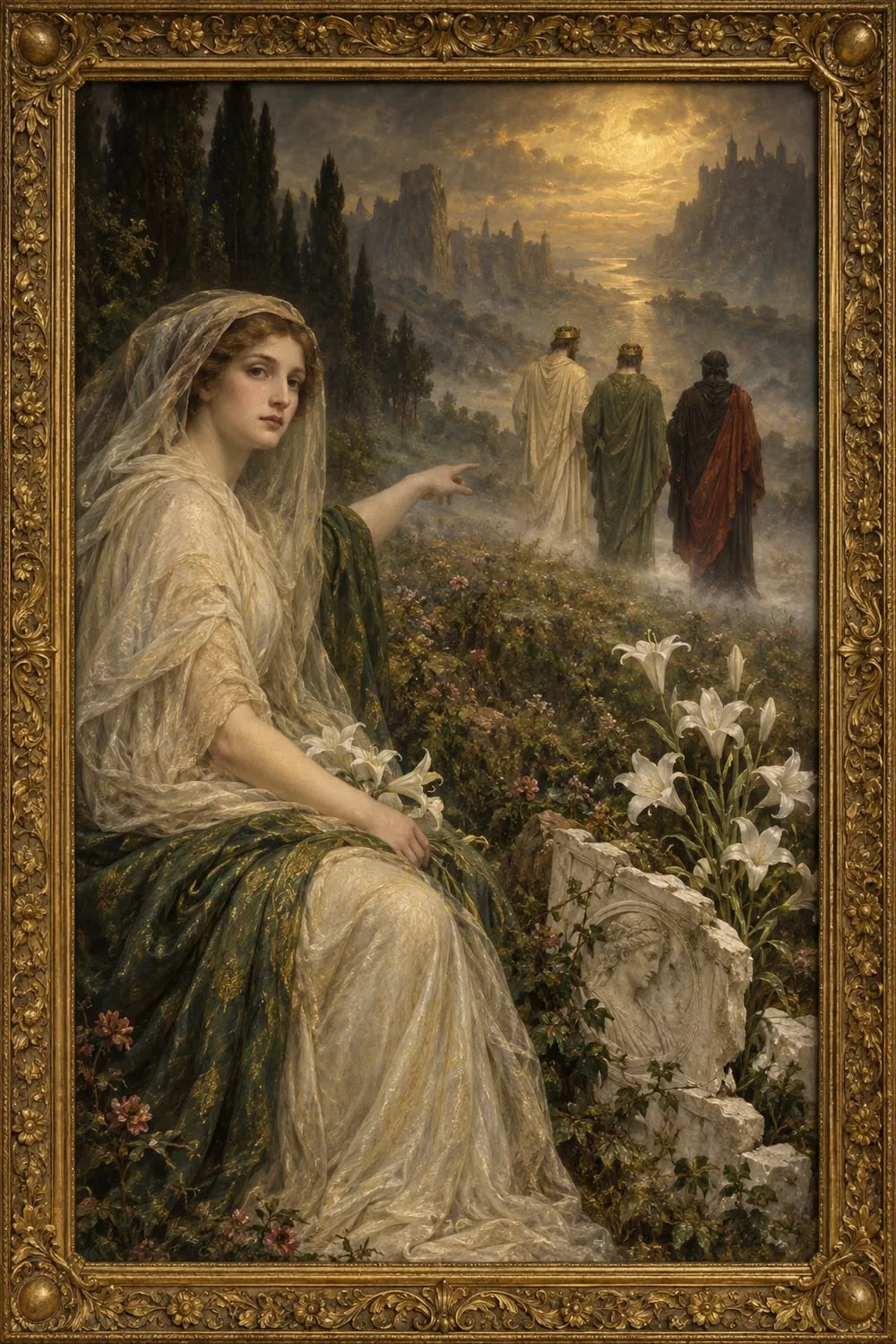
Three tragedians in a dream
A Vision
"And last (wide stream of tears!) Euripides."
Poem
Two crownèd Kings, and One that stood aloneWith no green weight of laurels round his head,But with sad eyes as one uncomforted,And wearied with man’s never-ceasing moanFor sins no bleating victim can atone,And sweet long lips with tears and kisses fed.Girt was he in a garment black and red,And at his feet I marked a broken stoneWhich sent up lilies, dove-like, to his knees.Now at their sight, my heart being lit with flame,I cried to Beatricé, “Who are these?”And she made answer, knowing well each name,“Aeschylos first, the second Sophokles,And last (wide stream of tears!) Euripides.”
In brief
SummaryA sonnet cast as a dream vision in the manner of Dante. The speaker sees two crowned kings and a third figure standing alone, uncrowned, with sad eyes, worn out by mankind's endless grief, dressed in black and red, with lilies rising from a broken stone at his feet. Moved, he asks his guide Beatrice who they are. She names them: Aeschylos and Sophokles, the crowned kings, and last, with 'wide stream of tears', Euripides, the lonely and sorrowful third.
Key themes
"Two crownèd Kings, and One that stood alone"
Summary
The speaker sees 'Two crownèd Kings, and One that stood alone' without any 'green weight of laurels round his head'. This third figure has 'sad eyes as one uncomforted', is weary of 'man's never-ceasing moan / For sins no bleating victim can atone', and has 'sweet long lips with tears and kisses fed'. He wears 'a garment black and red', and at his feet a broken stone sends up lilies 'dove-like, to his knees'.
His heart 'lit with flame', the speaker cries to 'Beatricé', 'Who are these?' She knows every name and answers: 'Aeschylos first, the second Sophokles, / And last (wide stream of tears!) Euripides.' The whole sonnet builds towards that final name, and the bracketed cry of tears marks Euripides as the poet of human sorrow.
Characters
Euripides
The uncrowned mourner
The third figure, standing 'alone' without laurels, with sad eyes and 'sweet long lips with tears and kisses fed', dressed in black and red. Lilies rise from a broken stone at his feet. Beatrice names him last, with the cry 'wide stream of tears!'
Aeschylos and Sophokles
The two crowned kings
The first two figures in the vision, described only as 'Two crownèd Kings'. Beatrice names them 'Aeschylos first, the second Sophokles'. Their crowns contrast with the bare head of Euripides, who receives nearly all the poem's attention.
Beatricé
The speaker's guide
The guide to whom the speaker cries 'Who are these?', 'knowing well each name'. Her name recalls Beatrice, Dante's guide in the Divine Comedy, and casts the speaker as a Dante figure being shown the great dead.
The speaker
The dreamer
The one who sees the vision, notices every detail of the lonely third figure, and asks, with his 'heart being lit with flame', who the three are. He narrates the scene and lets Beatrice speak its final names.
Themes
The poet of sorrow
The two crowned kings get a single phrase; the uncrowned third gets almost the whole octave. He is 'uncomforted', wearied by 'man's never-ceasing moan', and his lips are 'with tears and kisses fed'. When Beatrice names him, the aside '(wide stream of tears!)' breaks into her line. The poem honours Euripides as the tragedian who felt human suffering most deeply.
Honour and neglect
Aeschylos and Sophokles are 'crownèd Kings', while Euripides stands 'alone / With no green weight of laurels round his head'. The poem sets public glory against private grief, and gives its sympathy to the figure without the wreath. The broken stone that sends up lilies 'dove-like, to his knees' suggests a reward that crowns cannot give.
A sacred likeness
The picture of Euripides borrows religious imagery. He grieves for 'sins no bleating victim can atone', sins that no animal sacrifice can pay for, and lilies and a dove-like rising spring from a broken stone. His 'garment black and red' and his sorrow for mankind make the Greek poet into something close to a suffering saviour.
Context
'A Vision' appears in the 'Flowers of Gold' section of Wilde's collected poems. It is a sonnet framed as a Dantean dream: the speaker questions 'Beatricé', echoing Beatrice, Dante's guide through Paradise. The three figures are the Athenian writers of tragedy, given in Greek-style spellings, Aeschylos and Sophokles, with Euripides saved for the last line.
About this edition
- Text: the complete work from Standard Ebooks, released into the public domain (CC0 1.0). We change only the layout.
- Download the EPUB of the whole book it comes from, free, for any e-reader.
- Every quotation and glossary word in these notes is checked against the text.