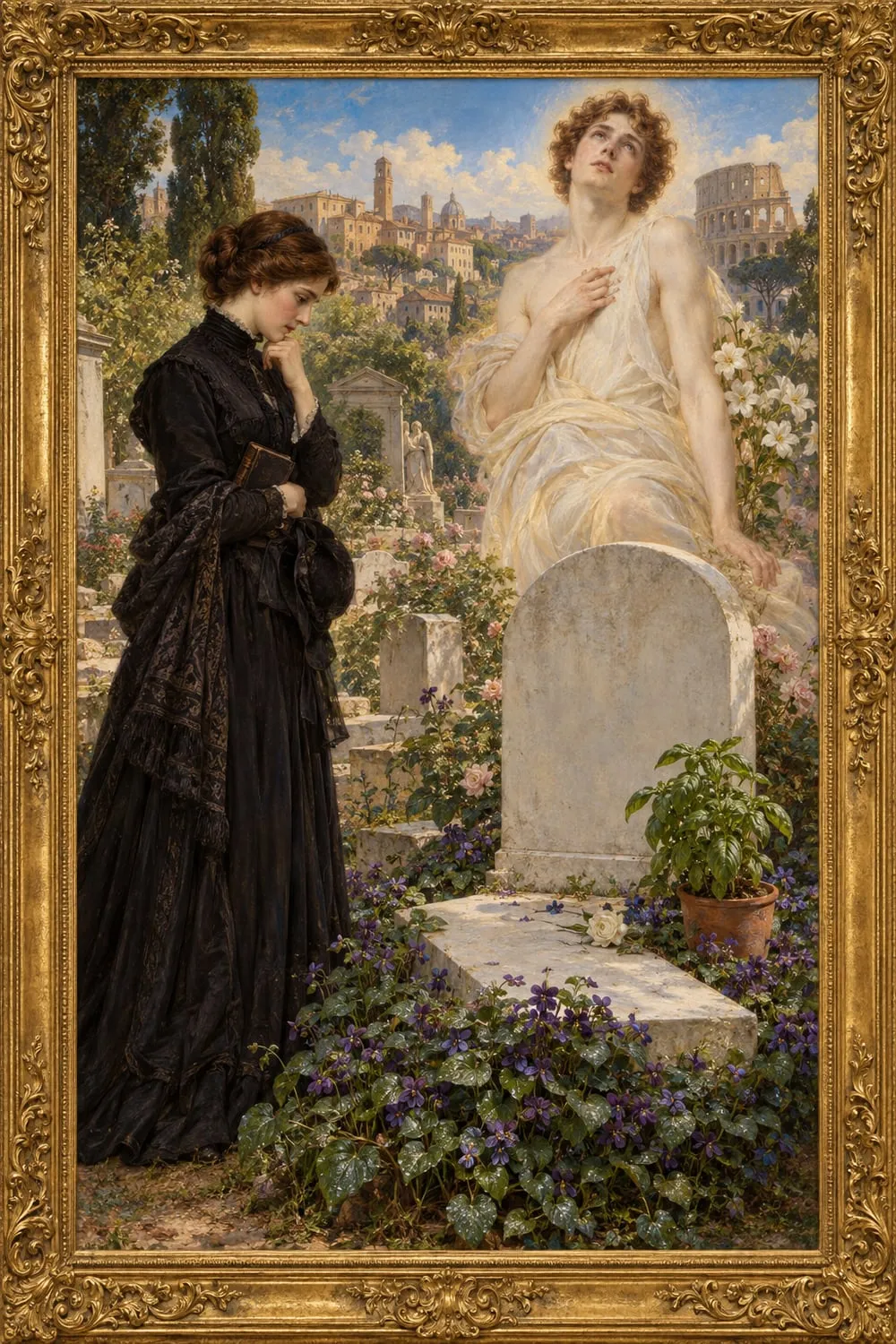
Violets on a young poet's grave
The Grave of Keats
"O proudest heart that broke for misery!"
Poem
Rid of the world’s injustice, and his pain,He rests at last beneath God’s veil of blue:Taken from life when life and love were newThe youngest of the martyrs here is lain,Fair as Sebastian, and as early slain.No cypress shades his grave, no funeral yew,But gentle violets weeping with the dewWeave on his bones an ever-blossoming chain.O proudest heart that broke for misery!O sweetest lips since those of Mitylene!O poet-painter of our English Land!Thy name was writ in water—it shall stand:And tears like mine will keep thy memory green,As Isabella did her Basil-tree.
Rome.
In brief
SummaryThe speaker stands at Keats's grave in Rome. Free now of the world's injustice, the poet rests under a blue sky, 'The youngest of the martyrs', as beautiful as Saint Sebastian and killed as young. No cypress or yew shades him, only violets wet with dew. The last six lines break into praise of his proud heart, his sweet lips and his gifts as a 'poet-painter'. Answering the epitaph that says his name was 'writ in water', the speaker promises that it will last, kept green by tears, as Isabella kept her basil plant.
Key themes
"Fair as Sebastian, and as early slain."

Summary
The first eight lines describe the grave. Keats, 'Rid of the world's injustice, and his pain', 'rests at last beneath God's veil of blue'. Taken from life 'when life and love were new', he is 'The youngest of the martyrs', 'Fair as Sebastian, and as early slain'. There is 'No cypress' and 'no funeral yew' over him; instead 'gentle violets weeping with the dew' weave on his bones 'an ever-blossoming chain'.
The last six lines are a series of cries. 'O proudest heart that broke for misery!' 'O sweetest lips since those of Mitylene!' 'O poet-painter of our English Land!' The speaker then takes up the words of Keats's own epitaph, that his name was 'writ in water', and contradicts them: 'it shall stand'. Tears like the speaker's will keep his memory green, 'As Isabella did her Basil-tree', the plant watered with tears in Keats's poem Isabella. The word Rome at the foot places the speaker at the graveside.
Characters
The speaker
The mourner at the grave
A visitor to Keats's grave in Rome who grieves for him as a martyr and a poet. He praises Keats's heart, lips and art, and vows that his own tears will keep the dead poet's memory green.
Keats
The poet in the grave
The English poet John Keats, named only in the title, who lies 'beneath God's veil of blue' with violets growing over him. The speaker calls him 'The youngest of the martyrs', the 'poet-painter of our English Land', whose heart 'broke for misery'.
Themes
The poet as martyr
The speaker treats Keats as a saint who died for his art. He is 'The youngest of the martyrs', compared to Saint Sebastian, the young martyr pierced with arrows, and freed at last from 'the world's injustice'. The 'proudest heart that broke for misery' suggests he was killed by suffering and neglect. The sonnet lifts a poet's early death into the language of sacrifice.
Memory that outlasts death
The poem answers Keats's own despairing epitaph. His grave says his name was 'writ in water'; the speaker replies 'it shall stand'. Memory is kept alive by grief: 'tears like mine will keep thy memory green'. The final image, from Keats's poem, of Isabella tending her basil with tears, makes mourning a kind of gardening, just as violets 'Weave on his bones an ever-blossoming chain'.
Youth and beauty cut off
Keats is 'Taken from life when life and love were new' and 'as early slain' as Sebastian. The speaker praises beauty of body as well as of mind, calling his the 'sweetest lips since those of Mitylene', the city of Sappho. His early death keeps him young for ever, and his grave is marked not by dark cypress but by living violets.
Context
The Grave of Keats is a sonnet in the Flowers of Gold group of Wilde's Poems (1881), with the word Rome printed at its foot. John Keats died in Rome in 1821 and is buried in the city's Protestant Cemetery under a stone describing him as one 'whose name was writ in water'. The last line recalls his poem Isabella, in which a grieving woman waters a pot of basil with her tears. Wilde also wrote of the grave in a prose piece, The Tomb of Keats, published in the Irish Monthly in 1877.
About this edition
- Text: the complete work from Standard Ebooks, released into the public domain (CC0 1.0). We change only the layout.
- Download the EPUB of the whole book it comes from, free, for any e-reader.
- Every quotation and glossary word in these notes is checked against the text.