Summary
A note explains that the lecture is pieced together from manuscript fragments, some written in Philadelphia in 1882. Wilde begins by denying any opposition between the beautiful and the useful: 'There is no opposition to beauty except ugliness.' Poor designs attract only poor workmen, noble designs bring men who work with heart and head. Beauty is a necessity of life, not an ornament to be taken or left, and commerce is no enemy to it, since Genoa, Florence and Venice were built by traders, bankers and merchants. The art America needs must suit modern American life, not revive the thirteenth century.
Machinery, Wilde says, is to be revered when it frees men from ignoble labour, but machine-made ornament is worthless. The telephone is only as good as what is said down it; a train that rushes a tourist through Italy does little good, while the engines that carried help to burning Chicago were as beautiful as angels. Workmen need stately architecture, bright dress and a school of design in each city, filled with the best examples of world art. There they should learn that beautiful colours are graduated colours, that the true designer thinks in colour, and that good design fills a limited space so completely that nothing can be added or taken away, as a Japanese artist fills a fan with one spray of leaves and a bird.
Design must suit its material and use: Wilde mocks the young ladies he saw painting moonlight landscapes on dishes and sunsets on dinner-plates, and says schools of art should be local, as every Italian city had its own. Great art needs clean air, healthy people and individualism, which is why it came from republics like Athens, Venice and Florence and not from the gilt furniture of Louis XIV. The aim is not for the rich to possess more beautiful things but for the poor to create them. A sculptor who complains of frock-coats should watch dockers, athletes, reapers and cattle-drivers.
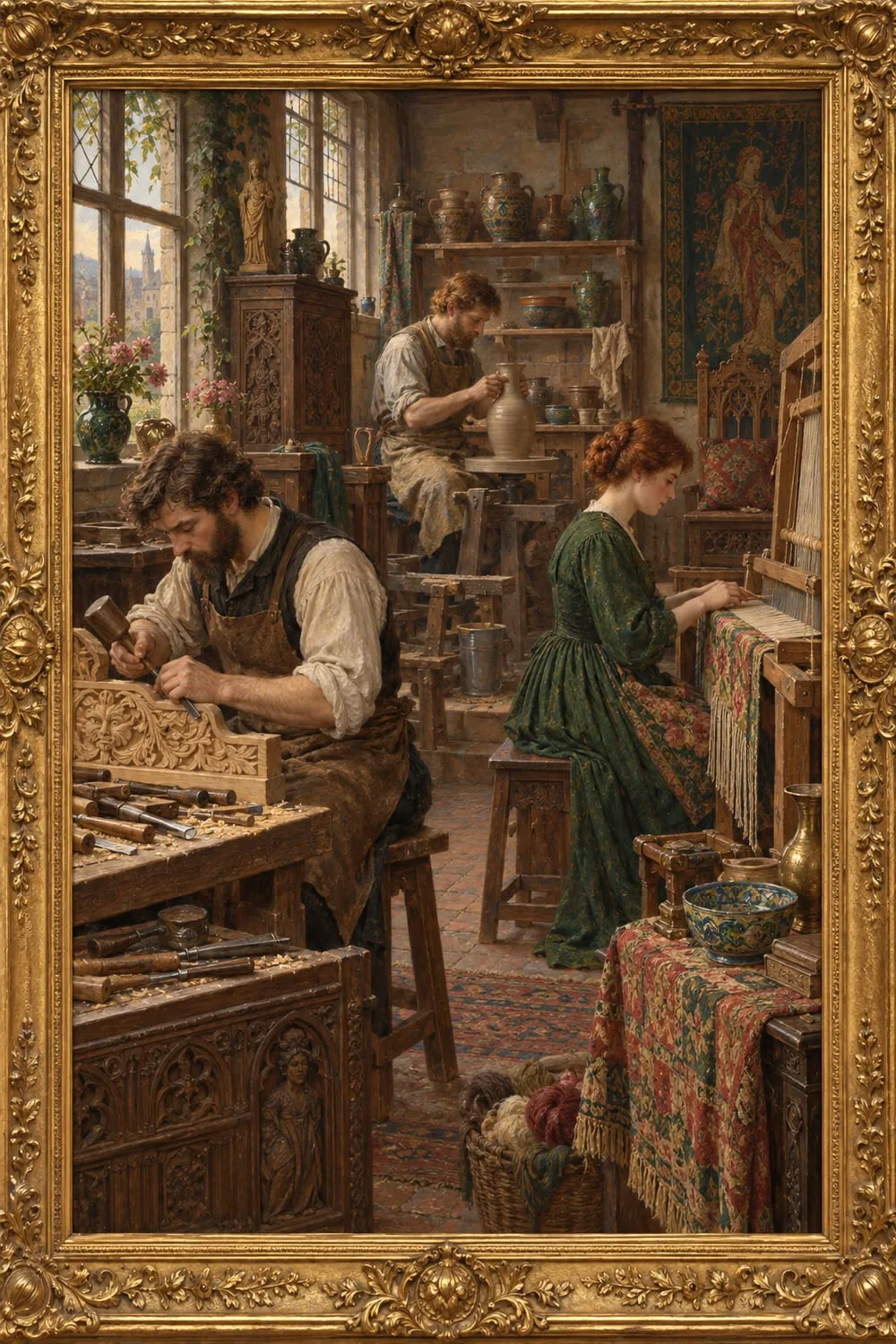
The English movement, he claims, was the first to reunite the handicraftsman and the artist: the Greek potter taught the sculptor restraint, and the Venetian decorator of chests taught the painter colour, so all the arts are decorative. Americans should absorb the spirit of other nations but copy nothing, carving buffalo and wild deer rather than lions and dragons, and using golden rod and aster. Their marble should be carved, filled with sculpture or inlaid, or else they should build in plain red brick; a long passage from Ruskin's Seven Lamps of Architecture praises the natural colours of stone. American gold deserves goldsmiths like Ghiberti, whose gates Michael Angelo called worthy of Paradise.
Wilde attacks the newspapers, which judge a sculptor by how he treats his wife and a poet by his neck-tie, and jokes that critics belong among the criminal classes. Knowing he is known in America as a young man trying to live up to his blue china, he tells how the movement began: Ruskin persuaded a group of Oxford undergraduates to build a road across a swamp between Upper and Lower Hinksey, and when Ruskin left for Venice the road ended in the middle of the swamp. From those young men Wilde formed an artistic movement. He urges each listener to practise some art, quotes Emerson on manual work, and ends with Concord and Longfellow: art is the one thing Death cannot harm.