Themes
Beauty and utility
The lecture opens by denying that beauty and use are opposed: 'There is no opposition to beauty except ugliness', and good decoration always expresses 'the use you put a thing to'. The same idea governs the sections on machinery, where 'all good machinery is graceful', since 'the line of strength and the line of beauty' are one, and on design, where the use of a dish should forbid painting a harrowing sunset on it. For Wilde, the useless and the ugly go together, like the idle loafer who is uninteresting to the artist.
Machinery as means, not end
Wilde is careful to say the movement does not hate machines: 'we reverence it when it does its proper work, when it relieves man from ignoble and soulless labour.' What he rejects is machine-made ornament and the confusion of 'the means of civilisation' with its end. The telephone and the train are measured by how they are used: slander shrieked down a tube is no gain, but the engines that carried relief to burning Chicago were as noble as 'any golden troop of angels'.
Artist and craftsman reunited
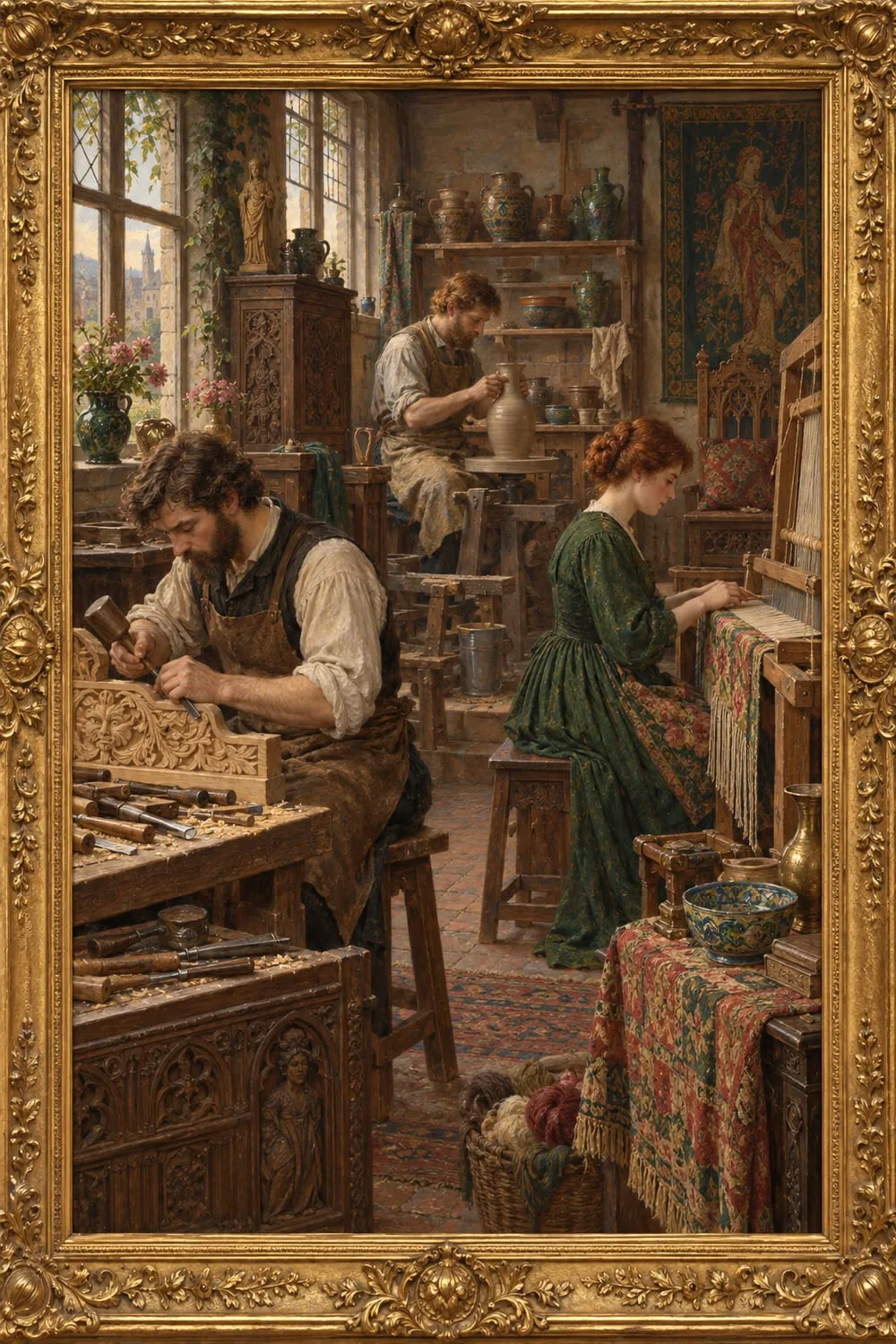
Wilde claims the English movement was the first to bring 'the handicraftsman and the artist together', warning that separating them robs the one of 'spiritual motive' and the other of technical perfection. He finds the proof in history: the Greek potter taught the Parthenon sculptors restraint, the Italian decorator of chests kept Venetian painting true to colour, and Michael Angelo and Tintoret, 'the dyer's son', both made their greatest works as decoration. Hence his plea for the goldsmith to be sought out and honoured.
An American art for Americans
Wilde repeatedly tells his audience to look at their own country. Copy no nation, Greek or Japanese: 'Let the Greek carve his lions and the Goth his dragons: buffalo and wild deer are the animals for you.' Golden rod and aster should be their flowers, their own men and women their subjects, and their marble and gold should become art rather than 'barren speculation'. Even schools of design should belong to particular cities, as every Italian town once had its own school.
Labour and the Hinksey road
The most personal passage explains why an aesthete talks about labour. Wilde recalls Ruskin, one summer afternoon in Oxford, urging undergraduates to spend their strength on something useful instead of rowing and cricket. They spent two months breaking stones and wheeling barrows to build a road across the swamp at Hinksey, mocked from the bank, until Ruskin left and the road stopped in the middle of the swamp. From that spirit, Wilde says, came the artistic movement he now describes.