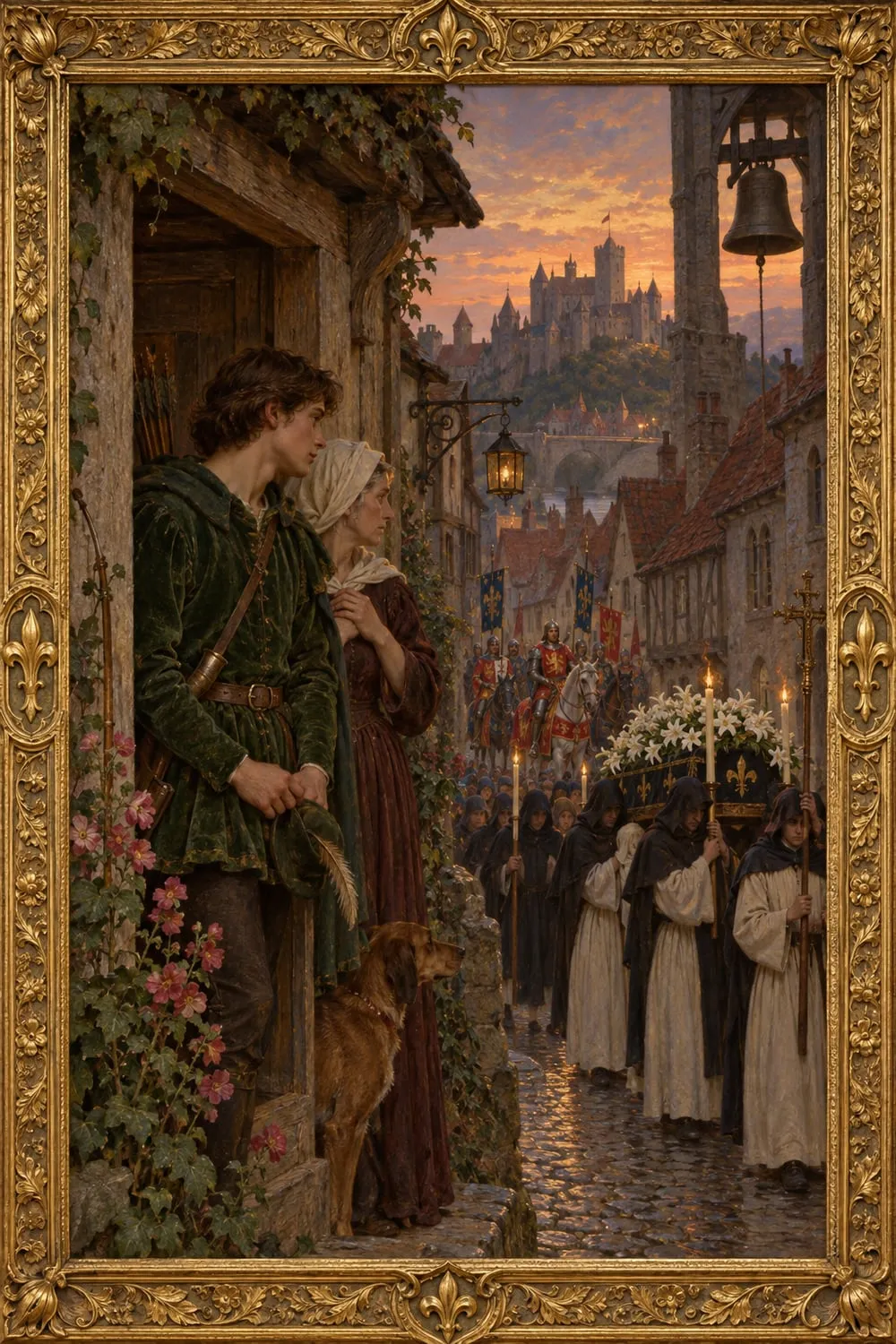
A forester's son and a dead lady
Ballade de Marguerite
"O mother, hath one grave room for two?"
Poem
(Normande)
I am weary of lying within the chaseWhen the knights are meeting in market-place.
Nay, go not thou to the red-roofed townLest the hoofs of the war-horse tread thee down.
But I would not go where the Squires ride,I would only walk by my Lady’s side.
Alack! and alack! thou art overbold,A Forester’s son may not eat off gold.
Will she love me the less that my Father is seenEach Martinmas day in a doublet green?
Perchance she is sewing at tapestrie,Spindle and loom are not meet for thee.
Ah, if she is working the arras brightI might ravel the threads by the fire-light.
Perchance she is hunting of the deer,How could you follow o’er hill and mere?
Ah, if she is riding with the court,I might run beside her and wind the morte.
Perchance she is kneeling in St. Denys,(On her soul may our Lady have gramercy!)
Ah, if she is praying in lone chapelle,I might swing the censer and ring the bell.
Come in, my son, for you look sae pale,The father shall fill thee a stoup of ale.
But who are these knights in bright array?Is it a pageant the rich folks play?
’Tis the King of England from over sea,Who has come unto visit our fair countrie.
But why does the curfew toll sae low?And why do the mourners walk a-row?
O ’tis Hugh of Amiens my sister’s sonWho is lying stark, for his day is done.
Nay, nay, for I see white lilies clear,It is no strong man who lies on the bier.
O ’tis old Dame Jeannette that kept the hall,I knew she would die at the autumn fall.
Dame Jeannette had not that gold-brown hair,Old Jeannette was not a maiden fair.
O ’tis none of our kith and none of our kin,(Her soul may our Lady assoil from sin!)
But I hear the boy’s voice chaunting sweet,“Elle est morte, la Marguerite.”
Come in, my son, and lie on the bed,And let the dead folk bury their dead.
O mother, you know I loved her true:O mother, hath one grave room for two?
In brief
SummaryA forester's son tells his mother he is weary of the woods and wants to go to town, not to see the knights but to walk beside his Lady. His mother warns him that a poor man's son cannot aspire so high, and for each place she imagines the Lady might be, he names some humble service he could do her there. Then a procession passes, with a tolling curfew and mourners, and the mother tries to hide whose funeral it is. A boy's song gives it away: Marguerite is dead, and her lover asks whether one grave has room for two.
Key themes
"A Forester's son may not eat off gold."
Summary
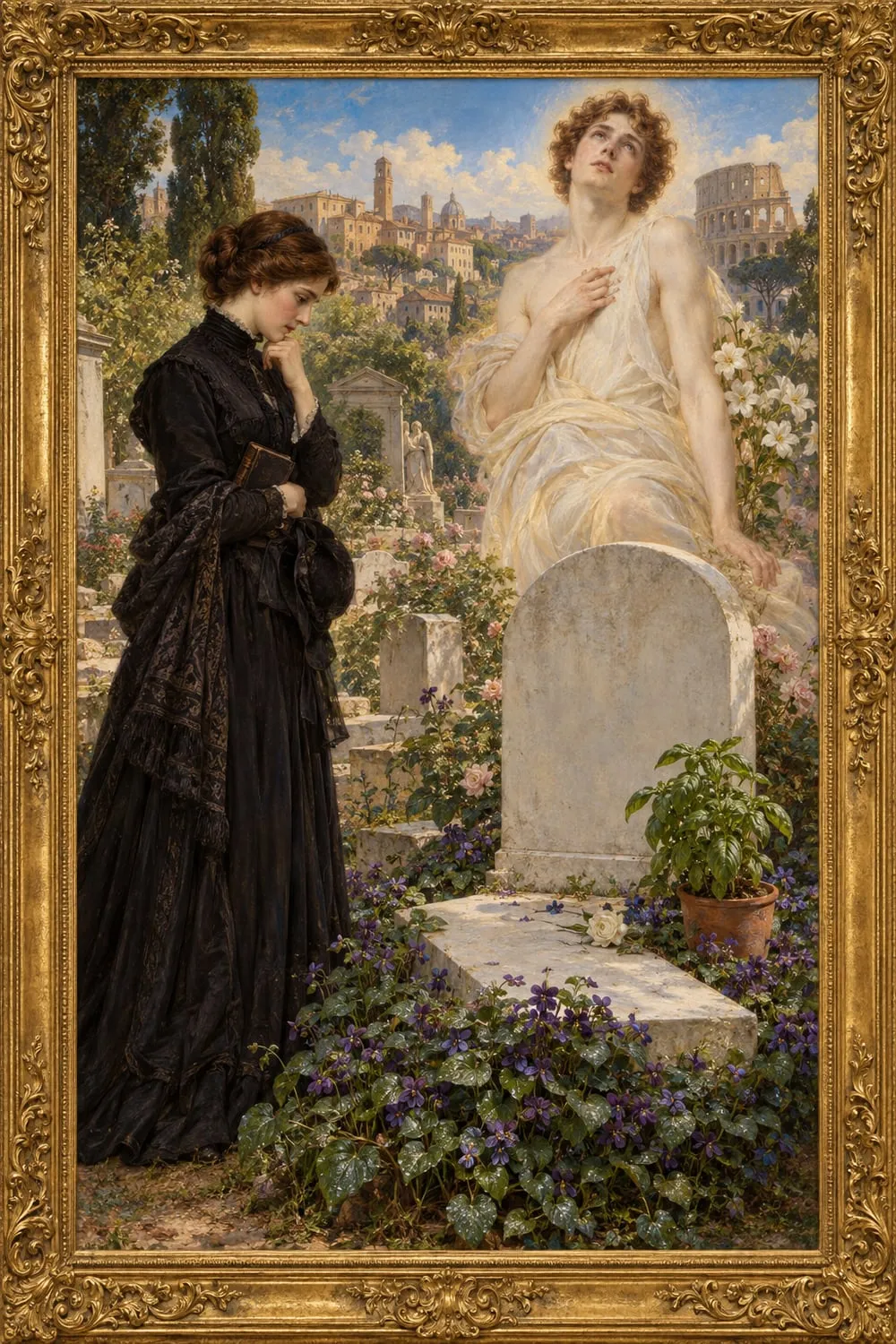
The poem is a dialogue in couplets between a young man and his mother. He is 'weary of lying within the chase' while the knights meet in the market-place; she tells him not to go to 'the red-roofed town' in case a war-horse tramples him. He answers that he only wants to 'walk by my Lady's side', and she reminds him that 'A Forester's son may not eat off gold'. He asks whether the Lady will love him less because his father wears a green doublet every Martinmas.
The mother then imagines where the Lady might be, and he answers each time with a way to serve her. If she is sewing, he could unravel the threads by the fire; if she is hunting, he could run beside her horse and 'wind the morte'; if she is praying in chapel, he could swing the censer and ring the bell. When the mother pictures her kneeling in St. Denys, she adds a prayer for the Lady's soul.
Now the mother calls him in, looking pale, for a cup of ale. He sees knights in bright array, and she says it is the King of England visiting. He hears the curfew toll and sees mourners; she claims the dead is her sister's son, Hugh of Amiens, then old Dame Jeannette. He sees through each lie: there are white lilies on the bier, and the dead woman has 'gold-brown hair'. When a boy sings 'Elle est morte, la Marguerite' (Marguerite is dead), his mother tells him to lie down and 'let the dead folk bury their dead'. He asks her whether one grave has room for two.
Characters
The forester's son
The humble lover
A young man tired of the woods, in love with a lady far above his station. He asks nothing of her except to be near her, imagining small services he could do. He sees through each of his mother's lies about the funeral, and at the end asks whether he may share Marguerite's grave.
The mother
The protective voice
The son's mother, who answers every couplet he speaks. She warns him against going to town and against loving above himself, then tries to hide the Lady's death by naming the King of England, Hugh of Amiens and Dame Jeannette. At the end she can only tell him to lie down.
Marguerite
The Lady on the bier
The son's 'Lady', never seen alive, whose name is given only by the boy's song, 'Elle est morte, la Marguerite'. Her funeral passes with white lilies on the bier, and her 'gold-brown hair' shows the son that the dead woman is a young maiden and not an old servant.
Themes
Love across rank
The son loves a lady far above him, and his mother keeps reminding him of it: 'thou art overbold, / A Forester's son may not eat off gold'. He asks whether the Lady will love him less because his father wears 'a doublet green', and his dreams of her are all of service, not of equality: ravelling her threads, running beside her horse, ringing the bell while she prays. His love never needs to be answered to be complete.
Truth told slowly
The mother tries to shield her son with a string of evasions: the knights are the King of England, the dead is 'Hugh of Amiens', then 'old Dame Jeannette', then 'none of our kith and none of our kin'. Each time he reads the signs better than she wants: 'white lilies' mean no strong man lies on the bier, and 'gold-brown hair' cannot belong to an old servant. A child's song finally speaks the truth she will not say.
Love and death joined
Death shadows the poem before it is announced. The mother's aside when she imagines the Lady at prayer, 'On her soul may our Lady have gramercy!', already sounds like a prayer for the dead. The son's last question, 'hath one grave room for two?', answers his mother's command to 'let the dead folk bury their dead': he counts himself among the dead now that Marguerite is gone.
Quotes
"A Forester's son may not eat off gold."
The mother · Read in context
"Elle est morte, la Marguerite."
A boy's song · Read in context
"And let the dead folk bury their dead."
The mother · Read in context
Context
'Ballade de Marguerite' appears in the 'Flowers of Gold' section of Wilde's collected poems. Its subtitle, '(Normande)', marks it as Norman in manner, and it is written in the style of an old folk ballad: short rhyming couplets of question and answer between a mother and son, with old spellings such as 'sae' and 'chaunting', French words such as 'chapelle', and a refrain in French. The poem gives no author or source beyond that subtitle.
About this edition
- Text: the complete work from Standard Ebooks, released into the public domain (CC0 1.0). We change only the layout.
- Download the EPUB of the whole book it comes from, free, for any e-reader.
- Every quotation and glossary word in these notes is checked against the text.