Characters
Oscar Wilde
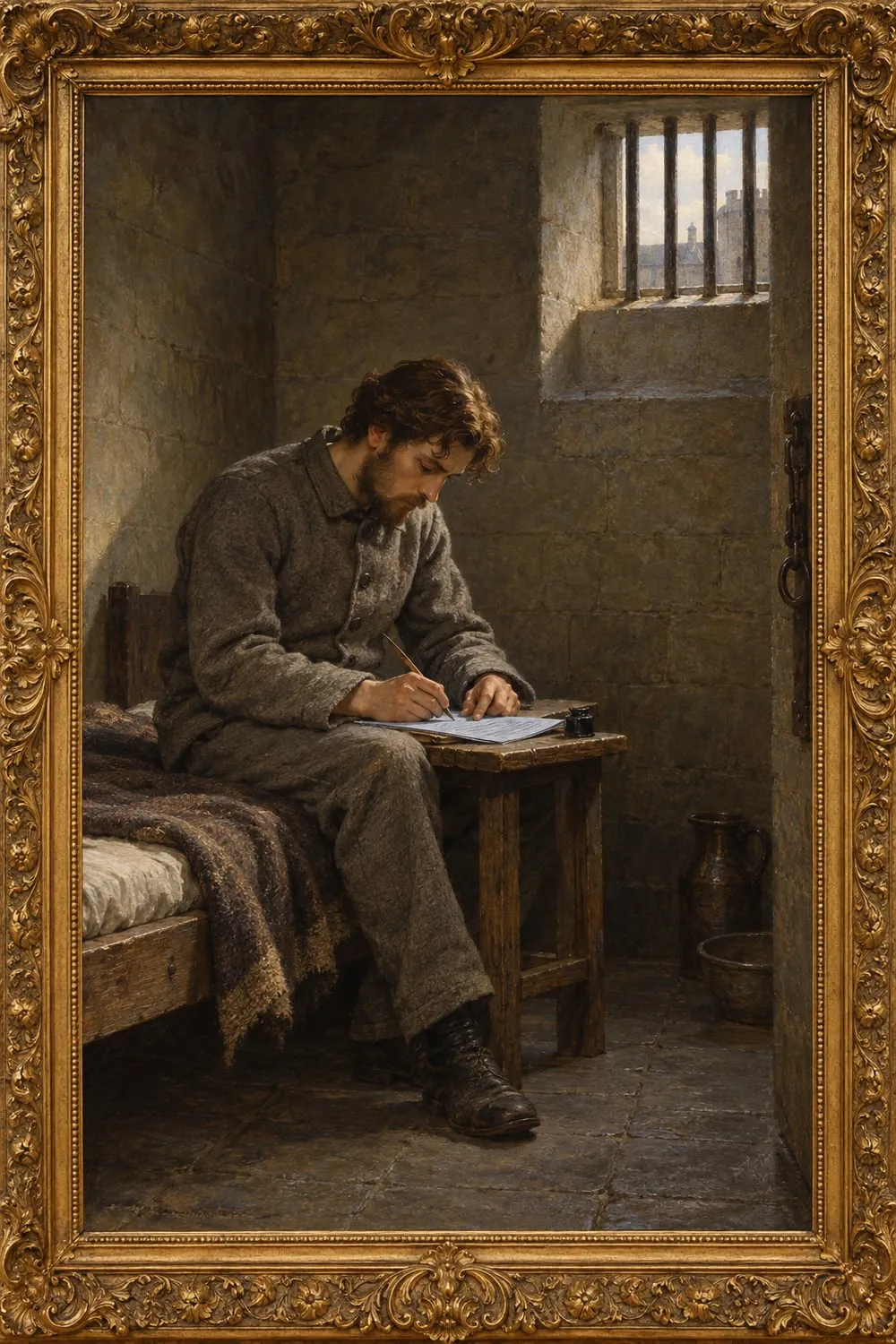
The prisoner writing
Wilde writes in the first person after nearly two years in prison. He presents himself as a man who once stood in symbolic relation to his age, then wasted his genius in pleasure and was ruined by his own hand. He has passed through despair, rage and a wish to die, and now seeks humility, happiness and a new life. He expects release at the end of May and hopes to write again.
The person addressed
The unnamed 'you'
The letter speaks throughout to an unnamed "you", for whom what Wilde suffers now is something "long ago forgotten", and who may find it strange that he chooses the artistic life and conduct as a subject. The abridged text never names this person or says who it is. The full letter from which these passages come was addressed to Lord Alfred Douglas.
Christ
The supreme individualist
Christ is the subject of the letter's longest passages. Wilde sees him as a poet whose nature rests on imagination, whose life is "the most wonderful of poems", and whose passion surpasses Greek tragedy. He is the first individualist in history, pities the rich more than the poor, loves the sinner, and makes of himself the image of the Man of Sorrows. Wilde calls him "the precursor of the romantic movement in life".
R---
The faithful friend
A friend identified only by the initial R---, generally taken to be Robert Ross, who later published this abridged text. Wilde writes that R--- will be waiting outside the prison gate on his release, as "the symbol" of his own affection and that of many others. Wilde saw him for an hour on a recent visit and tried to show his delight, and plans to go abroad to the sea with R--- and M--- after his release.
Wilde's mother
Grief and remembered wisdom
Wilde's mother dies while he is in prison, three months after his transfer. He writes that no one knew how deeply he loved and honoured her, and that he had disgraced the name she and his father had made noble. She "knew life as a whole" and used to quote Goethe's lines about eating bread in sorrow, whose truth he refused to accept when he was young.
Wilde's wife
Kindness in bad news
Wilde describes his wife as "always kind and gentle to me". Ill as she was, she travelled all the way from Genoa to England so that he would hear of his mother's death from her rather than from indifferent lips. She is mentioned only in this one passage.
The friend at the court
A silent act of love
An unnamed friend, whose name the text leaves blank, waited in the long corridor of the Court of Bankruptcy so that he could gravely raise his hat to Wilde as he passed, handcuffed, between two policemen. Wilde has never thanked him and does not know whether he realises it was noticed, but stores the act "in the treasure-house of my heart".
The woman of noble kindness
Beauty and sorrow together
An unnamed woman whom Wilde calls "one of the most beautiful personalities I have ever known", whose sympathy helped him bear his troubles simply by her being what she is. Once he told her that the suffering in one London lane proved God did not love man. She told him he was wrong, and he now agrees.
The friend of ten years
Friendship on true terms
A great friend of ten years' standing visits Wilde to say he believes him innocent and the victim of a hideous plot. Wilde bursts into tears and tells him that, although many charges were untrue, his life had been full of perverse pleasures, and that they cannot be friends unless he accepts this. The friend is shocked, but they remain friends.