Summary
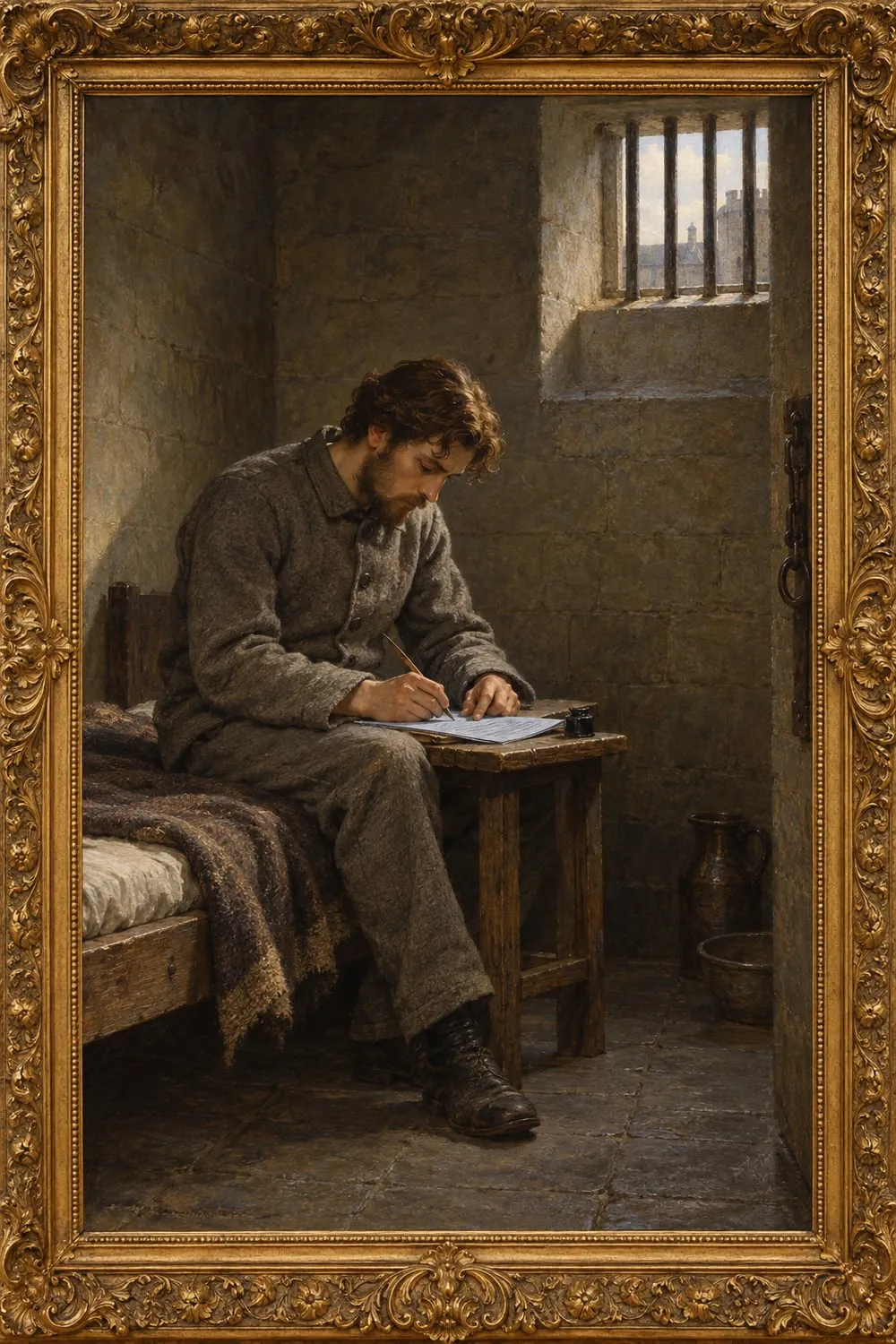
The text opens mid-letter. In prison, Wilde writes, suffering is "one very long moment": time revolves round one centre of pain, and it is always twilight in the cell. He writes so that "you", for whom these things are long forgotten, may understand. After his transfer his mother dies; he grieves that he has disgraced the name she and his father made noble, and his wife travels, ill, from Genoa to break the news to him herself. Sorrow, he says, is the most sensitive of all things, and "Where there is sorrow there is holy ground." He remembers a friend who waited in a corridor of the Court of Bankruptcy to raise his hat as Wilde passed, handcuffed, and he stores that silent act of love "in the treasure-house of my heart".
Wilde insists that he ruined himself. He once stood in symbolic relation to his age, more nobly than Byron, but amused himself as a dandy, surrounded himself with meaner minds, and went to the depths for new sensation until he was "no longer the captain of my soul". After every mood of suffering he has found Humility, the start of a Vita Nuova. He is penniless and homeless, but would rather beg than leave prison bitter; R--- will be waiting at the gate. Morality, religion and reason cannot help him. He must turn the plank bed, the oakum and the shame into spiritual experience, count prison with Oxford as a turning point of his life, and learn not to be ashamed of punishment. Society, shallow as it is, abandons a man just when its duty to him begins.
He must also learn to be happy. At Wandsworth he longed to die and later resolved to wear gloom as a king wears purple, but now he tries to be cheerful for visiting friends, and for the first time has a real desire for life. Sorrow is his new world. His mother used to quote Goethe's lines about eating bread in sorrow, which he refused to accept. He now sees sorrow as the type and test of all great art, because "Pain, unlike pleasure, wears no mask", and he admits that a woman of noble kindness was right when she told him that suffering does not prove God has no love for man. At Oxford he meant to eat the fruit of every tree in the garden, but kept to the sunlit side; he does not regret pleasure, and finds the other side foreshadowed in his own books.
The longest part of the letter is about Christ. Wilde sees an intimate link between the true life of Christ and the true life of the artist. Christ's nature rests on imagination; his place is with the poets, his life is the most wonderful of poems, and the last act of his passion surpasses Greek tragedy. He is the supreme individualist. When Wilde's children were taken from him, he knelt and wept, and that moment of accepting everything seemed to save him. "Most people are other people", but Christ was the first individualist in history, with more pity for the rich than for the poor.
Each morning, after cleaning his cell, Wilde reads a few verses of the Gospels in Greek, and he eats every crumb of the white bread the doctor has allowed him: "So one should look on love." If he writes again, he wants to treat two subjects: Christ as the precursor of the romantic movement in life, and the artistic life in its relation to conduct. Christ's morality is all sympathy; he loved the sinner, forgave the woman who loved much, and showed that repentance can alter the past. St Francis of Assisi is the one true Christian since.
People point to Reading Gaol as the place where the artistic life leads a man; Wilde hopes to prove them right in a better sense. Those who want a mask must wear it, while those who seek self-realisation never know where they are going. He praises Verlaine and Kropotkin, and a new spirit that has come into the prison over recent months, so that he now says, "What a beginning, what a wonderful beginning!" He wants a deeper note in his art, and hears the cry of Marsyas in modern art.
He tells of standing handcuffed in convict dress at Clapham Junction on 13 November 1895, jeered at by a crowd, and of weeping every day for a year afterwards. Now he pities those who laughed. His ruin, he says, came from too little individualism: his one unpardonable act was to appeal to society for protection, and society turned its laws on him. He tells a friend of ten years that he must accept the truth of Wilde's perverse pleasures, and uses Rosencrantz and Guildenstern to show that those who cause a tragedy do not share its feeling.
Wilde expects release at the end of May and plans to go with R--- and M--- to a seaside village abroad. He longs for the sea and for elemental things, looks forward to the laburnum and lilac, and seeks the Mystical in Art, Life and Nature. Society has no place for him, but Nature will hide him, "cleanse me in great waters, and with bitter herbs make me whole".