Summary
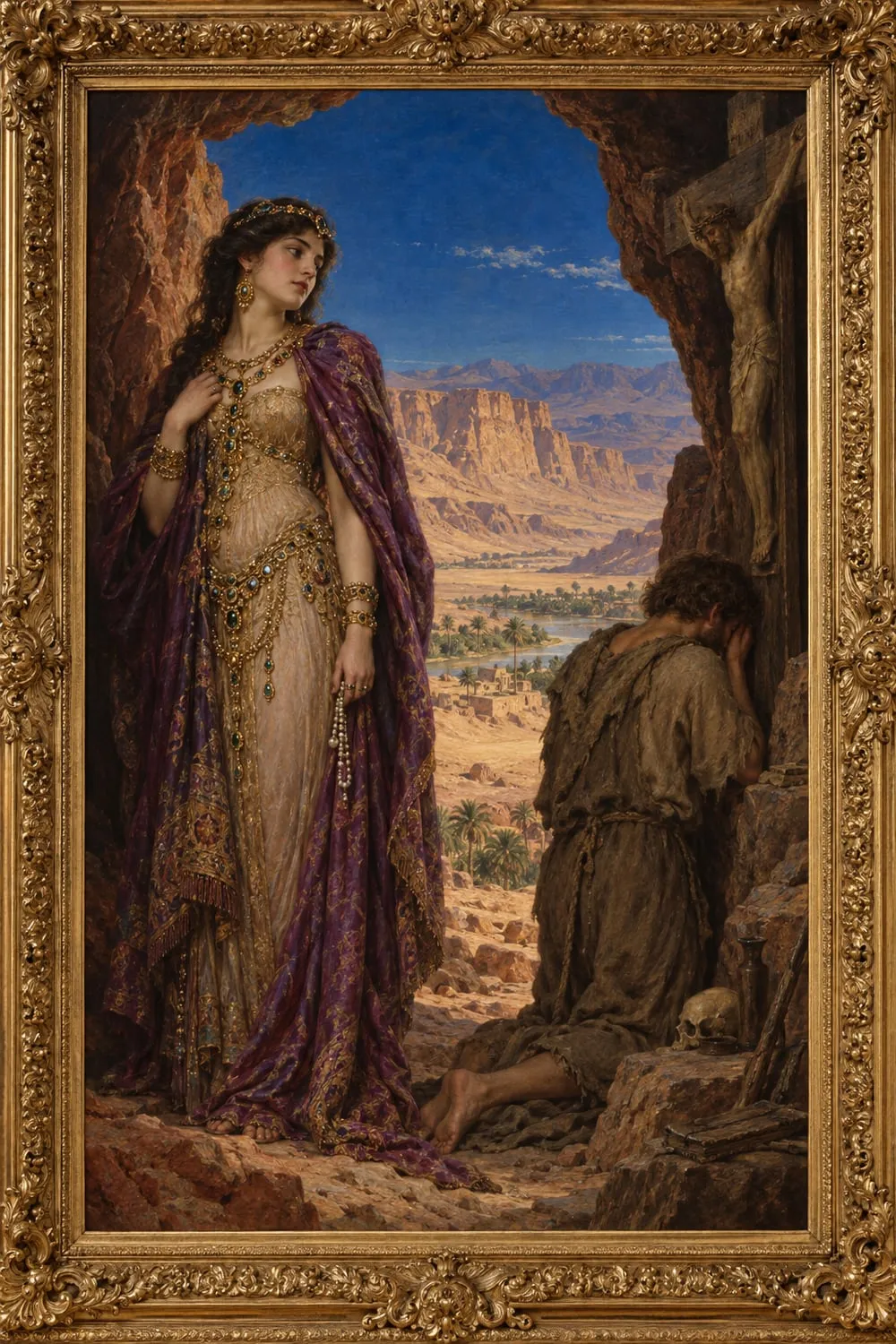
The scene is a corner of a valley in the Thebaid, with a cavern and a great crucifix on one side and sand dunes on the other. Two men watch a woman approach in a purple cloak and a tunic sewn with pearls. One thinks she is the Emperor's daughter, the other one of the gods. She is Myrrhina, and she asks for the beautiful young hermit who will not look on the face of woman. The men tell her he lives in the cave, where a centaur or a white unicorn once lived. They talk of the seven gods they keep hidden in their tunics, and she admits that Death is the only god she fears.
The men tell her that they feed the hermit every evening, that they are afraid of him, and that a voice speaks to him at night in his cave and calls him Honorius. Three lepers once called on him to heal them, and he did not. Myrrhina calls his name and bids him come forth. After a gap in the text she describes her life: a chamber of cedar and purple, lovers who come from the ends of the earth, the Emperor of Byzantium sailing to her in secret, a Thracian gladiator whose death she signalled in the circus. She offers to clothe Honorius in silk and pour spikenard on his hair.
Honorius replies that there is no love but the love of God. He tells her of Christ on the cross, of the Sibyls and prophets who foretold Him, and of the robber He brought into Paradise, and urges her to repent. He leaves her, and she wonders why he spoke so strangely and with such scorn.
After another gap the positions are reversed. Honorius says the scales have fallen from his eyes and begs her to take him to Alexandria to taste the seven sins. Myrrhina has repented and is seeking a cave where she too may dwell. They say farewell, and she begs him not to go. In the last lines she has cursed her beauty, thanks God that Honorius revealed Him to her, and says she tempted him so that he should see 'Sin in its painted mask'. The fragment ends there.