Themes
Temptation and conversion
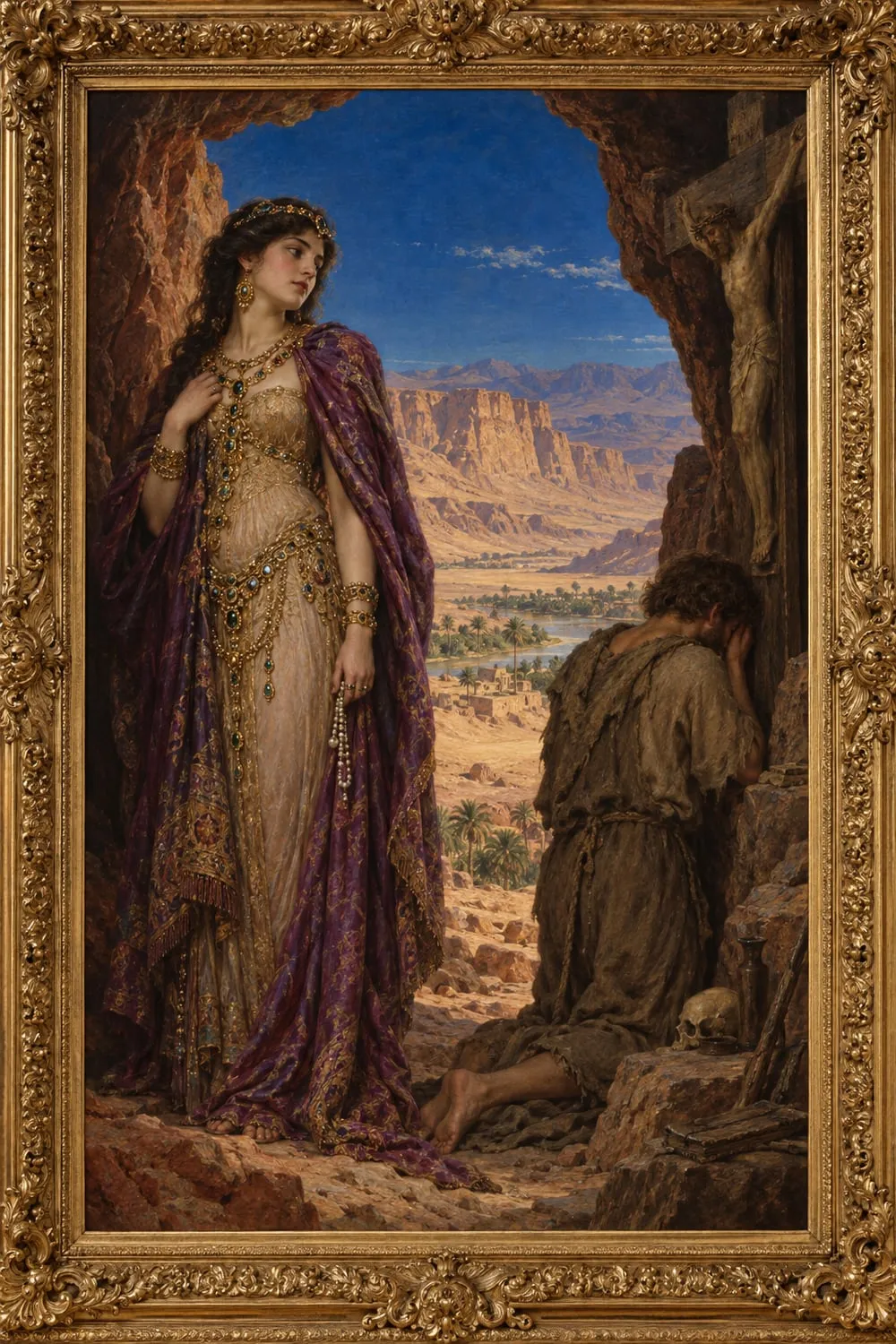
The fragment turns on a double exchange. Myrrhina comes to seduce Honorius and is converted by his account of Christ; Honorius, having converted her, loses his faith and begs her to take him to Alexandria 'and let me taste of the seven sins'. Each gives the other what they had. By the end Myrrhina is seeking a cave in the desert and the hermit wants the city, and the play leaves unclear what becomes of either.
Beauty that dazzles
Myrrhina is 'the woman covered with jewels', and her beauty is too bright to look at. The two men cannot meet her eyes because 'You are too bright to look at', and Honorius will not look on the face of any woman. Her great speech is a list of splendid things and the men destroyed by them. In the last lines she has 'cursed my beauty for what it has done'.
Many gods and one
The two men worship seven gods they keep hidden in their tunics and have seen gods crossing a plain at daybreak. Myrrhina has heard a sophist say there is only one God, and fears only Death. Against this crowded, frightened world Honorius sets the love of the one God, 'He whom thou seest on the cross'. The crucifix stands before his cave from the first stage direction, and in the last lines Myrrhina prays to the God it represents, saying that by Honorius 'Thou wast revealed to me'.
Love of the body and love of the soul
Myrrhina offers Honorius silk, myrrh, honey and 'Love', and he answers that 'The body is vile' and that God will raise her with a new body that knows no corruption. When she begins to speak of beauty, he answers with 'The beauty of the soul'. The quarrel between earthly and heavenly love is the whole of their first meeting. Yet the fragment suggests that neither side is safe: the hermit who despised the body is the one who ends by longing for Alexandria.