Summary
Wilde opens by answering the charge that artists lack wholeness of nature. Some have served the state, like Rubens, Goethe and Milton, and Thomas Griffiths Wainewright followed many masters besides art: he was a poet, painter, art critic, antiquarian and writer of prose, and also a forger and a poisoner 'almost without rival in this or any age'. Born at Chiswick in 1794, he lost his mother at his birth, was brought up by his grandfather and then by an uncle, 'whom he subsequently poisoned', and spent his boyhood at Linden House, Turnham Green, where he learned his love of nature. After school at Charles Burney's academy he became a young guardsman, wearied of barrack life, and, restored by art and by Wordsworth after a severe illness, resolved at twenty-five to take up literature.
Invited to write for the London Magazine, he wrote under masks such as Janus Weathercock and Egomet Bonmot, and Wilde comments that 'a mask tells us more than a face'. He became known as a dandy, with fine rings, a cameo breast-pin and pale lemon-coloured kid gloves, and entertained writers and actors to dinner. De Quincey met him at Charles Lamb's table and later wrote: 'Amongst the company, all literary men, sat a murderer.' Wilde admits that his surviving work hardly justifies his reputation, but only the Philistine judges a man by what he produces: Wainewright 'sought to be somebody, rather than to do something'.
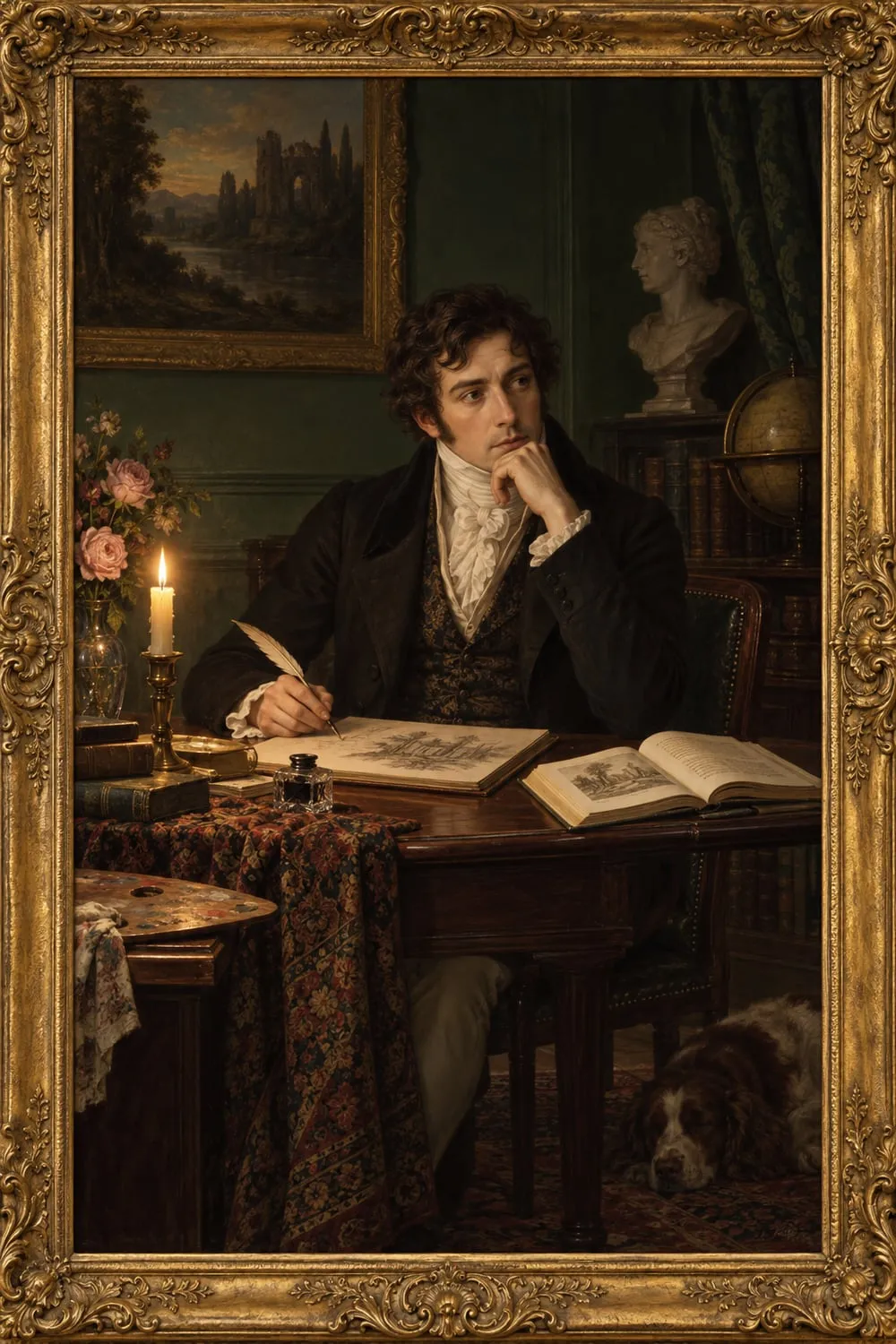
Wilde then describes his tastes and his criticism. Wainewright loved Greek gems, Persian carpets, fine bindings, cats and the colour green, and his library mixed a Greek vase, engravings after Michael Angelo and Giorgione, Florentine majolica and a Roman lamp, which shows that he grasped the truth that 'all beautiful things belong to the same age'. As a critic he recorded his own impressions, admired Turner and Constable before they were widely valued, disliked what was obvious in art, and held that a work 'can be tried' only 'by laws deduced from itself'. He was uneasy about contemporary work and preferred to look at it through 'Time's telescope'. Wilde quotes his technical account of a Tintoretto and his prose poems on Rembrandt's 'Crucifixion' and Giulio Romano's 'Cephalus and Procris', and observes that in an ugly and sensible age the arts borrow 'not from life, but from each other'.
Wainewright admired Keats, Shelley, Wordsworth and Blake, wrote generously of Lamb and his fellow contributors, and held that poetry and painting grow from the same seeds. Wilde credits him with inventing both the gorgeous style of the Fleet Street leader-writer and the habit of telling the public what one had for dinner, and adds that like most artificial people he loved nature. His phrase comparing a polyanthus to 'a solitary picture of Giorgione on a dark oaken panel' is typical of him.
Wilde then turns to the poisonings. Wainewright carried crystals of strychnine in one of his rings. He killed his uncle in 1829 to gain Linden House, then his wife's mother, Mrs. Abercrombie, for no known reason, and then his sister-in-law Helen Abercrombie, whose life he and his wife had insured for about £18,000. At lodgings in Conduit Street they gave her poisoned jelly and went out for a walk; when they returned she was dead. The insurance companies refused to pay, and after five years a lawsuit went against him. Arrested for debt, he went abroad, persuaded a friend at Boulogne to insure his life, and poisoned his coffee, simply to revenge himself on the insurers. He then lived for some years in France.
In 1837 he returned secretly to London, following a woman he loved. Staying at a hotel in Covent Garden, he pushed aside the blind to look at a noise in the street and was recognised by Forrester, the Bow Street runner, as 'Wainewright, the Bank-forger'. Thirteen years earlier he had forged his trustees' names to draw on money inherited from his mother. He pleaded guilty to two charges and was sentenced to transportation for life. In Newgate, Dickens and Macready came across him by chance, and he told an insurance agent that the sweep and bricklayer in his cell 'never offer me the broom!' Reproached with Helen Abercrombie's murder, he said she 'had very thick ankles'.
He was sent to Van Diemen's Land in the Susan. At Hobart Town he opened a studio and painted portraits, tried twice more to poison people who had offended him and failed, and was refused a ticket-of-leave. Wilde records that he died of apoplexy with a cat as his only companion, and suggests that his crimes gave his art the strong personality it had lacked: one portrait, it was said, carried 'the expression of his own wickedness'.
In closing, Wilde rejects the view of W. Carew Hazlitt, the biographer he has relied on, that Wainewright's love of art and nature was a pretence. 'There is no essential incongruity between crime and culture.' We cannot judge him artistically yet, because he is too modern, just as we no longer blame Nero or Tiberius, who have 'passed into the sphere of art and science'. Fiction has already honoured him: he is the hero of Dickens's Hunted Down and the Varney of Bulwer's Lucretia.