Themes
Crime and culture
The essay's provocation is that a murderer can be a genuine artist and critic. Wilde refuses to let the poisonings cancel Wainewright's taste: 'The fact of a man being a poisoner is nothing against his prose.' He goes further, suggesting that the crimes 'gave a strong personality to his style', and that one of his Tasmanian portraits carried 'the expression of his own wickedness'. The claim is a test case for the argument of Intentions as a whole, that art and ethics belong to separate spheres and that one cannot be judged by the standards of the other.
Life as a work of art
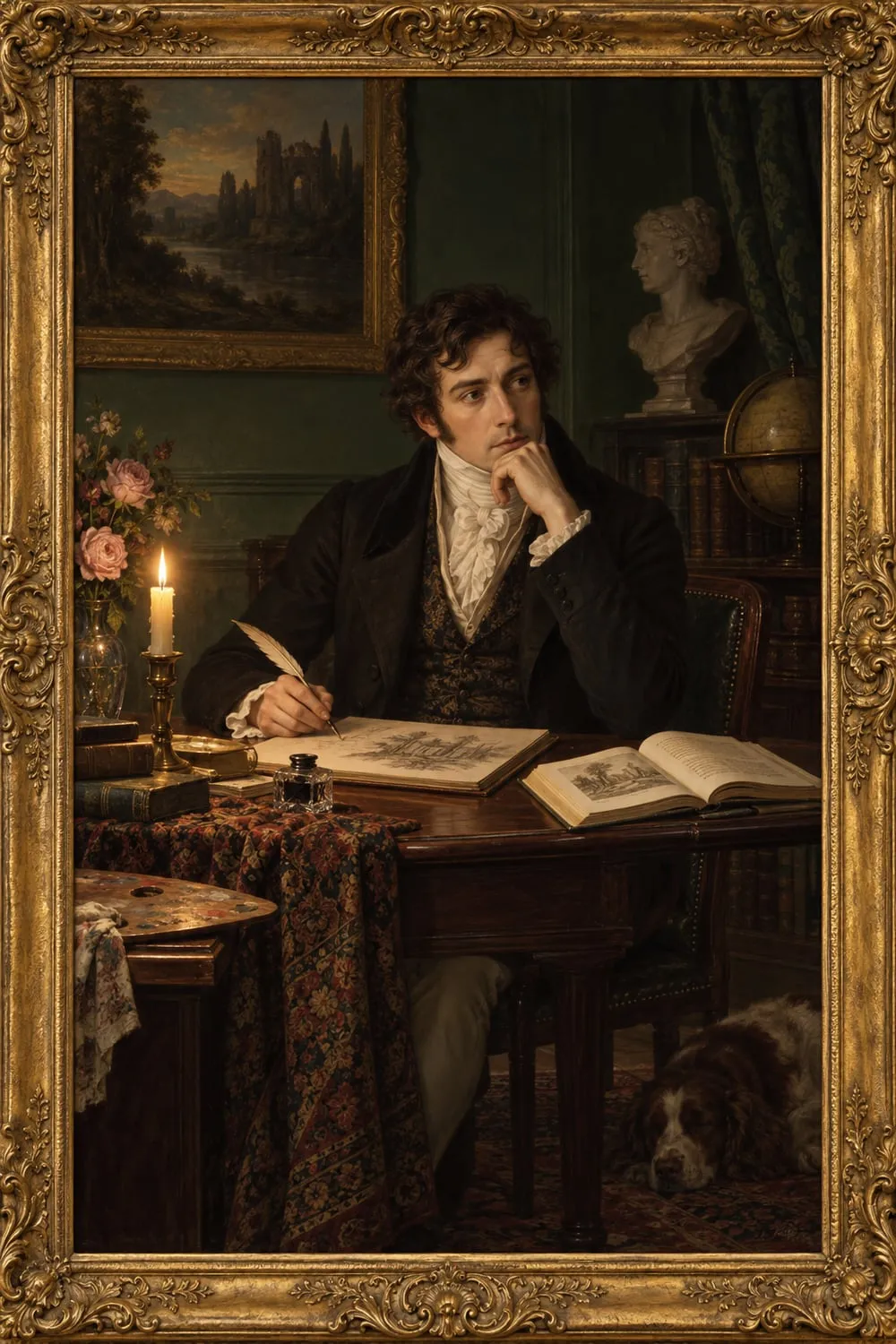
Wilde presents Wainewright as a man who made his life a matter of style. 'This young dandy sought to be somebody, rather than to do something.' His rings, cameo breast-pin and lemon-coloured gloves, his room of Greek gems and majolica, and his pseudonyms all belong to the portrait. The masks he wrote behind, Janus Weathercock and Egomet Bonmot, 'intensified his personality', which leads to the essay's central aphorism: 'A mask tells us more than a face.' Even his return to England, following a woman who did not love him, is told as a romantic gesture.
Criticism as impression
Wainewright's art criticism anticipates Wilde's own. He cared for 'the complex impressions produced by a work of art' rather than abstract theories of beauty, and he held that a work should be judged only 'by laws deduced from itself'. His descriptions of Rembrandt's 'Crucifixion' and Giulio Romano's 'Cephalus and Procris' turn paintings into prose poems, and Wilde, though critical of their excess, calls the conception 'excellent'. From this he draws a principle of the essay: 'the arts borrow, not from life, but from each other.'
History, distance and judgement
The closing pages ask why we judge Wainewright differently from the great criminals of the past. Wilde argues that time turns historical villains into 'the puppets of a play': nobody with historical sense scolds Nero or censures Caesar Borgia, because they 'have passed into the sphere of art and science'. Wainewright is simply 'a little too modern' for this detachment, and it is hard not to feel prejudice against a man 'who might have poisoned Lord Tennyson'. Fiction has already begun the process, and Wilde ends by ranking suggestiveness for fiction above fact.