Summary
The text opens with a note that the lecture was first given at the Chickering Hall, New York, on 9 January 1882, and is collated from four copies. Wilde declines, like Goethe, to offer an abstract definition of beauty. He will instead describe the ideas behind the English Renaissance, so called because, like the Italian Renaissance, it is a new birth of the passion for beauty and form. It unites Hellenism, with its sanity and calm, and the intensified individualism of romance, as Faust and Helen of Troy produced Euphorion. The classical spirit deals with the type, the romantic with the exception.
The first condition of this renaissance, Wilde argues, is the French Revolution, prepared by the critical spirit and by Rousseau, Goethe and Scott. From it came a scientific habit of close observation and a love of the sharp boundary line that Blake praised, together with a transcendental spirit that Wilde calls alien to art, since the artist is the only true realist. The age of Byron and Napoleon was an age of revolt; the aim of culture is peace, and in Keats, calm and self-controlled, the artistic spirit of the century first took full form.
The Pre-Raphaelite Brotherhood, young admirers of Keats who began meeting in London in 1847, among them Rossetti, Holman Hunt and Millais, were mocked because the English public never forgives youth, power and enthusiasm. They sought a return to nature and a deeper spiritual and decorative value in art. Burne-Jones and Morris followed, and Morris gave the movement its social idea through the revival of the decorative arts. Their revolution was one of execution: every great era in art, from Parian marble to Venetian oil painting, rests on technical advance, and in poetry this shows in new French metres and in Gautier's advice to read the dictionary.
The artistic spirit governs inspiration and the choice of subject too. Wilde quotes Keats's wish to compose without fever and Baudelaire's claim that 'the heart contains passion but the imagination alone contains poetry.' Art keeps apart from poor-laws and bimetallism; the poet is a spectator of all time, to whom Achilles is more real than Wellington. Its social meaning lies only in the perfect form of its expression, as in a Rubens where a cavalcade passing to the death of Christ is still joy in art. A painting is first a beautifully coloured surface, the joy of poetry lies in the handling of language, music is the art to which the others aspire, and the critic's first duty is to hold his tongue. He tells his audience not to judge aestheticism by Mr. Gilbert's satire in Patience.
Yet the renaissance is incomplete. England's commercial spirit has killed great sculpture and great drama, which need a noble national life, and even Shelley's The Cenci found no successors. Wilde turns to America, young and unburdened by the past, as the country that might complete the movement. It needs not more moral supervision, for one should never speak of a moral or an immoral poem, but a standard of taste and the classical restraint of form. Art can make nations brothers, and it is the one empire an enemy cannot conquer.
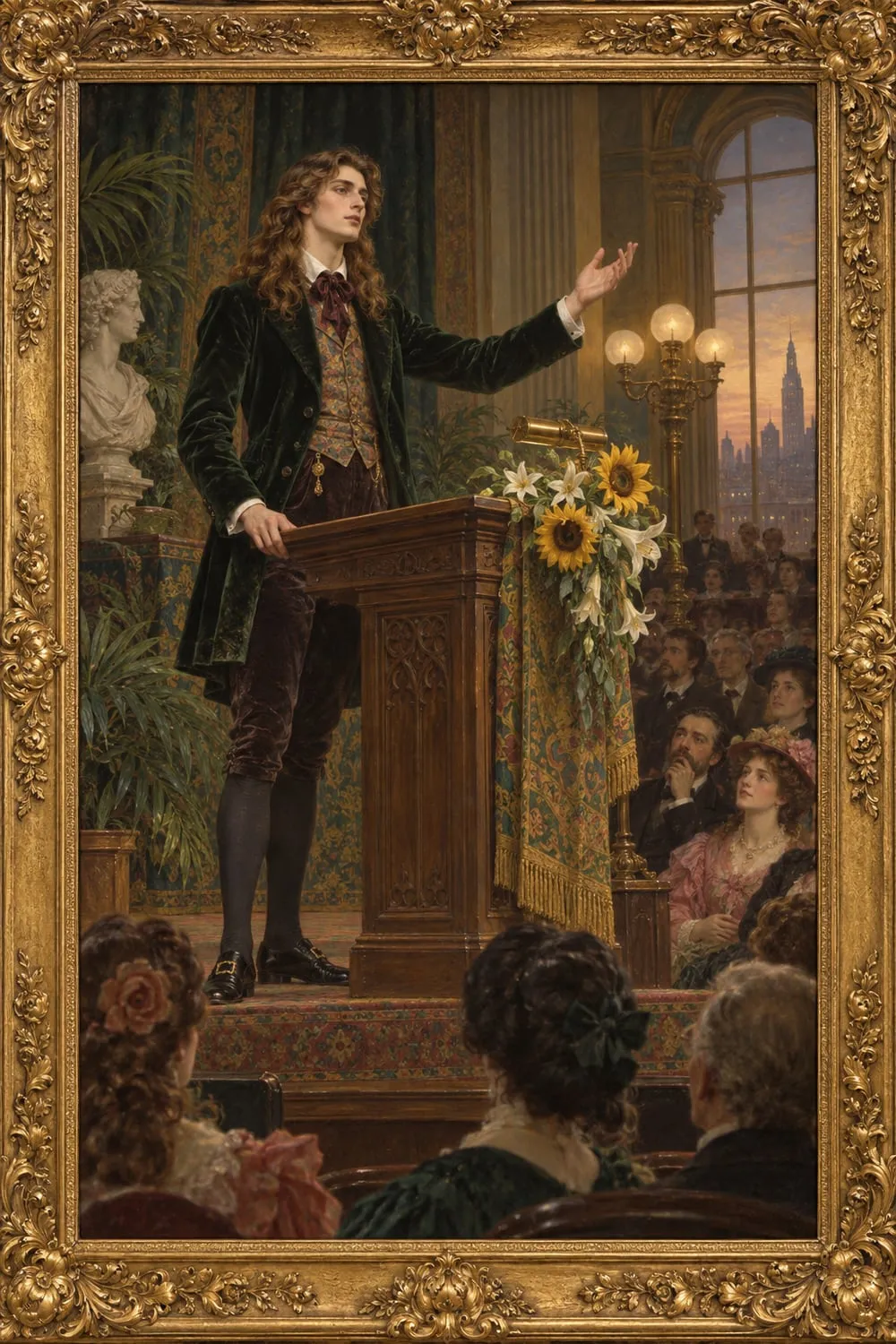
The truths of art cannot be taught, only revealed, which is why the movement gives such weight to the decorative arts of Burne-Jones and Morris. Wilde quotes Plato's picture of children growing up among fair things until they love beauty before they know why. Decoration is the worker's expression of joy in his work; Morris, he recalls, tried to make each of his workers an artist. Explaining that the lily and the sunflower are loved as models of design, not as food, Wilde urges Americans to make their own flowers and birds the forms of their art, and closes: the secret of life is in art.