Themes
Hellenism and romance
Wilde defines the English Renaissance as a marriage of two spirits: Hellenism, with 'its breadth, its sanity of purpose, its calm possession of beauty', and romance, with its 'intensified individualism' and 'passionate colour'. The image he chooses is Faust and Helen of Troy and their child Euphorion. The same double inheritance runs through the lecture, from Keats's Grecian Urn to the knights and ladies of Burne-Jones, and returns at the end as the nineteenth century taking 'from Athens its wonder without its worship, from Venice its splendour without its sin.'
Form above subject
The lecture insists that art has 'only one high law, the law of form or harmony.' Great eras are eras of new technique, not new feeling; a painting is 'a beautifully coloured surface, nothing more'; the joy of poetry comes 'never from the subject' but from rhythmical language. The Rubens procession shows the point most sharply: though the subject is the death of Christ, the swirl of banner and armour is still 'joy in art.' Health in art means respect for the limits of one's material.
Art apart from morals and politics
Wilde asks for 'a separate realm for the artist'. Into 'the secure and sacred house of Beauty' the artist admits nothing debatable; he may write on poor-laws and local taxation, but in prose, 'with his left hand'. He tells Americans their literature needs no 'increased moral supervision', since poems are simply well or badly written. Appeals for art 'to have a mission' should be made to the public, whom the critic must teach how to receive beauty.
Beauty in daily life
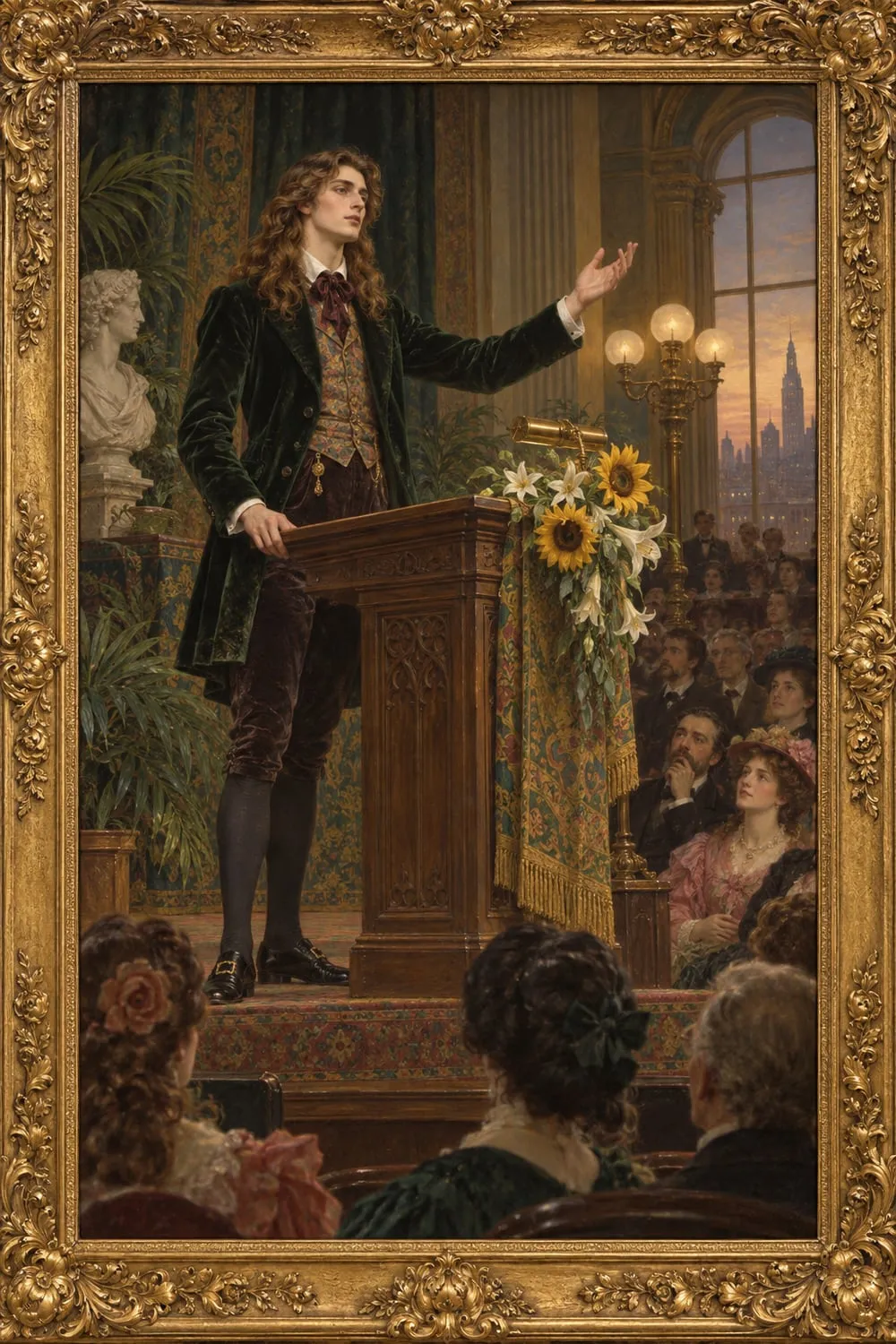
The lecture ends in the house and the workshop. Wilde hopes that one day nothing will be in any man's house 'which has not given delight to its maker and does not give delight to its user.' He draws on Plato's children raised among fair things and the windows of Chartres, where the dyer and potter appear at their work. Decoration is 'the worker's expression of joy in his work', and 'industry without art is barbarism.' The lily and the sunflower are models of design, not an affectation.