Summary
A young Student cries out that the girl he loves will dance with him at the Prince's ball tomorrow only if he brings her red roses, and there is no red rose in all his garden. From her nest in the holm-oak the Nightingale hears him and believes she has found the true lover she has sung of night after night. The Student pictures the girl dancing past him, flings himself on the grass and weeps. A little Green Lizard, a Butterfly and a Daisy think it very ridiculous to weep for a red rose, but the Nightingale sits silent and thinks about the mystery of Love.
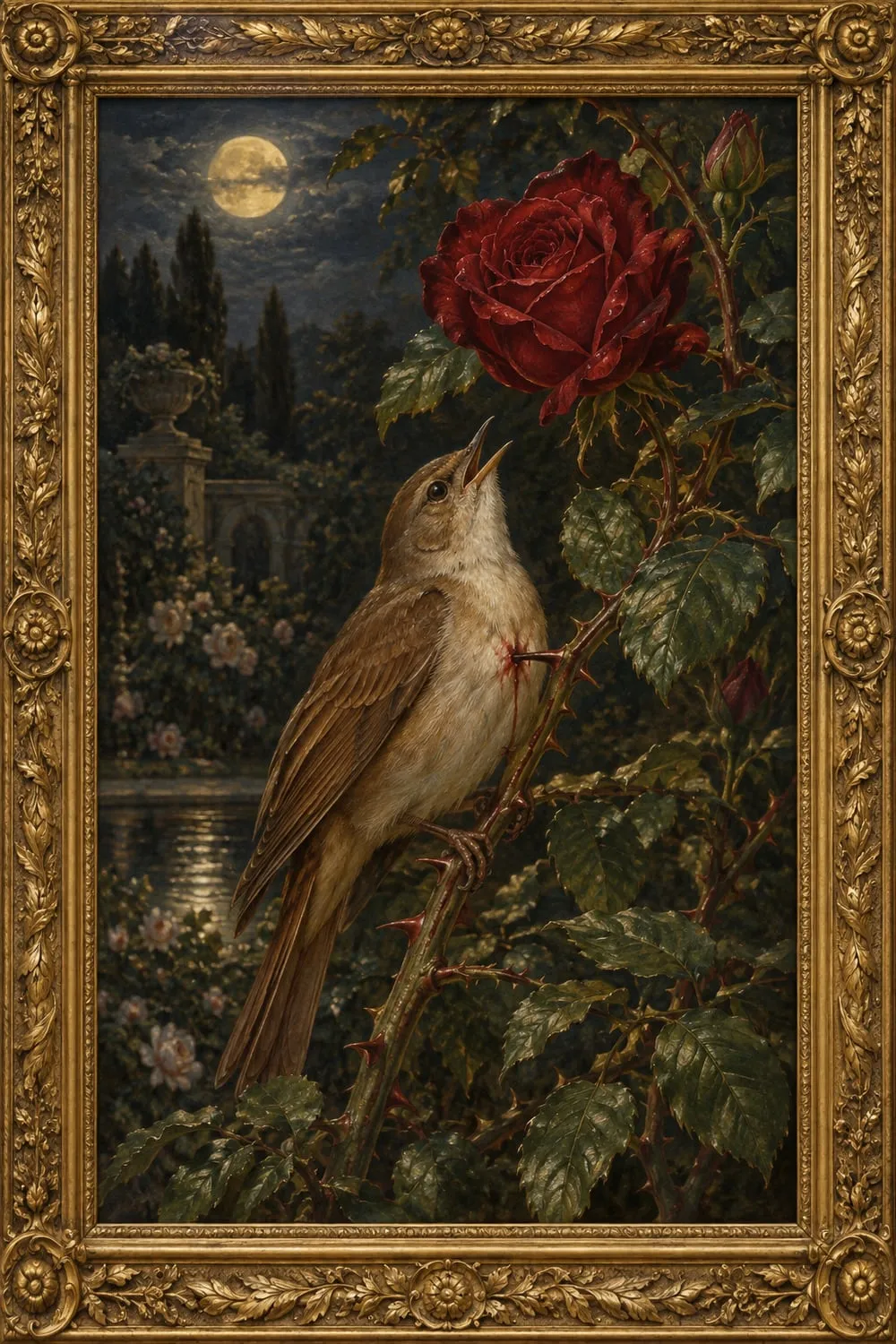
She flies to the Rose-tree in the centre of the grass-plot, which has only white roses, and to its brother round the old sundial, which has only yellow ones. The Rose-tree beneath the Student's window has red roses, but winter has chilled its veins and it will bear none this year. There is one terrible way, it tells her: she must build a red rose out of music by moonlight and stain it with her heart's-blood, singing all night with her breast against a thorn. She weighs the sweetness of life, then decides that Love is better than Life. She tells the Student to be happy and asks only that he be a true lover, but he cannot understand her. The Oak-tree, who is fond of her, asks for one last song. Afterwards the Student notes that she has form but no feeling, like most artists, and falls asleep.
When the moon rises, the Nightingale sets her breast against the thorn and sings all night. As she sings of the birth of love, a pale rose blossoms on the topmost spray. The Tree cries to her to press closer before the day comes; she sings of passion, and the petals flush pink, but the heart of the rose stays white. She presses closer still, the thorn reaches her heart, and she sings of the Love that is perfected by Death. The rose turns crimson. With one last burst of music she dies in the long grass, the thorn in her heart.
At noon the Student sees the rose from his window and plucks it, sure it must have a long Latin name. He runs to the Professor's house, where the Professor's daughter sits winding blue silk. She frowns: the rose will not go with her dress, and the Chamberlain's nephew has sent her real jewels, which cost far more than flowers. The Student calls her ungrateful and throws the rose into the street, where a cartwheel goes over it, and she retorts that he is only a Student, without even silver buckles on his shoes. Walking away, he decides that Love is not half as useful as Logic, resolves to go back to Philosophy and Metaphysics, and sits down with a great dusty book.