Themes
Love and sacrifice
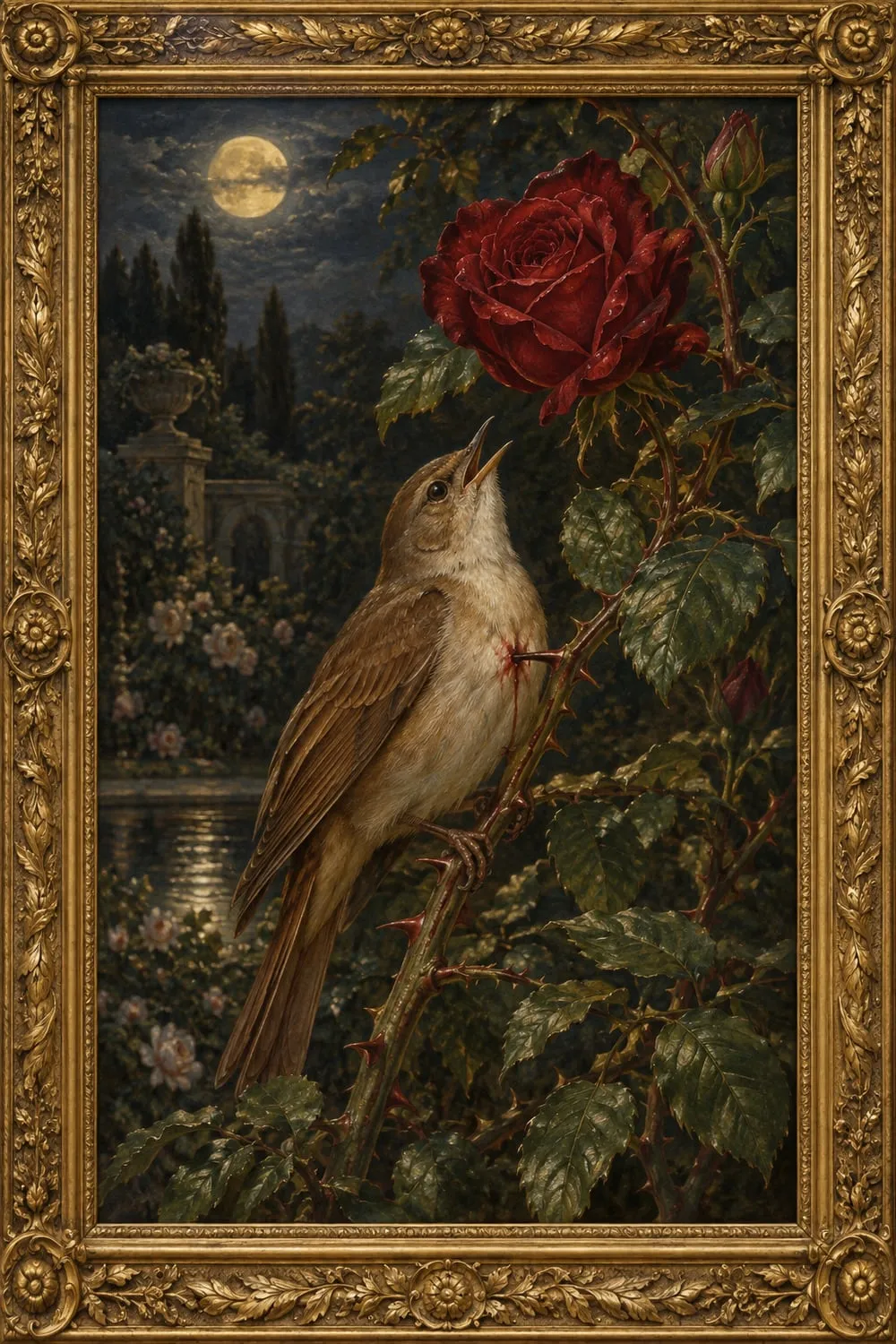
The Nightingale treats Love as worth more than anything that can be bought: 'more precious than emeralds, and dearer than fine opals'. When the Rose-tree names the price, she weighs the sun, the moon, the hawthorn and the bluebells against it, and concludes that 'Love is better than Life'. Her death is the purest act in the tale, and her song climbs from the birth of love to 'the Love that is perfected by Death'. The irony is that she dies for a love she has only imagined, in a man who does not share it.
Art and the artist
The Student's verdict on the Nightingale is a joke at his own expense. She is 'all style, without any sincerity', he says, and 'would not sacrifice herself for others', a few hours before she does exactly that. The rose itself is a work of art, built 'out of music by moonlight' and coloured with the artist's own blood. The tale lets the reader see what the critic cannot: that her beautiful notes do mean something, even if they do no 'practical good', and that the art he calls selfish costs her everything.
Romance and the practical world
The human world in the tale runs on price and use. The Professor's daughter refuses the rose because it will not match her dress and because 'jewels cost far more than flowers'. The Student, stung, decides that Love is 'quite unpractical' and that 'in this age to be practical is everything'. The rose that cost a life ends in the gutter under a cartwheel, a single image of how little the practical world values what it has not paid for.
Learning without understanding
The Student has 'read all that the wise men have written', yet he cannot understand the Nightingale when she speaks to him, 'for he only knew the things that are written down in books'. The Oak-tree understands her at once and grieves. Faced with the most beautiful rose he has ever seen, the Student's first thought is that it must have 'a long Latin name'. When love fails him he retreats into Logic and Metaphysics, and the great dusty book stands for a mind that learns nothing from what has happened.