Themes
Costume as drama
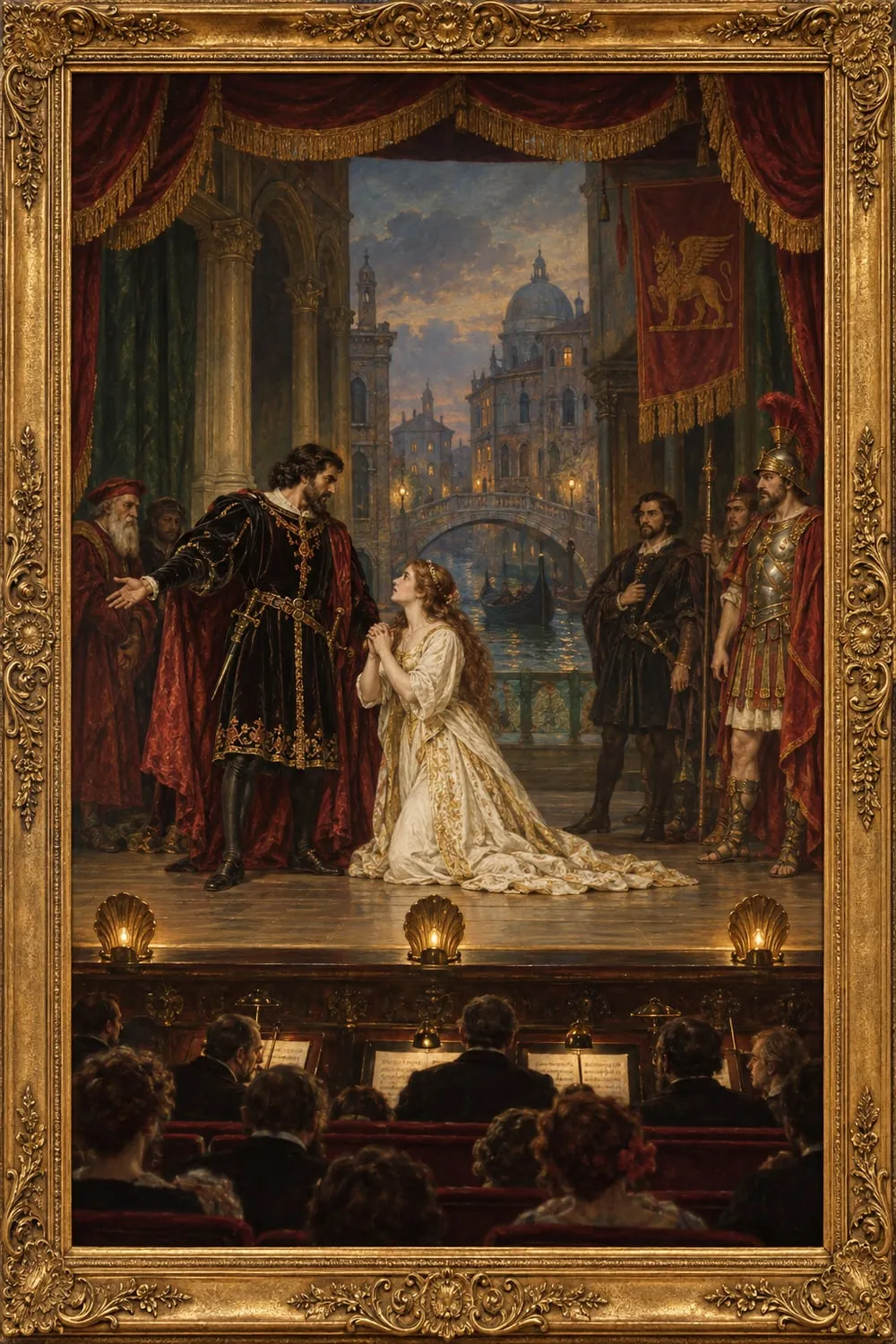
Wilde's first point is that Shakespeare used dress not only for beauty but as a way 'of producing certain dramatic effects'. The essay piles up examples: Rosalind's doublet and hose, Juliet laid out in rich raiment that makes the tomb 'a feasting presence full of light', Caesar's cloak held up to the crowd, Cloten dressing in Posthumus's clothes to commit his crime. Costume, he concludes, is 'a means of displaying character without description', and even a handkerchief or a ring can decide the course of a play.
Fact turned into effect
Against the charge of pedantry, Wilde insists that archaeology 'is neither good nor bad, but a fact simply', and that its value depends on the artist who uses it. The archaeologist supplies the facts 'which the artist is to convert into effects'. His examples are Godwin's Claudian, where accurate costume showed a man's whole character 'down to what horses he backed', and Shakespeare's use of Plutarch for Coriolanus's gown. Accuracy is 'merely a condition of illusionist stage effect', never the goal: 'Better to take pleasure in a rose than to put its root under a microscope.'
Unity of effect
The later pages turn from history to the practice of staging, and their constant principle is unity. Background and costumes should share one colour-scheme, 'settled as absolutely as for the decoration of a room'. Periods must not be mixed, or the stage becomes 'that caricature of the centuries, the Fancy Dress Ball'. Above all, one artist should control everything, even the way each dress is worn, because 'the facts of art are diverse, but the essence of artistic effect is unity'. A theatre, Wilde says, 'should be in the power of a cultured despot'.
The truth of masks
The final paragraph unsettles everything before it. After arguing his case with confidence, Wilde announces: 'Not that I agree with everything that I have said in this essay.' The essay 'simply represents an artistic standpoint', and 'in æsthetic criticism attitude is everything'. A truth in art is one 'whose contradictory is also true'. The title, added when the essay was revised, points to this turn: a costume is a mask, an argument is a mask too, and 'the truths of metaphysics are the truths of masks'.