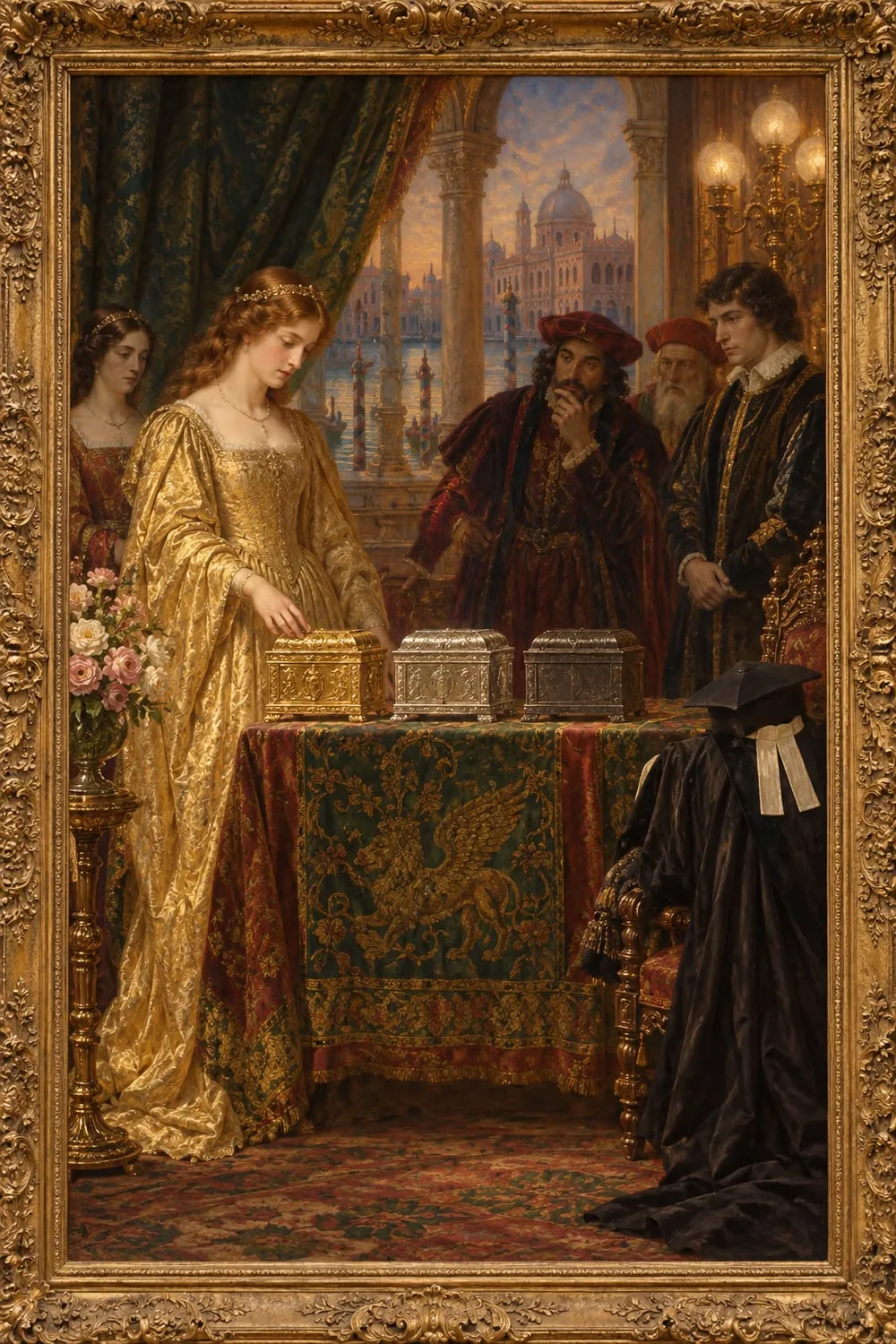
Portia in gold and in gown
Portia
"O Portia! take my heart: it is thy due:"
Poem
I marvel not Bassanio was so boldTo peril all he had upon the lead,Or that proud Aragon bent low his headOr that Morocco’s fiery heart grew cold:For in that gorgeous dress of beaten goldWhich is more golden than the golden sunNo woman Veronesé looked uponWas half so fair as thou whom I behold.Yet fairer when with wisdom as your shieldThe sober-suited lawyer’s gown you donned,And would not let the laws of Venice yieldAntonio’s heart to that accursèd Jew—O Portia! take my heart: it is thy due:I think I will not quarrel with the Bond.
In brief
SummaryA playful sonnet to Portia of The Merchant of Venice, watched on stage. The speaker is not surprised that Bassanio risked everything on the lead casket, or that her other suitors, Aragon and Morocco, were humbled, for in her dress of beaten gold she is fairer than any woman the painter Veronese saw. Yet she is fairer still in the lawyer's gown, saving Antonio's heart from Shylock's bond. The speaker ends by offering her his own heart, and promises not to quarrel with the bond.
Key themes
"Was half so fair as thou whom I behold."
Summary
The octave begins with the casket test from the play. 'I marvel not', says the speaker, that Bassanio 'was so bold / To peril all he had upon the lead', or that 'proud Aragon bent low his head' and 'Morocco's fiery heart grew cold'. The reason is before his eyes: 'in that gorgeous dress of beaten gold / Which is more golden than the golden sun', no woman 'Veronesé looked upon / Was half so fair as thou whom I behold'.
The sestet raises the praise. Portia is 'fairer' still when, 'with wisdom as your shield', she puts on 'The sober-suited lawyer's gown' and will not let the laws of Venice hand over 'Antonio's heart to that accursèd Jew', as the play's Christians call Shylock. The speaker then turns the trial into a joke about himself: 'O Portia! take my heart: it is thy due: / I think I will not quarrel with the Bond.'
Characters
Portia
The golden heiress and lawyer
The heroine of The Merchant of Venice, whom the speaker beholds on stage in a 'dress of beaten gold' and then in 'The sober-suited lawyer's gown'. She wins Bassanio, humbles her other suitors and saves Antonio from the bond, and at the end the speaker offers her his heart.
The speaker
The smitten spectator
A playgoer who watches Portia and understands at once why Bassanio risked all for her. He addresses her directly, praises her beauty and her wisdom, and closes by surrendering his heart with a joke about the play's bond.
Themes
Beauty and wisdom
The poem praises Portia twice. First for beauty, in a 'gorgeous dress of beaten gold', lovelier than any woman painted by Veronese. Then, 'Yet fairer', for wisdom, when she wears 'The sober-suited lawyer's gown' and saves Antonio. The move from gold to sober black suggests that her mind, not her dress, is what finally wins the speaker.
A lover's surrender
The ending plays on the bond at the centre of The Merchant of Venice, in which Antonio's flesh is forfeit. Portia saves Antonio's heart, and the speaker gives her his own instead: 'take my heart: it is thy due'. His last line, 'I think I will not quarrel with the Bond', is a witty admission that he is happy to pay a debt that Antonio escaped.
Quotes
Context
'Portia' is the first of the poems grouped as 'Written at the Lyceum Theatre' in Wilde's collected poems. It is a sonnet addressed to Portia, the heroine of Shakespeare's The Merchant of Venice, and it draws on the play's plot: the casket test by which Bassanio wins her, and the trial in which she saves Antonio from Shylock's bond. It names no performer.
About this edition
- Text: the complete work from Standard Ebooks, released into the public domain (CC0 1.0). We change only the layout.
- Download the EPUB of the whole book it comes from, free, for any e-reader.
- Every quotation and glossary word in these notes is checked against the text.