From priestess to Cleopatra
Camma
"The world thine Actium, me thine Anthony!"
Poem
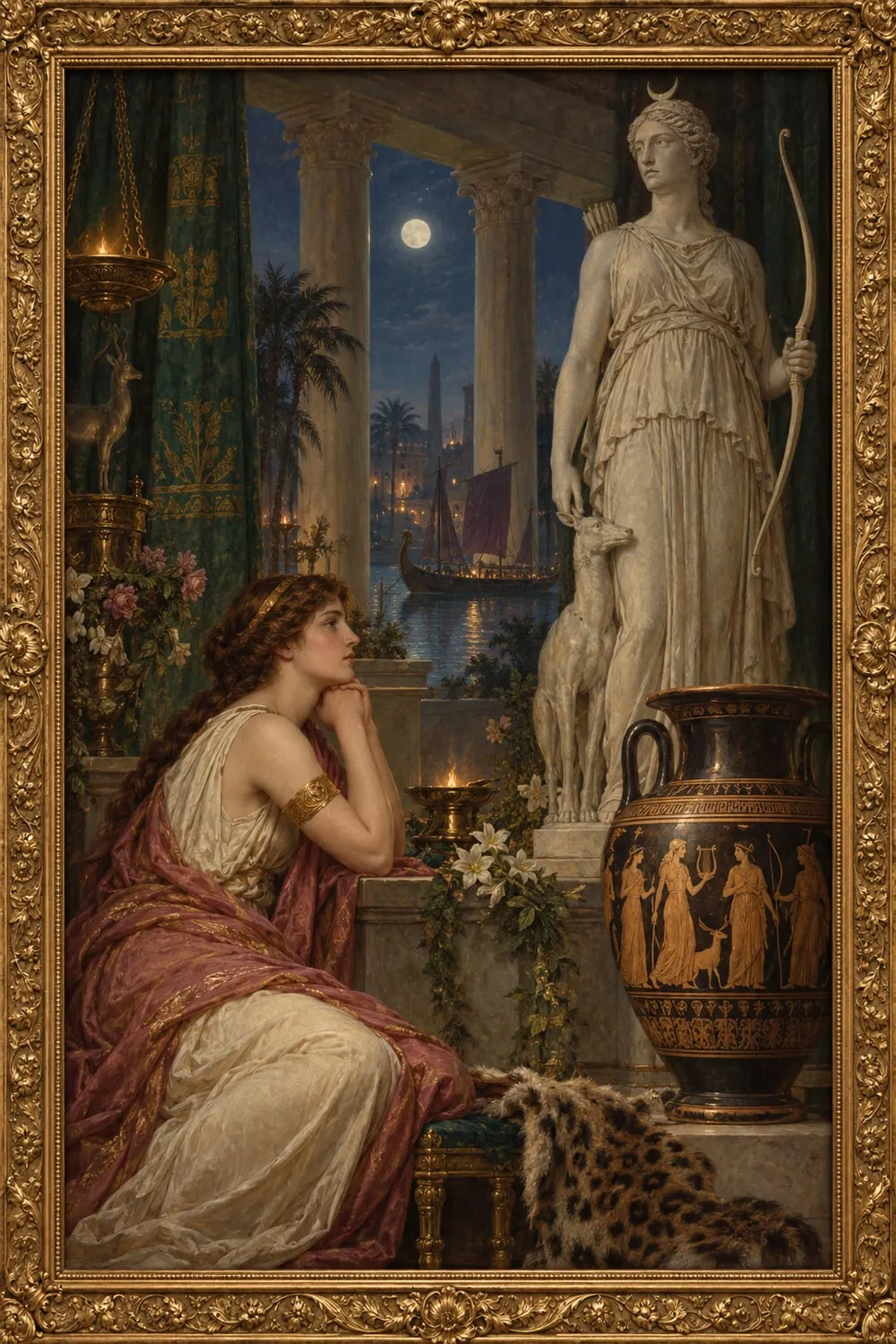
As one who poring on a Grecian urnScans the fair shapes some Attic hand hath made,God with slim goddess, goodly man with maid,And for their beauty’s sake is loth to turnAnd face the obvious day, must I not yearnFor many a secret moon of indolent bliss,When in midmost shrine of ArtemisI see thee standing, antique-limbed, and stern?
And yet—methinks I’d rather see thee playThat serpent of old Nile, whose witcheryMade Emperors drunken—come, great Egypt, shakeOur stage with all thy mimic pageants! Nay,I am grown sick of unreal passions, makeThe world thine Actium, me thine Anthony!
In brief
SummaryA sonnet addressed to Camma, seen standing in the shrine of Artemis. Like someone gazing at the figures on a Grecian urn who cannot bear to turn back to ordinary daylight, the speaker longs to stay lost in her statue-like, 'antique-limbed' beauty. Then he changes his wish: he would rather see her play Cleopatra, the 'serpent of old Nile', and shake the stage with her pageants. Finally he rejects stage passions altogether and asks her to make the real world her Actium and him her Antony.
Key themes
"I see thee standing, antique-limbed, and stern?"

Summary
The octave is a single long comparison. The speaker is like 'one who poring on a Grecian urn / Scans the fair shapes some Attic hand hath made', gods and goddesses, men and maids, and 'for their beauty's sake is loth to turn / And face the obvious day'. In the same way he yearns 'For many a secret moon of indolent bliss' when he sees Camma standing 'in midmost shrine of Artemis', 'antique-limbed, and stern'.
The sestet begins 'And yet'. He would 'rather see thee play / That serpent of old Nile, whose witchery / Made Emperors drunken', and calls on her, 'come, great Egypt', to shake the stage 'with all thy mimic pageants!' Then he checks himself again: 'Nay, / I am grown sick of unreal passions'. His final wish is to move from theatre to life: 'make / The world thine Actium, me thine Anthony!'
Characters
Camma
The priestess of Artemis
The figure the speaker sees 'in midmost shrine of Artemis', 'antique-limbed, and stern', as still and lovely as a shape on a Grecian urn. He wishes she would play Cleopatra instead, and finally asks her to bring real passion into his own life.
The speaker
The restless spectator
A watcher who changes his mind twice in fourteen lines: first content to gaze on Camma like a work of art, then eager to see her as Cleopatra, then 'sick of unreal passions' and asking to be her Antony in the real world.
Themes
Art and life
The poem moves through three stages. First the speaker would stay with art, like one 'poring on a Grecian urn' who is 'loth to turn / And face the obvious day'. Then he wants more dramatic art, Cleopatra's 'mimic pageants'. Finally he rejects performance itself: 'I am grown sick of unreal passions'. The last line asks for passion in 'The world', not on the stage.
Stillness and fire
Camma is pictured as a statue: 'antique-limbed, and stern', standing in a shrine like a figure on a vase. Cleopatra is the opposite, all 'witchery' that 'Made Emperors drunken'. The speaker's desire moves from calm contemplation, 'indolent bliss', to the fatal love of Antony, whose defeat at Actium he is willing to share.
Quotes
Context
'Camma' is the third of the poems grouped as 'Written at the Lyceum Theatre' in Wilde's collected poems. Camma is the priestess of Artemis in Tennyson's verse tragedy The Cup. The sonnet's opening recalls Keats's 'Ode on a Grecian Urn', and its sestet borrows from Shakespeare's Antony and Cleopatra, where Cleopatra is Antony's 'serpent of old Nile'. The poem names no performer.
About this edition
- Text: the complete work from Standard Ebooks, released into the public domain (CC0 1.0). We change only the layout.
- Download the EPUB of the whole book it comes from, free, for any e-reader.
- Every quotation and glossary word in these notes is checked against the text.