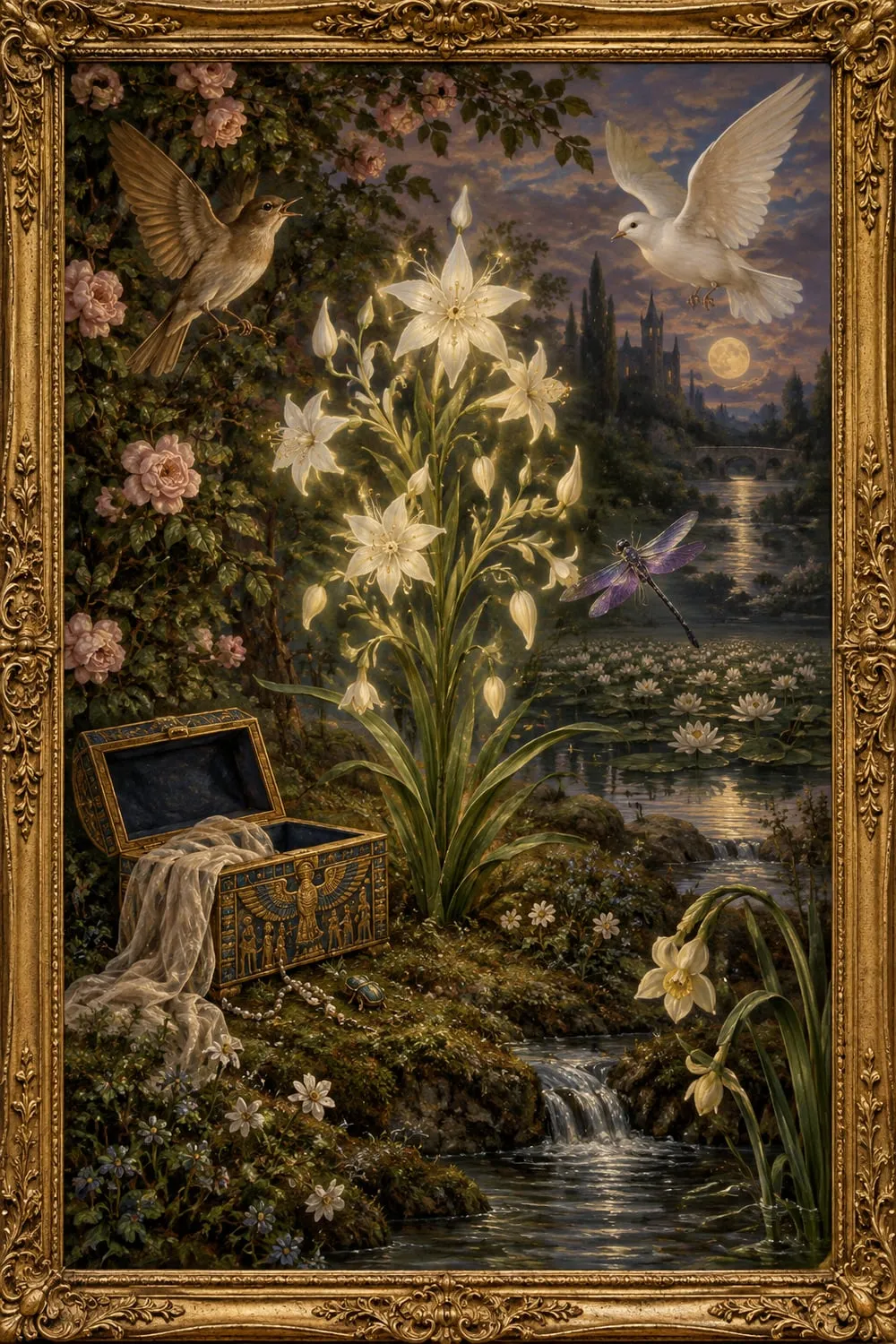
An Egyptian seed that cannot die
Athanasia
"It is the child of all eternity."
Poem
To that gaunt House of Art which lacks for naughtOf all the great things men have saved from Time,The withered body of a girl was broughtDead ere the world’s glad youth had touched its prime,And seen by lonely Arabs lying hidIn the dim womb of some black pyramid.
But when they had unloosed the linen bandWhich swathed the Egyptian’s body—lo! was foundClosed in the wasted hollow of her handA little seed, which sown in English groundDid wondrous snow of starry blossoms bearAnd spread rich odours through our spring-tide air.
With such strange arts this flower did allureThat all forgotten was the asphodel,And the brown bee, the lily’s paramour,Forsook the cup where he was wont to dwell,For not a thing of earth it seemed to be,But stolen from some heavenly Arcady.
In vain the sad narcissus, wan and whiteAt its own beauty, hung across the stream,The purple dragon-fly had no delightWith its gold dust to make his wings a-gleam,Ah! no delight the jasmine-bloom to kiss,Or brush the rain-pearls from the eucharis.
For love of it the passionate nightingaleForgot the hills of Thrace, the cruel king,And the pale dove no longer cared to sailThrough the wet woods at time of blossoming,But round this flower of Egypt sought to float,With silvered wing and amethystine throat.
While the hot sun blazed in his tower of blueA cooling wind crept from the land of snows,And the warm south with tender tears of dewDrenched its white leaves when Hesperos up-roseAmid those sea-green meadows of the skyOn which the scarlet bars of sunset lie.
But when o’er wastes of lily-haunted fieldThe tired birds had stayed their amorous tune,And broad and glittering like an argent shieldHigh in the sapphire heavens hung the moon,Did no strange dream or evil memory makeEach tremulous petal of its blossoms shake?
Ah no! to this bright flower a thousand yearsSeemed but the lingering of a summer’s day,It never knew the tide of cankering fearsWhich turn a boy’s gold hair to withered grey,The dread desire of death it never knew,Or how all folk that they were born must rue.
For we to death with pipe and dancing go,Nor would we pass the ivory gate again,As some sad river wearied of its flowThrough the dull plains, the haunts of common men,Leaps lover-like into the terrible sea!And counts it gain to die so gloriously.
We mar our lordly strength in barren strifeWith the world’s legions led by clamorous care,It never feels decay but gathers lifeFrom the pure sunlight and the supreme air,We live beneath Time’s wasting sovereignty,It is the child of all eternity.
In brief
SummaryThe withered body of a young Egyptian girl, found by Arabs hidden in a pyramid, is brought to a great museum. When the linen wrappings are loosened, a small seed is found in her hand. Sown in English soil, it grows into a flower of starry white blossom and rich scent that draws bees and birds away from every other flower. The speaker asks whether any dream or memory of its long burial troubles it, and answers no. The flower knows nothing of fear or decay; people live and die under Time, but it is 'the child of all eternity'.
Key themes
"For we to death with pipe and dancing go,"
Summary
The title is the Greek word for immortality. The poem opens in 'that gaunt House of Art' where men keep the great things 'saved from Time'. To it is brought the body of a girl who died young, found by 'lonely Arabs' in 'the dim womb of some black pyramid'. When the linen band around her is loosened, a little seed is found 'Closed in the wasted hollow of her hand'. Sown 'in English ground', it bears a 'wondrous snow of starry blossoms' and fills the spring air with scent.
The next stanzas show the flower drawing all nature to itself. The asphodel is forgotten, the bee forsakes the lily, and the flower seems 'stolen from some heavenly Arcady'. The narcissus, the dragon-fly, the jasmine and the eucharis lose their charm; the nightingale forgets 'the hills of Thrace, the cruel king', and the dove floats round the 'flower of Egypt'. Sun, cool wind and evening dew tend it. At night the speaker asks whether some 'strange dream or evil memory' makes its petals shake.
The answer is 'Ah no!' To the flower a thousand years were 'but the lingering of a summer's day'. It never knew the fears that 'turn a boy's gold hair to withered grey', or 'The dread desire of death'. People, by contrast, go to death 'with pipe and dancing', like a weary river leaping into the sea, and waste their strength 'in barren strife'. The final couplet sets the two side by side: 'We live beneath Time's wasting sovereignty, It is the child of all eternity.'
Characters
The Egyptian girl
Dead before her prime
A girl who died 'ere the world's glad youth had touched its prime' and whose withered body lay hidden in a pyramid until Arabs found it. She is brought to a museum, and in her closed hand lies the seed of the deathless flower, the only part of her that lives on.
Themes
Life out of death
The seed survives in 'the wasted hollow' of a dead girl's hand, buried in 'the dim womb of some black pyramid'. The word 'womb' turns the tomb into a place of birth, and in English soil the seed blossoms. The girl was 'Dead ere the world's glad youth had touched its prime'; the flower that comes from her hand lives on, so death becomes the keeper of life.
Human mortality and the eternal
The last three stanzas turn from the flower to 'we'. People know 'the tide of cankering fears', grow grey, and are drawn towards death like 'some sad river' that 'Leaps lover-like into the terrible sea'. The flower 'never feels decay'. The closing couplet, 'We live beneath Time's wasting sovereignty, It is the child of all eternity', states the contrast plainly and explains the title.
Beauty not of this earth
The middle stanzas describe a contest the new flower wins without effort. The asphodel is 'forgotten', the bee forsakes the lily, the narcissus hangs 'In vain' over the stream, and the nightingale forgets its sorrow. The flower seems 'not a thing of earth' but 'stolen from some heavenly Arcady'. Its power over bees and birds is the power of something from outside time.
Context
Athanasia is one of the poems in the Wind Flowers group of Wilde's Poems (1881). Its Greek title means 'immortality'. It is written in ten six-line stanzas rhyming ababcc, and it tells of a seed found in the hand of an Egyptian mummy and grown in England. The museum where the body is taken is never named; the poem calls it only 'that gaunt House of Art'.
About this edition
- Text: the complete work from Standard Ebooks, released into the public domain (CC0 1.0). We change only the layout.
- Download the EPUB of the whole book it comes from, free, for any e-reader.
- Every quotation and glossary word in these notes is checked against the text.