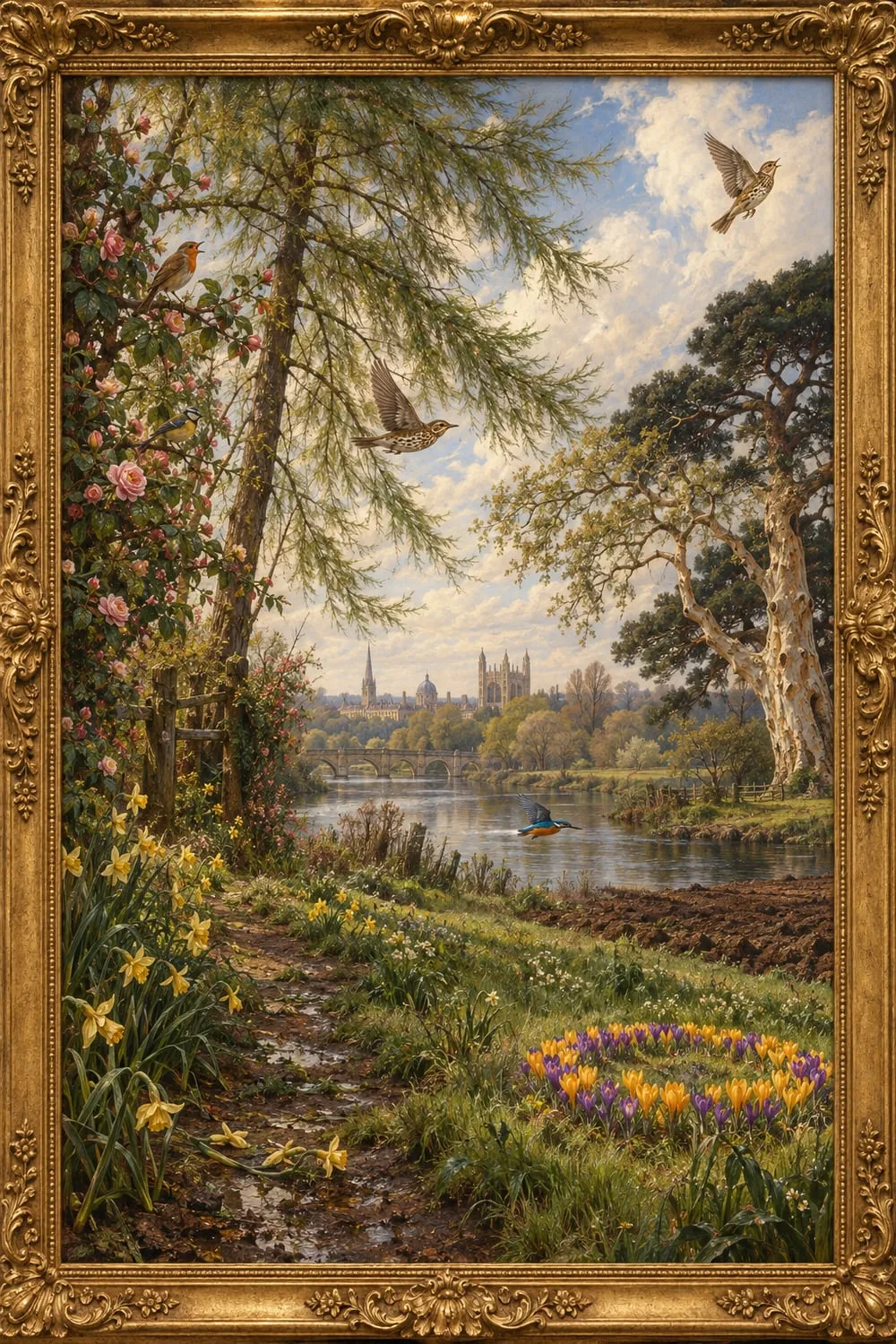
A March morning alive with spring
Magdalen Walks
"The kingfisher flies like an arrow, and wounds the air."
Poem
The little white clouds are racing over the sky,And the fields are strewn with the gold of the flower of March,The daffodil breaks under foot, and the tasselled larchSways and swings as the thrush goes hurrying by.
A delicate odour is borne on the wings of the morning breeze,The odour of deep wet grass, and of brown new-furrowed earth,The birds are singing for joy of the Spring’s glad birth,Hopping from branch to branch on the rocking trees.
And all the woods are alive with the murmur and sound of Spring,And the rose-bud breaks into pink on the climbing briar,And the crocus-bed is a quivering moon of fireGirdled round with the belt of an amethyst ring.
And the plane to the pine-tree is whispering some tale of loveTill it rustles with laughter and tosses its mantle of green,And the gloom of the wych-elm’s hollow is lit with the iris sheenOf the burnished rainbow throat and the silver breast of a dove.
See! the lark starts up from his bed in the meadow there,Breaking the gossamer threads and the nets of dew,And flashing adown the river, a flame of blue!The kingfisher flies like an arrow, and wounds the air.
In brief
SummaryA spring morning in March rushes past in five stanzas of long, quick lines. White clouds race across the sky, daffodils break underfoot, the larch sways as a thrush hurries by, and the air smells of wet grass and new-ploughed earth. Birds sing, rosebuds open, the crocus bed glows like a ring of fire, and the plane tree whispers a tale of love to the pine. The poem ends in sudden movement: a lark starts up from the dewy meadow, and a kingfisher flashes down the river like a blue arrow that 'wounds the air'.
Key themes
"The little white clouds are racing over the sky,"


Summary
Each stanza adds another sign of spring. In the first, 'The little white clouds are racing over the sky', the fields are 'strewn with the gold of the flower of March', the daffodil breaks underfoot, and the tasselled larch 'Sways and swings as the thrush goes hurrying by'. The second brings scent and sound: 'A delicate odour' of 'deep wet grass' and 'brown new-furrowed earth' on the breeze, and birds singing 'for joy of the Spring's glad birth' as they hop from branch to branch.
The third stanza fills the woods with 'the murmur and sound of Spring'. A rosebud 'breaks into pink on the climbing briar', and the crocus bed is 'a quivering moon of fire' ringed with amethyst. In the fourth the trees seem to talk and laugh: the plane whispers 'some tale of love' to the pine, and the dark hollow of a wych-elm is lit by the rainbow throat and silver breast of a dove.
The last stanza is all speed. 'See!' a lark starts up from his bed in the meadow, breaking 'the gossamer threads and the nets of dew', and a kingfisher, 'a flame of blue', flashes down the river: it 'flies like an arrow, and wounds the air'.
Themes
The rush of spring
The poem is built on movement. Clouds are 'racing', the larch 'Sways and swings', the thrush goes 'hurrying by', the lark 'starts up', the kingfisher 'flies like an arrow'. The long, galloping lines carry the same energy, and even the trees 'rustle with laughter'. Spring here is not a scene to be admired from a bench but a force in motion.
Colour and jewels
Wilde paints the morning in precious materials: fields strewn with 'gold', a crocus bed 'Girdled round with the belt of an amethyst ring', a dove with a 'burnished rainbow throat' and 'silver breast', a kingfisher like 'a flame of blue'. Nature is described as if it were a jeweller's work, rich and bright, and the effect is joyful rather than solemn.
A world without people
No person appears on the walk. The only voices are the birds' and the trees', with the plane 'whispering some tale of love' to the pine. The one command, 'See!', is addressed to the reader, who is invited to share the moment. The poem's delight lies entirely in what the senses take in: the smell of 'deep wet grass', the flash of wings, the laughter of leaves.
Context
Magdalen Walks is part of the Wind Flowers group in Wilde's Poems (1881). The title names the walks of Magdalen College, Oxford, but the poem itself mentions no place beyond 'the river' and 'the meadow'. It is a pure description of a March morning, written in five four-line stanzas of long, loosely stressed lines rhyming abba.
About this edition
- Text: the complete work from Standard Ebooks, released into the public domain (CC0 1.0). We change only the layout.
- Download the EPUB of the whole book it comes from, free, for any e-reader.
- Every quotation and glossary word in these notes is checked against the text.