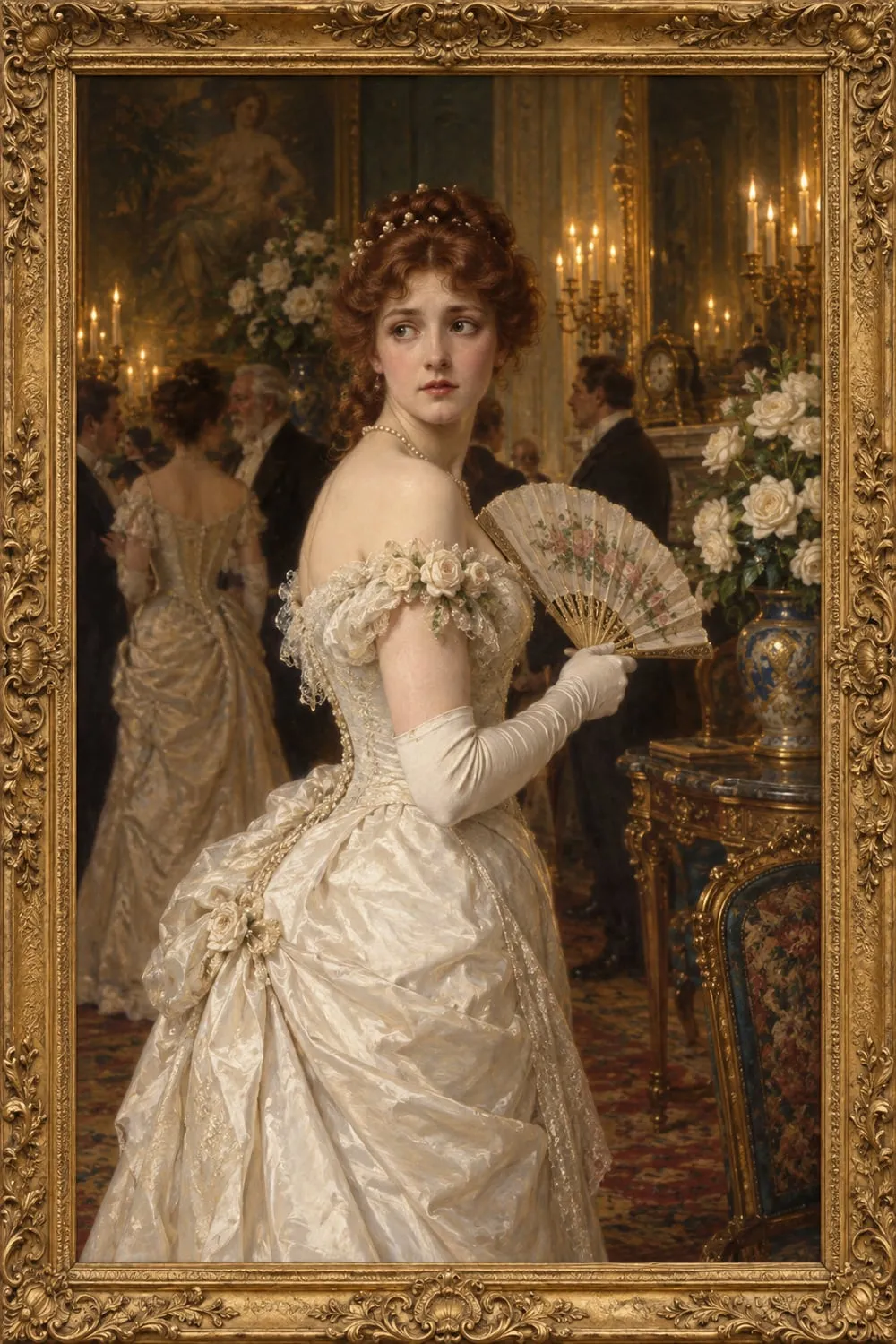
Painting for Lady Windermere's Fan

A society comedy of secrets, scandal and sacrifice

Lady Windermere's Fan

Play·1892·4 acts·about 1 h 30 min

"I can resist everything except temptation."
Lord Darlington

The story in brief

AI-assisted summary

On her twenty-first birthday, Lady Windermere hears that her husband is paying large sums to Mrs Erlynne, a woman with a notorious past. When he insists on inviting Mrs Erlynne to that night's ball, his wife swears she will strike her across the face with the fan he has just given her. When the guest arrives, she lets the fan fall and only bows coldly.

Humiliated, and certain her marriage is over, Lady Windermere decides to accept Lord Darlington's love and goes to his rooms, leaving a letter for her husband. Mrs Erlynne finds the letter and follows her. She is Lady Windermere's mother, who left her own husband and baby twenty years before, and Lord Windermere has been paying her to keep that secret. She persuades her daughter to go home, but the men arrive from their club and the fan is found on the sofa. Mrs Erlynne steps out of hiding and claims it as her own, giving up her reputation so that her daughter can slip away.

Next morning Mrs Erlynne returns the fan, keeps her secret and asks Lady Windermere to keep hers. She leaves for a life abroad, engaged to Lord Augustus Lorton and carrying the fan. Lady Windermere, who once divided women into the good and the bad, ends the play calling her 'a very good woman'.

Key themes

"No, we are all in the gutter, but some of us are looking at the stars."
Lord Darlington

Summary

AI-assisted summary

On a Tuesday afternoon in her house in Carlton House Terrace, Lady Windermere arranges roses and shows Lord Darlington the fan her husband has given her: it is her birthday, she has come of age, and she is giving a dance that night. Darlington pays her compliments she dislikes and puts an 'imaginary instance' of a young husband who befriends a woman of doubtful character, asking whether the wife should console herself. Lady Windermere, brought up by her stern aunt Lady Julia, answers that women who have committed a fault should never be forgiven and that men should be judged by the same laws.

The Duchess of Berwick arrives with her daughter, Lady Agatha, sends the girl off to look at photographs and then the sunset, and tells Lady Windermere what all London is saying: that Lord Windermere visits a Mrs Erlynne in Curzon Street four or five times a week and seems to be paying for her house and her ponies. Left alone, Lady Windermere searches her husband's bank book and finds nothing, then cuts open a second, locked book and finds payments to Mrs Erlynne of £600, £700 and £400.

Lord Windermere comes in and is angry that she has spied on him. He swears he has never loved anyone but her, says that Mrs Erlynne lost her place in the world twenty years ago, and asks his wife to invite her to the party so that she can return to society. Lady Windermere refuses, so he writes the card himself and sends it to 84A Curzon Street. She warns him that if the woman crosses her threshold she will strike her across the face with the fan, and tells Parker to announce the guests' names very distinctly. Alone, Lord Windermere admits that he dare not tell his wife who Mrs Erlynne really is, because the shame would kill her.

That night the drawing-room fills with guests. The Duchess steers Agatha towards Mr Hopper, a rich young Australian, while her brother Lord Augustus Lorton questions Lord Windermere about Mrs Erlynne, with whom he is infatuated. When Parker announces Mrs Erlynne, Lady Windermere lets the fan drop and only bows coldly. Mrs Erlynne sets about conquering the room: she makes Cecil Graham introduce her to his aunt, Lady Jedburgh, and wins an invitation to lunch, invites Mr Dumby to lunch in front of the jealous Lady Plymdale, and dances with Lord Windermere.

Lord Darlington tells Lady Windermere that he loves her and begs her to leave her husband that night. She says she has not the courage, and he tells her he will leave England the next day. The Duchess, now charmed by Mrs Erlynne, announces Agatha's engagement to Mr Hopper. Lady Windermere then watches her husband talk with Mrs Erlynne, who means to accept Lord Augustus and wants a settlement of £2,000 or £2,500 a year. Resolved, Lady Windermere writes her husband a letter and goes to Darlington. Parker tells Mrs Erlynne about the letter. She opens it and finds the same words she once wrote to her own husband, Lady Windermere's father. Determined to save her child, she keeps the letter from Lord Windermere and sends Lord Augustus to hold him at his club all night.

In Lord Darlington's rooms, Lady Windermere loses her nerve and is about to go home when Mrs Erlynne arrives. She refuses to believe her at first, sure that her husband has sent his mistress to fetch her back. Mrs Erlynne burns the letter, swears that Lord Windermere is guiltless, and describes the life of an outcast in which 'one pays for one's sin, and then one pays again'. Her plea that Lady Windermere must stay with her child breaks her resistance. As they go, voices are heard outside, and the two women hide, Lady Windermere behind the window curtain and Mrs Erlynne in the next room.

Turned out of their club at two o'clock, Lord Augustus, Lord Windermere, Cecil Graham and Mr Dumby arrive with Lord Darlington. The men drink and trade epigrams about women, and Darlington admits he loves a good woman who is not free. Cecil Graham notices a fan on the sofa and, thinking Darlington has a woman hidden in his rooms, shows it to Lord Windermere, who recognises it as his wife's. He demands an explanation and makes for the curtain, but Mrs Erlynne steps out and says she took Lady Windermere's fan by mistake. In the confusion Lady Windermere slips away unseen.

Next morning Lady Windermere, sure that Mrs Erlynne will tell the truth, resolves to confess. Lord Windermere, now convinced that Mrs Erlynne is as bad as a woman can be, forbids his wife to see her, but Mrs Erlynne calls to return the fan and say goodbye before leaving to live abroad. While Lady Windermere fetches a photograph of herself with her little boy, Lord Windermere accuses Mrs Erlynne of blackmail. She tells him she has known a mother's feelings only once, the night before, that she has no wish to play the part of a mother, and forbids him to reveal who she is.

Mrs Erlynne learns that her daughter worships the memory of a mother she believes dead, and leaves that ideal undisturbed. Alone with Lady Windermere, she asks her to repay her by silence and never tell her husband about the night before. She asks for the fan, which bears the name Margaret, their shared Christian name, and leaves on the arm of Lord Augustus. He returns to announce that she has explained everything and accepted his hand. Lord Windermere remarks that he is marrying a very clever woman; his wife answers that he is marrying a very good one.

Act by act

AI-assisted summary
  1. The play is dedicated to the memory of Robert, Earl of Lytton. Its cast gathers titled Londoners, their servants and the mysterious Mrs Erlynne around Lord and Lady Windermere. Three acts take place in Lord Windermere's house and one in Lord Darlington's rooms. The whole action is set in London in 'the present' and runs for twenty-four hours, from five o'clock on a Tuesday afternoon to half-past one the next day.

    Lady Windermere, Lord Windermere, Mrs Erlynne, Lord Darlington, The Duchess of Berwick, Lord Augustus Lorton, Lady Agatha Carlisle, Cecil Graham, Mr Dumby, Mr Hopper, Parker, Lady Plymdale, Lady Jedburgh

  2. On her birthday, Lady Windermere turns aside Lord Darlington's compliments and insists that women who have sinned should never be forgiven. The Duchess of Berwick tells her that Lord Windermere visits Mrs Erlynne constantly, and a locked bank book confirms large payments. Lord Windermere denies any wrong but writes Mrs Erlynne an invitation to the ball himself, and his wife vows to strike her with the fan. Alone, he admits he dare not tell her who Mrs Erlynne really is.

    Lady Windermere, Lord Darlington, The Duchess of Berwick, Lady Agatha Carlisle, Lord Windermere, Mrs Erlynne, Parker

  3. At the ball Mrs Erlynne charms the guests, and Lady Agatha accepts Mr Hopper. Lord Darlington declares his love and begs Lady Windermere to leave with him; she refuses, and he says he will leave England. After watching her husband with Mrs Erlynne, she leaves him a letter and goes to Darlington. Mrs Erlynne reads the letter, recognises her own past in it, and sends Lord Augustus to keep Lord Windermere at his club.

    Lady Windermere, Lord Windermere, Mrs Erlynne, Lord Darlington, The Duchess of Berwick, Lord Augustus Lorton, Lady Agatha Carlisle, Cecil Graham, Mr Dumby, Mr Hopper, Parker, Lady Plymdale, Lady Jedburgh

  4. Mrs Erlynne finds Lady Windermere waiting in Lord Darlington's rooms, burns her letter and persuades her to go home to her husband and child. Before they can leave, the men arrive from their club and both women hide. Cecil Graham finds the fan on the sofa, and Lord Windermere recognises it as his wife's. As he makes for the curtain, Mrs Erlynne steps out and claims the fan, and Lady Windermere slips away unseen.

    Lady Windermere, Mrs Erlynne, Lord Darlington, Lord Windermere, Lord Augustus Lorton, Cecil Graham, Mr Dumby

  5. Next morning Lady Windermere resolves to confess, but Mrs Erlynne arrives to return the fan and say goodbye. Alone with Lord Windermere, she forbids him to tell his wife that she is her mother. She asks Lady Windermere for a photograph, for her silence and for the fan, and leaves on Lord Augustus's arm. He returns to announce that she has explained everything and accepted his hand.

    Lady Windermere, Lord Windermere, Mrs Erlynne, Lord Augustus Lorton, Parker

Characters

AI-assisted notes
  • Painted portrait of Lady Windermere

    Lady Windermere

    The Puritan wife

    Margaret, Lady Windermere, comes of age on the day the play begins and has a six-month-old son. Raised by her stern aunt, Lady Julia, she divides the world into good and bad and allows no compromise. Believing her husband unfaithful, she comes close to ruin by going to Lord Darlington's rooms. Saved by Mrs Erlynne, she learns that good women can be reckless and bad ones capable of sacrifice, though she never learns that Mrs Erlynne is her mother.

  • Painted portrait of Lord Windermere

    Lord Windermere

    The secret-keeping husband

    Arthur, Lord Windermere, loves his wife and has been paying Mrs Erlynne large sums for six months to keep her identity from her. Rather than tell Margaret that her mother is alive, he forces the invitation to the ball and endures the first quarrel of his marriage. After Mrs Erlynne is found in Lord Darlington's rooms he turns against her completely, and he ends the play believing that evil has never entered his wife's world.

  • Painted portrait of Mrs Erlynne

    Mrs Erlynne

    The woman with a past

    Mrs Erlynne is Lady Windermere's mother, who left her husband and baby for a lover twenty years before and has come back to London under an assumed name. Clever and worldly, she uses Lord Windermere's fear of scandal to fund her return to London society. When she reads her daughter's letter she feels a mother's love for the first time and gives up her own reputation to save her. She keeps her secret, takes the fan and marries Lord Augustus.

  • Painted portrait of Lord Darlington

    Lord Darlington

    Wit turned lover

    Lord Darlington is a witty man of fashion who, Lady Windermere suspects, pretends to be worse than he is. Over tea he argues that people are not good or bad but charming or tedious, and at the ball he declares his love and begs her to leave her husband. Refused, he resolves to leave England. In his rooms he speaks of the only good woman he has ever met, and the discovery of her fan nearly ruins her.

  • Painted portrait of The Duchess of Berwick

    The Duchess of Berwick

    Society's chief gossip

    The Duchess of Berwick is a talkative society mother and Lord Augustus's sister. She brings Lady Windermere the scandal about her husband and advises carrying him off to Homburg, since in her view all men are monsters. She manages her daughter Agatha completely. At the ball she changes her mind about Mrs Erlynne after one charming chat, and secures Mr Hopper for Agatha while steering the couple towards Grosvenor Square rather than Australia.

  • Painted portrait of Lord Augustus Lorton

    Lord Augustus Lorton

    The infatuated suitor

    Lord Augustus Lorton, known to his friends as Tuppy, is the Duchess of Berwick's 'disreputable brother', whose past marriages are a standing joke. He is infatuated with Mrs Erlynne and easily managed by her: she sends him to keep Lord Windermere at his club, which leads the men to Lord Darlington's rooms. Cool towards her the next morning, he is won back once she has 'explained everything', and he announces their engagement at the end.

  • Painted portrait of Lady Agatha Carlisle

    Lady Agatha Carlisle

    The obedient daughter

    Lady Agatha Carlisle is the Duchess of Berwick's daughter. Every line she speaks is some form of 'Yes, mamma', and her mother sends her to look at photographs or sunsets whenever the talk turns to scandal. Yet she quietly becomes engaged to Mr Hopper on the terrace at the ball and tells him she would like to go with him to Australia.

  • Painted portrait of Cecil Graham

    Cecil Graham

    The club wit

    Cecil Graham is a young dandy who lives for epigrams and prefers other people's business to his own. At the ball Mrs Erlynne makes him introduce her to his aunt, Lady Jedburgh. In Lord Darlington's rooms he teases Lord Augustus, explains the difference between gossip and scandal, and spots the fan on the sofa. Assuming Darlington has a woman hidden, he shows it to Lord Windermere and sets off the crisis of Act III.

  • Painted portrait of Mr Dumby

    Mr Dumby

    The languid cynic

    Mr Dumby drifts through the ball agreeing with everyone about the season and telling the jealous Lady Plymdale that he has never met Mrs Erlynne, until Mrs Erlynne invites him to lunch in front of her. In Lord Darlington's rooms he dozes in a chair between remarks, yet produces some of the play's sharpest lines, including his verdict that there are only two tragedies in the world.

  • Painted portrait of Mr Hopper

    Mr Hopper

    The rich Australian

    Mr Hopper, whose first name is James, is a rich young Australian whose father made a great fortune selling food in tins. The Duchess of Berwick flatters him as a match for Agatha. He proposes to Lady Agatha on the terrace and is accepted, though the Duchess plans to keep the couple in Grosvenor Square rather than let them go to Australia.

  • Painted portrait of Parker

    Parker

    The butler

    Parker is the Windermeres' butler. He announces every guest, and Lady Windermere orders him to pronounce the names very distinctly so that she will not miss Mrs Erlynne's. At the end of the ball he tells Mrs Erlynne that Lady Windermere has gone out of the house and left a letter for her husband, the news that sets the rescue in motion. Next morning he brings in the fan she returns.

  • Painted portrait of Lady Plymdale

    Lady Plymdale

    The jealous flirt

    Lady Plymdale is Mr Dumby's jealous companion at the ball. She is furious to learn that he knows Mrs Erlynne, then decides he must lunch with her after all and take her own husband along, to keep him busy. Her remark that such women 'form the basis of other people's marriages' shows how coolly society makes use of the scandal it condemns.

  • Painted portrait of Lady Jedburgh

    Lady Jedburgh

    A dowager won over

    Lady Jedburgh is Cecil Graham's aunt Caroline. At the ball Mrs Erlynne has herself introduced, flatters her about her nephew's political career and is invited to lunch on Thursday. By the end of the evening Lady Jedburgh calls her a fascinating woman, a sign of how quickly society opens its doors once one respectable house has received her.

Themes

AI-assisted notes

Good and bad women

Lady Windermere begins the play certain that women who have committed 'what the world calls a fault' should never be forgiven, and that life would be simpler with 'hard and fast rules'. The subtitle, A Play About a Good Woman, leaves open which woman is meant. By the last act the Puritan has nearly ruined herself, and the woman she called vile has saved her. She tells her husband that people cannot be divided 'into the good and the bad as though they were two separate races or creations', and the final line gives Mrs Erlynne the title of a very good woman.

A mother's sacrifice

Mrs Erlynne abandoned her child and has lived for twenty years without her. Reading her daughter's farewell letter, she recognises 'the same words' she once wrote to her own husband, and for the first time feels what she later calls a mother's feelings: 'They were terrible'. In Lord Darlington's rooms her plea rests on the child waiting at home, and she gives up her own name to protect her daughter. Yet she refuses a sentimental ending. She will not weep on her daughter's neck or retire to a convent, and she leaves to marry Lord Augustus.

Secrets and silence

Every main character ends the play keeping something back. Lord Windermere hides Mrs Erlynne's identity to spare his wife, and pays for it with the first quarrel of their marriage. Mrs Erlynne forbids him to reveal it and chooses not to tell Lady Windermere herself. Lady Windermere, in turn, promises never to tell her husband that she went to Lord Darlington's rooms. 'Then pay your debt by silence,' Mrs Erlynne tells her. The marriage survives because each partner is protected by a truth the other does not know.

Scandal and society

London society in the play lives on talk. The Duchess of Berwick passes on the gossip of her nieces, the Saville girls, then reverses her opinion of Mrs Erlynne after one conversation at the ball. Lady Jedburgh invites her to lunch, and Lady Plymdale wants her as a distraction for her own husband, since such women 'form the basis of other people's marriages'. Cecil Graham calls scandal 'gossip made tedious by morality'. A reputation, the play suggests, depends less on what a woman has done than on which houses are seen to receive her.

The fan

The fan carries the plot. It is Lord Windermere's birthday present to his wife, and it has her name, Margaret, on it. She threatens to strike Mrs Erlynne across the face with it, but lets it drop when her rival enters, and Lord Darlington hands it back to her. Left on his sofa, it is the evidence that nearly exposes her, and Mrs Erlynne's false claim to it saves her. In Act IV Mrs Erlynne asks for the fan and carries it away, since the name on it is hers too.

Marriage and money

The society of the play treats marriage as a market. The Duchess of Berwick says she accepted her husband only because of his threats of suicide, and calls Agatha's engagement 'love at the end of the season'. Mrs Erlynne, about to accept Lord Augustus, asks Lord Windermere for £2,000, then £2,500 a year, because 'In modern life margin is everything'. Dumby complains that women nowadays are 'awfully commercial'. Against this, Lady Windermere calls life 'a sacrament' whose purification is sacrifice, and it is Mrs Erlynne's unpaid sacrifice that settles the play.

Context

AI-assisted notes

Lady Windermere's Fan was Oscar Wilde's first society comedy. It was first performed at the St James's Theatre, London, on 20 February 1892, produced by George Alexander, who also played Lord Windermere. At the first night Wilde made a curtain speech, and he was criticised for appearing smoking a cigarette.

The play is subtitled 'A Play About a Good Woman', a phrase that leaves the audience to decide which of its women deserves it. It was published in 1893 by Elkin Mathews and John Lane, and the printed text is dedicated to the memory of Robert, Earl of Lytton.

Wilde sets the action in the London of his own day and confines it to twenty-four hours, from five o'clock on a Tuesday afternoon to half-past one the next day, in two rooms of the Windermeres' house and in Lord Darlington's rooms. The plot draws on the machinery of melodrama, with a lost mother, a letter, a woman hidden behind a curtain and a fan left on a sofa, but it is played out among people who talk in epigrams, above all in the men's scene of Act III.

First performed at the St James's Theatre, London, on 20 February 1892; published 1893.

About this edition

  • Text: the complete work from Standard Ebooks, released into the public domain (CC0 1.0). We change only the layout.
  • Download the EPUB, free, for any e-reader.
  • Audiobook: a full-cast reading by volunteers for LibriVox, in the public domain.
  • The summaries, character notes, themes and glossary were written with AI from the text and then checked: every quotation and every glossary word is matched against the text.