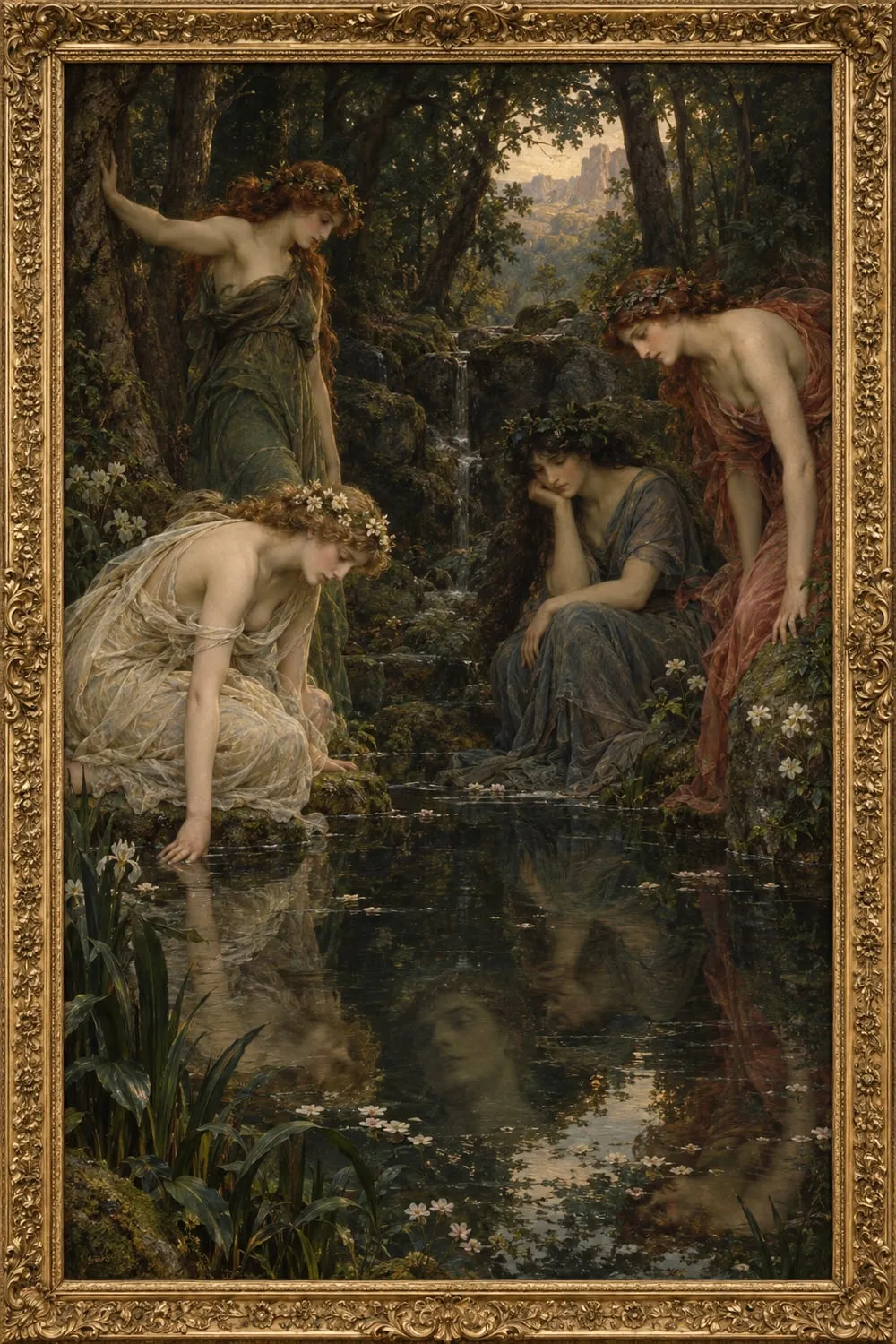
The pool that mourned Narcissus
The Disciple
"But was Narcissus beautiful?"
Poem in prose
When Narcissus died the pool of his pleasure changed from a cup of sweet waters into a cup of salt tears, and the Oreads came weeping through the woodland that they might sing to the pool and give it comfort.
And when they saw that the pool had changed from a cup of sweet waters into a cup of salt tears, they loosened the green tresses of their hair and cried to the pool and said, “We do not wonder that you should mourn in this manner for Narcissus, so beautiful was he.”
“But was Narcissus beautiful?” said the pool.
“Who should know that better than you?” answered the Oreads. “Us did he ever pass by, but you he sought for, and would lie on your banks and look down at you, and in the mirror of your waters he would mirror his own beauty.”
And the pool answered, “But I loved Narcissus because, as he lay on my banks and looked down at me, in the mirror of his eyes I saw ever my own beauty mirrored.”
In brief
SummaryWhen Narcissus dies, the pool where he used to gaze at himself turns from sweet water to salt tears. The Oreads come through the woodland to comfort it, saying they do not wonder at its grief, so beautiful was he. The pool asks, 'But was Narcissus beautiful?' The Oreads reply that the pool should know best, since Narcissus passed them by to lie on its banks and admire his own beauty in its waters. The pool answers that it loved Narcissus because, in the mirror of his eyes, it saw its own beauty.
Key themes
"But was Narcissus beautiful?"


Summary
When Narcissus dies, 'the pool of his pleasure' changes from 'a cup of sweet waters into a cup of salt tears', and the Oreads come weeping through the woodland to sing to it and give it comfort. Seeing the change, they loosen the green tresses of their hair and cry to the pool, 'We do not wonder that you should mourn in this manner for Narcissus, so beautiful was he.'
The pool's reply is a question: 'But was Narcissus beautiful?' The Oreads answer, 'Who should know that better than you?' Narcissus always passed them by and sought only the pool, lying on its banks and looking down, 'and in the mirror of your waters he would mirror his own beauty'. The pool then gives its own reason for loving him: 'as he lay on my banks and looked down at me, in the mirror of his eyes I saw ever my own beauty mirrored.' The mourner turns out to be as absorbed in itself as the youth it mourns.
Characters
The pool
Narcissus's mirror
The woodland pool in which Narcissus used to gaze. At his death its sweet water turns to salt tears. When the Oreads praise his beauty it asks whether he was beautiful at all, and admits it loved him only because it saw its own beauty in his eyes.
The Oreads
Nymphs who come to comfort
Nymphs who come weeping through the woodland, loosen the green tresses of their hair, and try to console the pool. They assume it mourns Narcissus for his beauty, and remind it that he passed them by for its waters. The pool's answer takes them by surprise.
Narcissus
The dead beauty
Already dead when the story begins. He passed the Oreads by and lay on the pool's banks to see 'his own beauty' mirrored in its waters. Everyone remembers him as beautiful except the pool, which never looked at him, only at itself.
Themes
Vanity reflected
The parable doubles the myth of Narcissus. He loved the pool because 'in the mirror of your waters he would mirror his own beauty'; the pool loved him because 'in the mirror of his eyes I saw ever my own beauty mirrored'. Each used the other as a looking-glass. The repeated word 'mirror' makes the symmetry exact, and the joke is that neither ever looked at the other.
Grief and self-love
The pool's grief is real, its sweet water turned to 'salt tears', but its cause is not what the Oreads suppose. The pool does not mourn Narcissus's beauty, which it never noticed, but the loss of its own reflection in his eyes. The story suggests that mourning, like love, can be a form of self-regard.
Master and disciple
The disciple of the title is the pool, a follower that has learned its master's lesson perfectly. Narcissus loved only what showed him his own face, and the pool has done exactly the same. The Oreads, who complain 'Us did he ever pass by', are the only figures in the story who look outward and admire someone else.
Context
The Disciple is one of the six Poems in Prose first published together in the Fortnightly Review in July 1894. It takes up the Greek myth of Narcissus, the youth who fell in love with his own reflection, and adds a twist of its own by telling the story from the side of the pool. At under two hundred words, it is the shortest of the six.
About this edition
- Text: the complete work from Standard Ebooks, released into the public domain (CC0 1.0). We change only the layout.
- Download the EPUB of the whole book it comes from, free, for any e-reader.
- Every quotation and glossary word in these notes is checked against the text.