Summary
Moonlight falls on a great terrace in the palace of Herod, the Tetrarch, set above the banqueting hall. The young Syrian, captain of the guard, keeps exclaiming at the beauty of the Princess Salomé, who sits at the feast inside. His friend the Page of Herodias begs him not to look at her so much and sees in the moon a dead woman looking for dead things. Soldiers, a Cappadocian and a Nubian pass the time talking about the Jews' quarrels over religion, the Tetrarch's three wines and the gods of their own countries. A voice rises from an old cistern: it is the prophet Jokanaan, foretelling one mightier than himself. The soldiers explain that he came from the desert, that Herod has forbidden anyone to see him, and that Herod's elder brother, the first husband of Herodias, was kept in the same cistern for twelve years before the executioner Naaman strangled him.
Salomé comes out onto the terrace, troubled by the way her mother's husband looks at her 'with his mole's eyes'. She calls the moon cold and chaste, a virgin. When Jokanaan cries out again she learns that he says terrible things about her mother and that Herod is afraid of him, and she demands to speak with him. The soldiers refuse. She turns to the young Syrian, calls him by his name, Narraboth, and promises to let fall a little green flower for him from her litter and to smile at him through her veils. He gives the order, and the prophet is brought up out of the cistern.
Jokanaan calls for the one 'whose cup of abominations is now full' and for the woman who gave herself to the captains of Assyria, and Salomé knows he means her mother. She is terrified by his eyes and fascinated by his pallor. When she tells him who she is, he orders her back, calls her daughter of Babylon and daughter of Sodom, and tells her to seek the Son of Man. She praises the whiteness of his body, and when he refuses her she calls it hideous; she praises his black hair, then reviles it; she praises his red mouth and declares, over and over, that she will kiss it. The young Syrian, unable to bear her words, kills himself and falls between them. Jokanaan curses her and goes back down into the cistern, while the Page mourns the dead captain and the soldiers hurry to hide the body.
Herod enters with Herodias and the whole court, looking for Salomé. He slips in the captain's blood, orders the body taken away, and hears a beating of vast wings that no one else can hear. Salomé refuses his wine, his fruit and her mother's throne, and Herodias tells him again and again not to look at her daughter. Jokanaan's voice keeps breaking in. Herodias asks why Herod will not hand him over to the Jews; Herod answers that he is a holy man who has seen God. Five Jews dispute whether any man has seen God since Elias, and two Nazarenes tell of a Messiah who turns water into wine, heals lepers and raises the dead. Herod forbids him to raise the dead. When the prophet calls for the wanton daughter of Babylon to be stoned, Herodias demands silence, and she and Herod quarrel over her first marriage and over which of them is sterile.
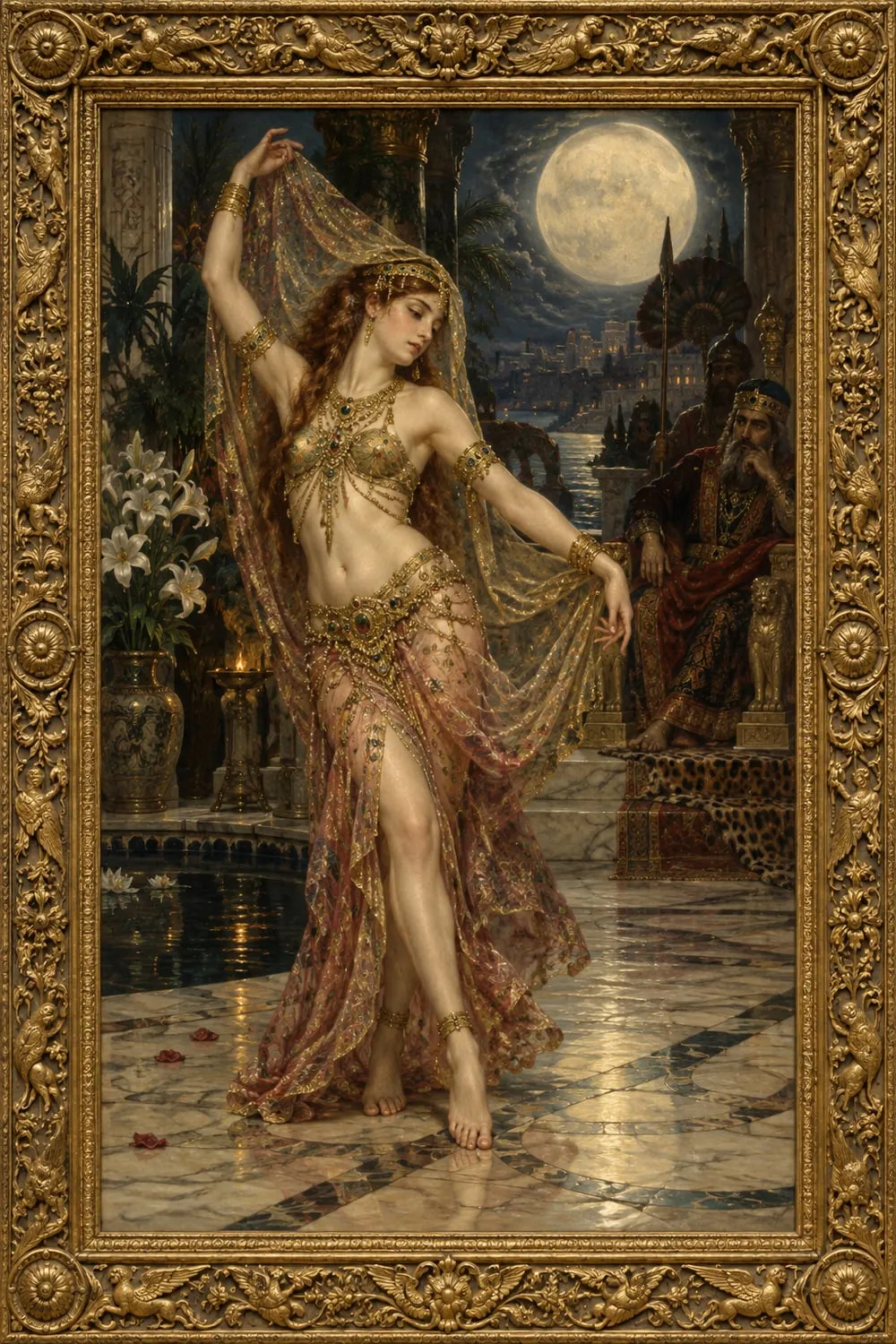
Herod asks Salomé to dance and she refuses. Sad, and shaken by the omens of the evening, he promises her anything she asks if she will dance, even to the half of his kingdom, and swears it by his life, his crown and his gods. Herodias begs her daughter not to dance. Herod tears off his garland of roses, which burns his forehead, and sees the moon turn as red as blood, as Jokanaan foretold. Salomé agrees. Her slaves bring perfumes and the seven veils and take off her sandals, and she dances the dance of the seven veils.
Kneeling, she asks for something in a silver charger, and Herod laughs and agrees; then she rises and names the head of Jokanaan. Herodias is delighted. Herod refuses, and Salomé insists that she asks for her own pleasure, not at her mother's bidding. He offers the largest emerald in the world, fifty and then all of his white peacocks, collars of pearls, topazes, opals and sapphires, the mantle of the high priest and the veil of the sanctuary. To every offer she answers only, 'Give me the head of Jokanaan.' At last he sinks back and gives way. Herodias draws the ring of death from his finger, and the executioner goes down into the cistern.
Salomé leans over the cistern and hears nothing. Believing the executioner has dropped his sword in fear, she calls on the Page and the soldiers to go down, but they shrink back. A huge black arm lifts the head up on a silver shield. Holding it, Salomé speaks to it at length: she taunts the shut eyes and the silent tongue, tells him he was the only man she has loved, and says that if he had looked at her he would have loved her. Herod calls her monstrous, has the torches put out and makes for the staircase as a cloud hides the moon. In the dark Salomé's voice says that she has kissed his mouth and that there was a bitter taste on his lips. A moonbeam falls on her, and Herod turns and cries, 'Kill that woman!' The soldiers crush her beneath their shields.