Summary
One morning the old Water-rat watches a Duck trying to teach her ducklings to stand on their heads, and tells her that he is not a family man: love is all very well, but a devoted friendship is higher. A Green Linnet asks what he thinks the duties of a devoted friend are. He expects his devoted friend to be devoted to him, and does not understand the question of what he would do in return. The Linnet offers him a story that is applicable to him.
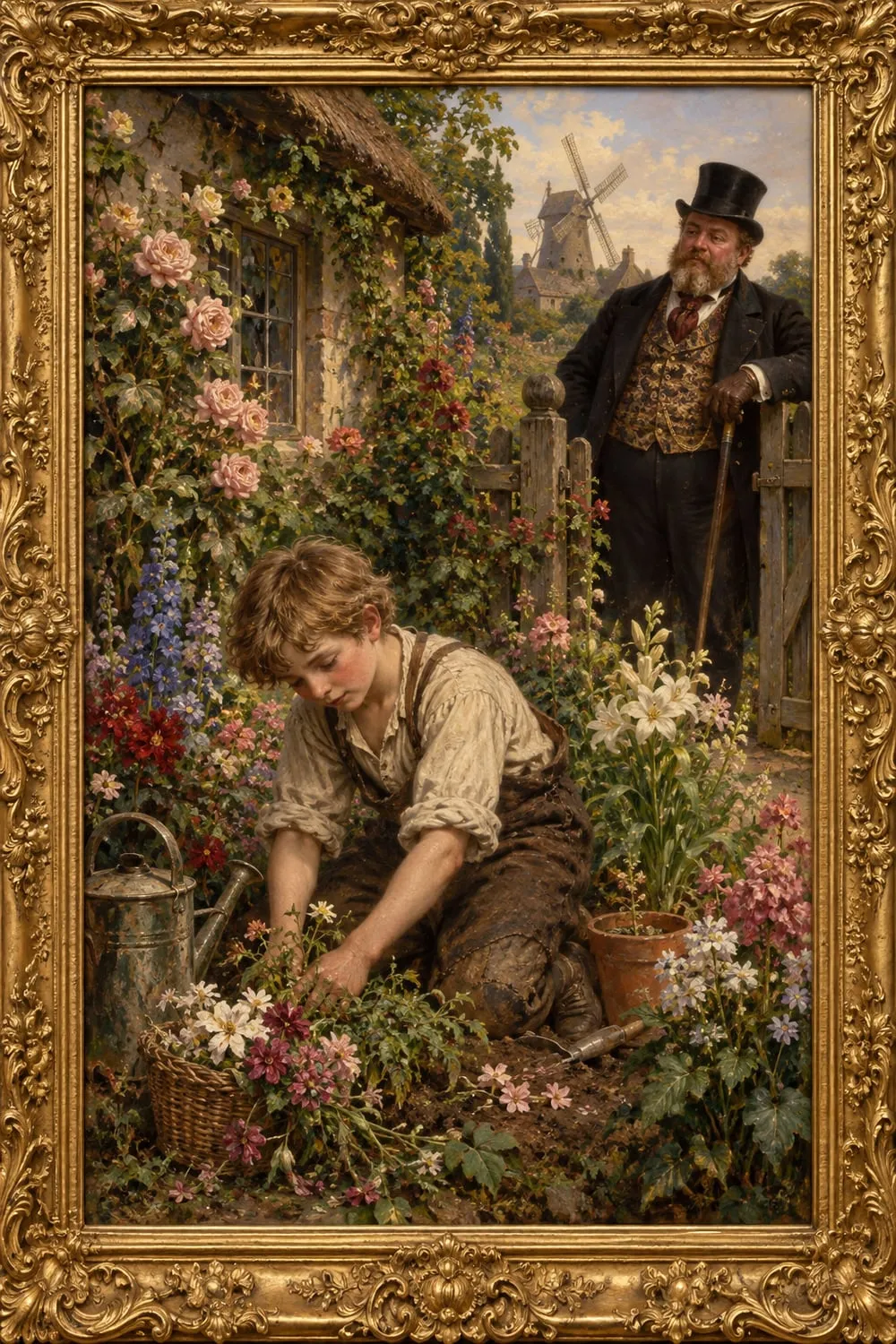
Little Hans lives alone in a tiny cottage with a beautiful garden. His most devoted friend is big Hugh the Miller, who fills his pockets from the garden whenever he passes and says that real friends should have everything in common, though he never gives Hans anything. In winter Hans is hungry and lonely, but the Miller stays away, telling his wife that people in trouble should be left alone. When his youngest son suggests inviting Hans to share their supper, the Miller scolds him: Hans might grow envious, or ask for flour on credit, and flour and friendship should not be confused. The Water-rat interrupts to say that he likes the Miller immensely.
In spring the Miller calls on Hans and learns that he has sold his silver buttons, his chain, his pipe and his wheelbarrow to buy bread. With great show he promises Hans his own broken wheelbarrow, then takes Hans's plank to mend his barn roof and has him fill a big basket with all his primroses, leaving none to sell. From then on every request comes backed by the promised wheelbarrow: Hans carries a sack of flour to market, mends the barn roof, drives the Miller's sheep to the mountain and runs endless errands, while his own flowers go unwatered. Hans copies the Miller's fine sayings into a notebook.
One wild night the Miller comes to the door: his little boy has fallen off a ladder, and it would be better if Hans went for the Doctor. He will not lend Hans his new lantern. Hans reaches the Doctor after three hours, but on the way back he loses his way on the moor and is drowned in a deep pool. At the funeral the Miller takes the best place as chief mourner, and at the inn afterwards he laments that he has been left with the wheelbarrow, since one always suffers for being generous.
The Water-rat asks what became of the Miller, and the Linnet says he does not care. When the Water-rat learns that the story has a moral, he shouts 'Pooh' and goes back into his hole. The Duck remarks that telling a story with a moral is always a very dangerous thing to do, and the narrator agrees with her.