Themes
False friendship
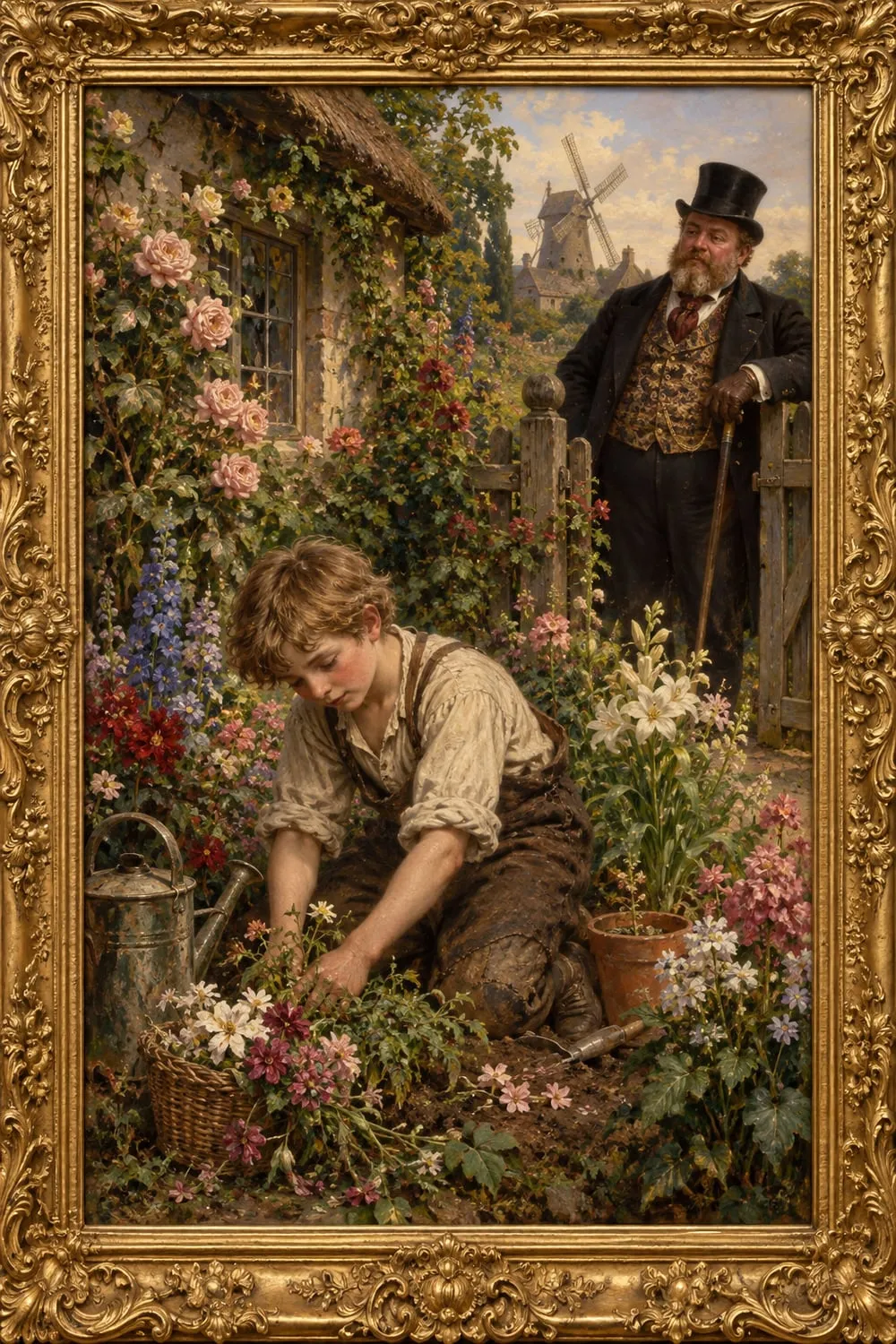
The Miller uses the language of friendship to take everything Hans has. 'Real friends should have everything in common', he says, while filling his pockets from Hans's garden and keeping his hundred sacks of flour to himself. His promise of a broken wheelbarrow, never delivered, buys him a plank, a basket of primroses, weeks of labour and finally Hans's life. The Water-rat's opening definition of friendship, that his friend should be devoted to him, is simply the Miller's creed stated plainly.
Fine words and plain deeds
The Miller prides himself on talking well. 'Lots of people act well', he tells his wife, 'but very few people talk well', and she says that listening to him is 'just like being in church'. He tells Hans that he has 'only the practice of friendship; some day you will have the theory also'. The tale turns the joke round: Hans, who acts, is the real friend, and the Miller, who talks, is exposed by every action he takes, down to refusing Hans his lantern on the night of the storm.
Goodness that cannot see
Hans's kindness makes him easy to use. He is proud to have a friend 'with such noble ideas', copies the Miller's sayings into a notebook, and would 'much sooner have your good opinion than my silver buttons'. He even takes the errand to the Doctor 'quite as a compliment'. The tale does not mock his goodness, but it shows how completely a generous person can be exploited by someone who has learned the right words, and how the neighbours notice what Hans himself will not.
Stories and their morals
The tale is told inside a frame. The Water-rat will only listen if the story is about him, advises the Linnet to follow the 'new method' of starting with the end, and admires a critic whose only reply to a young man is 'Pooh!'. When he learns the story has a moral, he is outraged and goes back into his hole. The Duck's warning that a moral is 'always a very dangerous thing' and the narrator's final agreement let Wilde tell a moral tale while laughing at moral tales.
Hypocrisy and respectability
The Miller is admired by his wife, who ranks him above the clergyman, and everyone accepts him as Hans's best friend. He walks at the head of Hans's funeral in a long black cloak, wiping his eyes, and claims the best place because he was the best friend. At the inn, over spiced wine and sweet cakes, his only regret is that the wheelbarrow is now in his way. His last words in the story, 'One always suffers for being generous', show a man whose self-regard survives even the death he caused.