Summary
At noon on Saint Philip's Day, Guido Ferranti and his friend Ascanio Cristofano wait in the market place of Padua. A month earlier a stranger gave Guido a letter signed 'Your Father's Friend', promising to reveal the secret of his birth. A man in a violet cloak with a silver falcon on the shoulder arrives: Count Moranzone. He sends Ascanio away and tells Guido that he is the son of Duke Lorenzo, Prince of Parma, who was taken in ambush by Giovanni Malatesta of Rimini and beheaded on a public scaffold, sold by a trusted friend for cities and lands. Guido's mother died giving birth to him, and Moranzone hid the child with an old servant near Perugia and reared him for revenge.
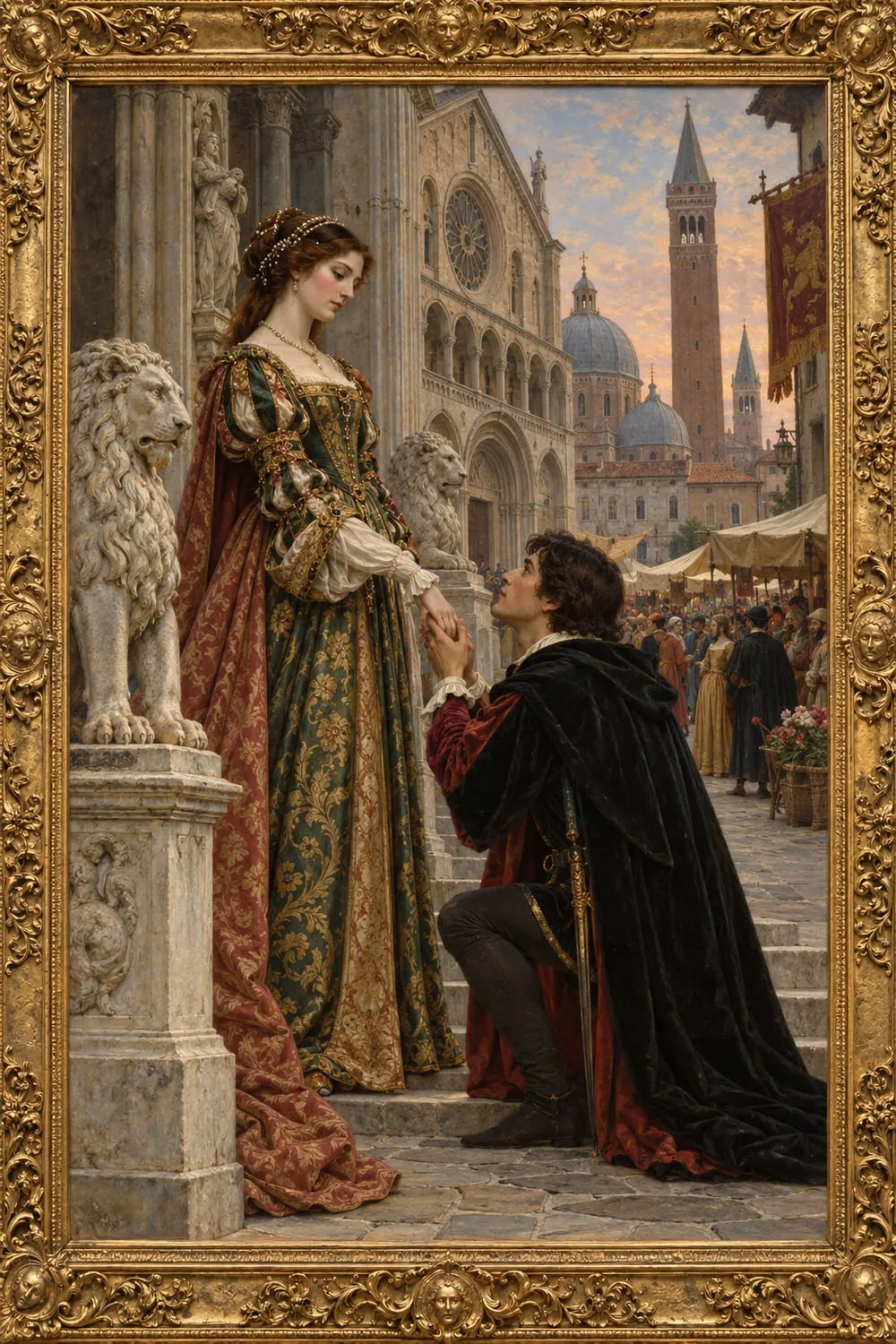
Guido swears not to strike until Moranzone sends him a sign, his father's dagger with its two leopards. When the Duke arrives with his court, Moranzone kneels to him: this is the man who sold Lorenzo. He passes Guido off as his Mantuan nephew, and the Duke lectures the young man on his creed: every man has his price, first impulses are generally good, and conscience is only cowardice. Guido has to kneel and kiss his hand. At Moranzone's order he sends Ascanio away for ever and swears to give up friendship and the love of women, but as he takes the oath the Duchess comes down the Cathedral steps, their eyes meet, and the dagger falls from his hand.
In the palace a mob shouts 'Death to the Duke'. The Duchess stops the guard from shooting and brings in citizens who complain of chaff bread, foul water and heavy taxes. The Duke mocks them, promises them a sermon from the Cardinal on the Beauty of Obedience, and pays one of them to cry 'God save the Duke'. The Duchess gives them a hundred ducats from her own purse and bread every Monday. The Duke reminds her that she is alone and friendless in Padua, and that his second Duchess, who also questioned him, lies under a monument of red marble.
Beatrice prays to the Madonna for help. Guido declares his love, and she confesses that she has loved him since the day she first saw him. Moranzone watches them through the doorway. A package arrives in vermilion silk, and Beatrice playfully opens it to find the leopard dagger. Appalled that love has made him forget his father, Guido tells her that a barrier lies between them and leaves. The Duke keeps her at home from the hunt, and she resolves to kill herself that night. Moranzone, dressed in black, tells her Guido does not love her and gives his name as Revenge.
At night, in a storm, Guido climbs into the palace by a rope ladder. Moranzone is waiting on the stairs with horses ready, but Guido tells him he will not kill the Duke: he will lay the dagger and a letter on the sleeping man's breast so that he knows he was spared, then take service with the Doge of Venice and seek death in the wars. Moranzone leaves in contempt. Beatrice appears in white at the top of the stairs. She woke meaning to stab herself, saw the Duke asleep, understood him to be the barrier, and killed him. Guido calls her an angel fresh from Hell who has murdered love. She pleads with him, then goes up the stairs threatening vengeance. Soldiers pour down with torches and she points Guido out as her husband's murderer; he is seized with her bloody knife in his hand.
In the Court of Justice the citizens gossip and Lucy reports that her mistress paced all night, afraid to dream. Moranzone hears that the Duke was killed with the Duchess's own dagger, guesses the truth and urges Guido to save himself, but Guido says he alone did it and asks leave to name the guilty one. The Duchess, now in the Duke's place, demands that he go gagged to the block. The judges withdraw, then rule that although a traitor has no right to speak, Guido, being alien born, must be heard. Beatrice tears the page from the statute book, orders a horse for Venice and tries to leave, but the usher bars the door.
While the sand runs through the time-glass, Guido tells the court that he is Lorenzo's son, that he entered the Duke's household for revenge, and that he stabbed the Duke himself with a dagger he found in the chamber. Beatrice cries out. Guido asks not to see another sun and is sentenced to die that night; as he is led away she calls his name and faints.
In the dungeon, soldiers play dice while Guido sleeps; being of gentle birth, he may drink the poison set beside him rather than meet the headsman at twelve. The Duchess arrives masked and uses her ring to be left alone with him. She has confessed to the judges, who would not believe her and refused her written pardon. Before he wakes she drinks the poison. She offers him her signet ring, cloak and vizard and horses at the second bridge, but he refuses to leave, takes the sin on himself and tells her that those who sin for love do not sin at all. When the Lord Justice and the headsman pass in the corridor, Guido reaches for the poison and finds the cup empty.
As the poison works, Beatrice begs for water and a doctor and sees Death at a wedding feast. She asks Guido whether he is sorry he ever met her, and he says he would not have lived otherwise. They kiss for the first time in the act, and she dies with the words 'I have loved much'. Guido kills himself with her dagger and falls across her, drawing the cloak over her. The Lord Justice pulls it back and finds her face at peace, the sign of God's forgiveness.
Act by act
SummaryThe play is set in Padua in the latter half of the sixteenth century. The cast is led by Simone Gesso, Duke of Padua, his wife Beatrice, the young Guido Ferranti and the old Count Moranzone, with the Cardinal, the Lord Justice, the headsman, courtiers and citizens. Its five acts move from the market place to the palace, the Hall of Justice and a dungeon.
Count Moranzone meets Guido Ferranti in the market place and tells him that his father, Duke Lorenzo of Parma, was sold to the scaffold by a friend. The Duke of Padua arrives, and Moranzone reveals him as the traitor. Guido swears to wait for a sign, his father's dagger, sends his friend Ascanio away and renounces love, just as the Duchess passes and the dagger falls from his hand.
The Duchess pleads for the starving citizens and the Duke mocks them, then reminds her that she has no friend in Padua. Guido declares his love and Beatrice returns it, until his father's dagger arrives as the sign. Guido tells her a barrier lies between them and leaves. Beatrice resolves to kill herself that night, and Moranzone tells her his name is Revenge.
On a stormy night Guido tells Moranzone he will spare the Duke and leave the dagger on his breast as a nobler vengeance. Beatrice appears and reveals that she has just stabbed her husband to remove the barrier between them. Guido recoils, calling her crime the murder of love, and drives her away. Moments later she leads the soldiers down the stairs and points him out as the murderer.
Guido is tried for the Duke's murder while Beatrice presides. Moranzone guesses her guilt, but Guido protects her. She tries every means to stop him speaking, until the Lord Justice rules that as a foreigner he must be heard. Given the time of a sand glass, Guido declares his birth and confesses to the murder himself. He is sentenced to die that night, and Beatrice faints.
Beatrice comes masked to Guido's cell, drinks the poison left for him and offers him her ring, cloak and horses to escape. He refuses to leave her, takes the guilt on himself and tells her those who sin for love do not sin at all. When he reaches for the poison the cup is empty. She dies in his arms, and he stabs himself with her dagger.