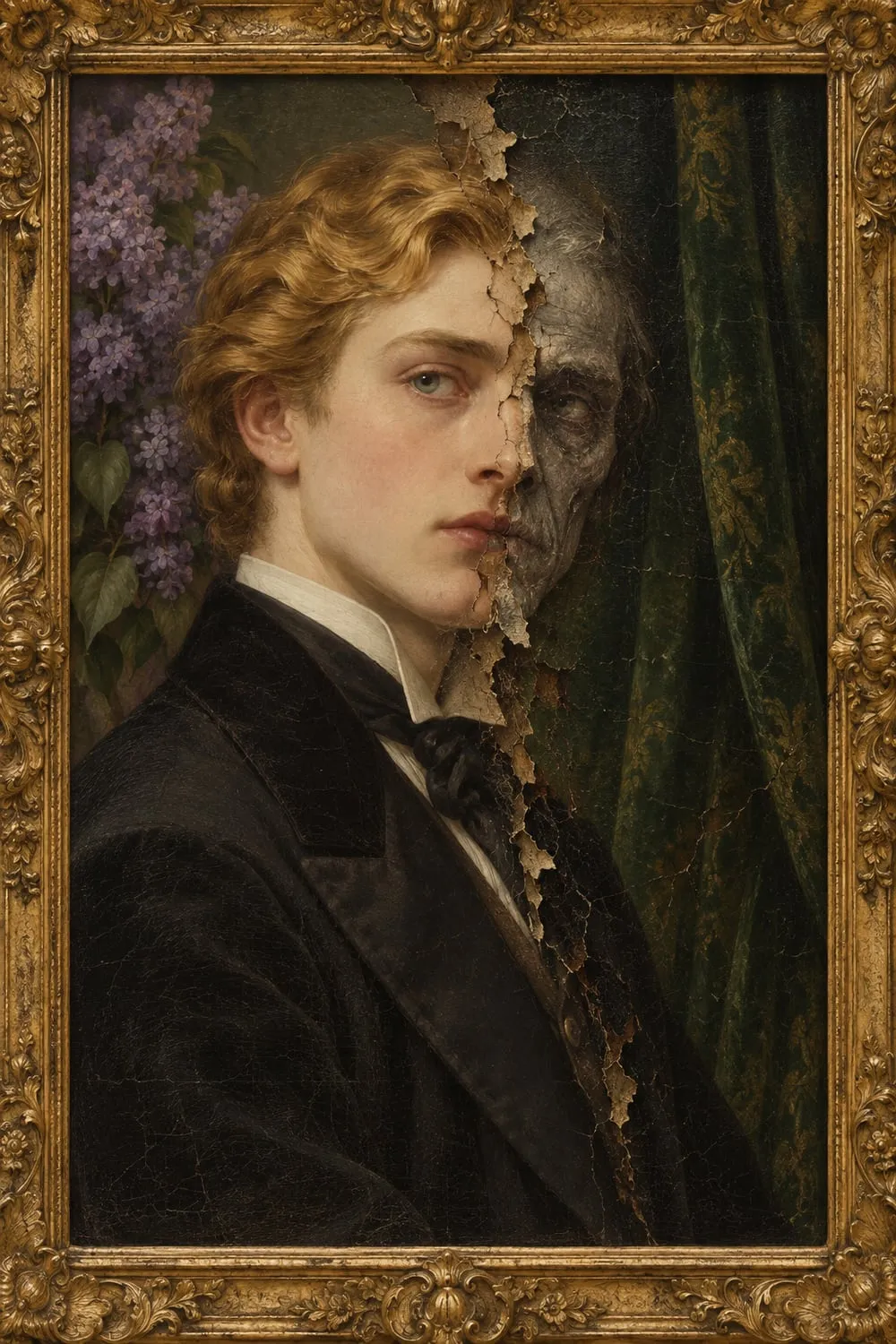
Painting for The Picture of Dorian Gray

Eternal youth, and the portrait that pays for it

The Picture of Dorian Gray

Novel·1890 (revised 1891)·20 chapters·about 5 h 45 min

"There is no such thing as a moral or an immoral book. Books are well written, or badly written. That is all."
Oscar Wilde

The story in brief

AI-assisted summary

One summer day in his London studio, the painter Basil Hallward finishes a full-length portrait of Dorian Gray, a young man of extraordinary beauty. While Dorian sits, Basil's friend Lord Henry Wotton dazzles him with talk of pleasure, sin and the shortness of youth. Seeing the finished picture, Dorian wishes that he might stay young and the portrait grow old, and says he would give his soul for it.

The wish comes true. Dorian falls in love with Sibyl Vane, a seventeen-year-old actress, then drops her cruelly when she acts badly. She poisons herself that night, and a touch of cruelty appears in the painted mouth. Dorian locks the picture away in his old schoolroom. Guided by Lord Henry and a strange yellow book, he gives eighteen years to pleasure and vice while his face stays young and the canvas grows hideous.

When Basil confronts him about the rumours, Dorian shows him the portrait and stabs him to death, then blackmails the chemist Alan Campbell into destroying the body. Sibyl's brother, James Vane, hunts Dorian down, only to be shot by accident at a shooting party. At last Dorian stabs the picture to be free of his past. His servants find the portrait as young and beautiful as the day it was painted and, on the floor, a withered, wrinkled dead man with a knife in his heart.

Key themes

"The only way to get rid of a temptation is to yield to it."
Lord Henry Wotton

Summary

AI-assisted summary

In his London studio, the painter Basil Hallward tells his friend Lord Henry Wotton why he will not exhibit his portrait of Dorian Gray: he has put too much of himself into it, and the young man has become his whole art. He begs Lord Henry not to influence Dorian. Dorian arrives, and while he poses Lord Henry talks to him of self-development, of yielding to temptation and of how quickly youth passes. When the portrait is finished, Dorian sees his own beauty for the first time and wishes aloud that he could stay young while the picture grows old: he would give his soul for it. Basil reaches for a palette-knife to destroy the canvas, but Dorian stops him.

Lord Henry learns from his uncle, Lord Fermor, that Dorian's mother, Lady Margaret Devereux, ran away with a penniless young officer who was killed in a duel arranged by her father, Lord Kelso, and that she died within a year. He resolves to dominate Dorian as Dorian, without knowing it, dominates Basil. A month later Dorian confesses that he loves Sibyl Vane, a seventeen-year-old actress who plays Shakespeare's heroines in a shabby little theatre and calls him Prince Charming. That night he telegraphs Lord Henry that they are engaged.

In the Vanes' lodgings in the Euston Road, Sibyl's mother reminds her of the money they owe the theatre manager, Mr. Isaacs. Sibyl's brother James, about to sail for Australia, distrusts him. On a walk in the park Sibyl glimpses Dorian driving past, but James misses him, and he swears to kill the man if he ever wrongs his sister. Before leaving, James makes his mother admit that she was never married to their father. Meanwhile Lord Henry and Basil dine with Dorian, who tells them of his engagement, and all three go to watch Sibyl play Juliet.

Sibyl acts badly. Afterwards she tells Dorian that now she knows real love she can no longer pretend on the stage. He tells her she has killed his love, calls her a third-rate actress with a pretty face and leaves her sobbing on the floor. At dawn he notices a touch of cruelty in the mouth of the portrait. Shaken, he resolves to marry her after all and writes begging her forgiveness, but Lord Henry arrives to tell him that Sibyl died in her dressing-room that night after swallowing poison. Lord Henry persuades him to see her death as a scene from a Jacobean tragedy, and Dorian decides to let the picture bear the burden of his shame. That evening he goes to the opera.

Next morning Basil is appalled by Dorian's calm and asks to see the portrait, which he now wants to exhibit in Paris. Dorian refuses, and draws from Basil a confession of how completely he once worshipped him. Dorian has the picture carried up to the locked schoolroom at the top of his house and covered with a purple and gold pall. The same day Lord Henry sends him a yellow book, a novel about a young Parisian who tries to live out the passions of every century but his own, and Dorian falls under its spell.

For years Dorian lives by the book. He studies perfumes, music, jewels, embroideries and church vestments, entertains brilliantly and slips away in disguise to dreadful places near the docks. Rumours spread and some men walk out of rooms he enters, yet his face stays innocent while the painted face grows old and vile. Sometimes he stands before the portrait with a mirror and takes pleasure in the contrast.

On the eve of his thirty-eighth birthday, Basil calls on him before leaving for Paris and confronts him with the ruined lives of his friends. When Basil says he would have to see Dorian's soul to know him, Dorian takes him upstairs and shows him the portrait. Basil begs him to pray. Seized by a sudden hatred, Dorian stabs him to death with a knife he had left in the room. Next day he summons Alan Campbell, a chemist and former friend, and forces him to destroy the body by threatening him with a letter whose contents are never revealed. A red stain like blood now glistens on the painted hand.

That evening Dorian dines at Lady Narborough's, burns Basil's coat and bag, and goes to an opium den near the river, where he meets the ruined Adrian Singleton. A woman calls him Prince Charming, and James Vane, about to sail for India, seizes him in an archway. Dorian saves himself by showing that his face is far too young for a man who knew Sibyl eighteen years before, though the woman then tells James the truth. A week later, at his country house, Selby Royal, Dorian faints on seeing James's face at the conservatory window. Three days on, Sir Geoffrey Clouston fires at a hare during a shooting party and kills a man in the thicket. It is James Vane, and Dorian weeps with relief.

Back in London, Dorian tells Lord Henry he means to be good: he has spared a village girl, Hetty, whom he had planned to take away with him. Lord Henry mocks the gesture, mentions Basil's disappearance and Alan Campbell's suicide, and laughs off the idea that Dorian could murder anyone. At home, Dorian smashes the mirror Lord Henry once gave him and goes to see whether his good deed has improved the picture. It has not: the face now shows cunning and hypocrisy, and the red stain has spread. Resolved to destroy the last evidence against him, he stabs the canvas with the knife that killed Basil. The servants hear a terrible cry. Breaking in, they find the portrait restored to its first beauty and, on the floor, a withered dead man whom they know only by his rings.

Chapter by chapter

AI-assisted summary
  1. Wilde opens the novel with a string of aphorisms on art, artists and critics. He declares that there is no such thing as a moral or an immoral book, only books well or badly written, and that art mirrors the spectator rather than life. No artist, he says, has ethical sympathies or wishes to prove anything. The Preface closes on its most provocative line: 'All art is quite useless.'

  2. Lord Henry Wotton lounges in Basil Hallward's studio, admiring Basil's full-length portrait of a beautiful young man and urging him to exhibit it. Basil refuses, confessing that he has put too much of himself into the picture and that its sitter, Dorian Gray, has become the whole of his art since they met at Lady Brandon's. Lord Henry is fascinated and recalls hearing the name at his aunt's. When Dorian arrives, Basil begs Henry not to influence him.

    Basil Hallward, Lord Henry Wotton, Dorian Gray

  3. Dorian Gray meets Lord Henry in Basil's studio and, while posing, listens to Henry's talk of self-development, temptation and the shortness of youth. In the garden Henry urges him to live fully before his beauty fades, calling for 'a new Hedonism'. When Basil finishes the portrait, Dorian wishes the picture could grow old instead of him, saying he would give his soul for it. He stops Basil from destroying the canvas, then leaves for the theatre with Henry.

    Dorian Gray, Lord Henry Wotton, Basil Hallward

  4. Lord Henry calls on his uncle, Lord Fermor, and learns that Dorian's mother, Lady Margaret Devereux, ran off with a penniless young officer who was killed months later in a duel her father, Lord Kelso, was said to have arranged; she died within a year. The story makes Dorian more interesting to Henry, who resolves to dominate him. At his Aunt Agatha's lunch Henry dazzles the table with a paradoxical praise of folly. Dorian, spellbound, breaks his promise to Basil and follows him out.

    Lord Henry Wotton, Lord Fermor, Lady Agatha, Dorian Gray

  5. Waiting in Lord Henry's Mayfair library, Dorian meets Henry's flighty wife, Victoria. When Henry arrives, Dorian confesses that he loves Sibyl Vane, a young actress he discovered playing Juliet in a shabby little theatre and now watches every night in Shakespeare's heroines. Henry agrees to come and see her act, then reflects with pleasure that the boy is largely his own creation, a subject for experiment. That night a telegram announces Dorian's engagement.

    Dorian Gray, Lord Henry Wotton, Lady Henry Wotton, Sibyl Vane

  6. Sibyl tells her mother she is in love with 'Prince Charming', whose real name she does not know, while Mrs Vane frets about their debt to the theatre manager, Mr Isaacs. Her brother James, about to sail for Australia, takes Sibyl for a walk in the park, where she glimpses Dorian driving past. James swears that if the stranger ever wrongs her he will kill him. Before leaving, he makes his mother admit that she was never married to their father.

    Sibyl Vane, Mrs. Vane, James Vane, Dorian Gray, Mr. Isaacs

  7. As they meet to dine at the Bristol, Lord Henry tells Basil that Dorian is engaged to an actress, and Basil is dismayed. Dorian arrives glowing, describes Sibyl as Rosalind and their first kiss, and says her trust will make him good and free him from Henry's 'poisonous' theories. Henry answers with paradoxes on pleasure, goodness and selfishness. As they leave for the theatre, Basil follows alone in a hansom and feels that he has lost Dorian.

    Lord Henry Wotton, Basil Hallward, Dorian Gray, Sibyl Vane

  8. Sibyl plays Juliet so badly that the audience hisses and Lord Henry and Basil leave. Backstage she tells Dorian joyfully that real love has shown her the hollowness of acting and she can no longer pretend. Dorian coldly tells her she has killed his love and leaves her sobbing at his feet. Returning home at dawn, he sees a new touch of cruelty in the portrait's mouth, remembers his wish, and resolves to go back and marry her.

    Dorian Gray, Sibyl Vane, Lord Henry Wotton, Basil Hallward, Mr. Isaacs

  9. Dorian wakes late, finds that the portrait really has changed, and writes Sibyl a passionate letter begging forgiveness. Lord Henry arrives with the news that she was found dead in her dressing-room, having swallowed poison. Henry persuades him to see her death as a beautiful scene from a Jacobean tragedy rather than as his fault. Alone again, Dorian decides that the portrait will bear the burden of his shame while he keeps his youth, and goes to the opera.

    Dorian Gray, Lord Henry Wotton, Sibyl Vane, Victor

  10. Basil comes to console Dorian and is appalled that he went to the opera on the day he heard of Sibyl's death and now calls it a romantic tragedy. When Basil moves to look at the portrait and says he will exhibit it in Paris, Dorian threatens to end their friendship. Dorian then draws from him the confession that he worshipped Dorian and feared the picture showed it. Relieved that his own secret is safe, Dorian resolves to hide the portrait away.

    Dorian Gray, Basil Hallward, Sibyl Vane

  11. Distrusting his valet Victor, Dorian gets the key of the old schoolroom from his housekeeper, Mrs Leaf, and wraps the portrait in a purple satin pall. The frame-maker Mr Hubbard and his assistant carry it to the top of the house, to the room built by the grandfather who hated him, and Dorian locks it away. A newspaper reports that the inquest has found Sibyl's death to be misadventure. Then Dorian loses himself in a strange, poisonous yellow book sent by Lord Henry.

    Dorian Gray, Victor, Lord Henry Wotton, Sibyl Vane

  12. Over many years Dorian shapes his life on the novel Lord Henry sent him, taking up perfumes, strange instruments, jewels, embroideries and church vestments in turn. In the locked room the portrait grows old and vile while his own face stays young, and he compares the two with a mirror. Rumours spread about his long absences, his haunts near the docks and the friends who now shun him, yet his beauty and wealth keep society on his side.

    Dorian Gray, Lord Henry Wotton, Basil Hallward

  13. On a foggy November night, the eve of his thirty-eighth birthday, Dorian meets Basil Hallward, who is about to leave for Paris by the midnight train. In the library Basil confronts him with the scandals told of him in London: young men ruined, Lord Henry's sister disgraced, whispers of dreadful houses. Basil says he could only know the truth if he could see Dorian's soul. With a bitter laugh, Dorian offers to show it to him upstairs.

    Dorian Gray, Basil Hallward, Adrian Singleton

  14. Dorian leads Basil up to the locked room and tears the curtain from the portrait. Basil recognises his own brushwork and signature on a hideous, ruined face and begs Dorian to pray with him for forgiveness. Seized by a sudden hatred, as if the picture had whispered it, Dorian stabs him to death with a knife lying on a painted chest. He hides Basil's bag and coat, fakes a late return for his valet Francis, and looks up Alan Campbell's address.

    Dorian Gray, Basil Hallward, Francis, Alan Campbell

  15. Dorian wakes calmly the next morning, reads Gautier to keep his mind from the body upstairs, and sends for Alan Campbell, a chemist and former close friend who now shuns him. Campbell refuses to help until Dorian writes him a note and threatens to send a letter whose contents are never revealed. Broken, Campbell does the work, while Dorian sees a red dew like blood on the portrait's hand and covers it. By evening the body is gone, leaving a smell of nitric acid.

    Dorian Gray, Alan Campbell, Basil Hallward, Francis

  16. That evening Dorian dines at Lady Narborough's, hiding his fever behind easy charm while Lord Henry trades epigrams on marriage and women with the hostess. Dorian cannot eat, and when Harry asks where he went the night before, he stumbles over his answer. At home he burns Basil's coat and bag, then takes a lacquer box of green paste from a hidden drawer. At midnight, dressed commonly, he hires a hansom and drives towards the river.

    Dorian Gray, Lord Henry Wotton, Lady Narborough, Basil Hallward

  17. Dorian drives through the rain to an opium den near the quays, where he finds Adrian Singleton, cut off by his friends and content with his pipe. As Dorian leaves, a woman at the bar calls him Prince Charming, and a sailor rushes out after him. James Vane seizes him in an archway to avenge Sibyl, but Dorian's boyish face under the lamp convinces him he has the wrong man. The woman then tells James that Prince Charming ruined her nearly eighteen years ago.

    Dorian Gray, Adrian Singleton, James Vane, Sibyl Vane

  18. A week later Dorian entertains a house party at Selby Royal. Over tea in the conservatory, Lord Henry and his cousin Gladys, Duchess of Monmouth, trade paradoxes about England, love and women, and he warns her that she is flirting with Dorian. Going to fetch her orchids, Dorian falls in a dead faint. He insists on coming down to dinner, but he is haunted by the face of James Vane, seen pressed against the conservatory glass.

    Dorian Gray, Lord Henry Wotton, The Duchess of Monmouth, Lady Narborough, James Vane

  19. Dorian hides indoors for two days in terror of James Vane, then persuades himself the face was only fancy. Out with the shooting party, he begs Sir Geoffrey Clouston to spare a hare, but Geoffrey fires into a thicket and kills a man hidden there. Dorian calls it a bad omen and resolves to leave Selby. Then the head-keeper reports that the dead man was an unknown sailor, and at the Home Farm Dorian finds the body of James Vane and rides home weeping with relief.

    Dorian Gray, Lord Henry Wotton, The Duchess of Monmouth, Sir Geoffrey Clouston, James Vane

  20. At Lord Henry's house, Dorian announces that he means to be good and has already spared Hetty, a village girl he loved. Lord Henry mocks the renunciation and gossips about Basil's disappearance, his own divorce and Alan Campbell's suicide. When Dorian asks what he would say to a confession that Dorian murdered Basil, Harry replies that crime is vulgar and beyond him. Harry praises Dorian's unchanged youth, and Dorian begs him never to lend that poisonous book to anyone again.

    Dorian Gray, Lord Henry Wotton, Hetty Merton, Basil Hallward, Alan Campbell, Lady Henry Wotton

  21. Walking home, Dorian hopes his one good deed has begun to cleanse the portrait. He smashes the mirror Lord Henry once gave him, then climbs to the locked room, where the face looks only more cunning and the blood on its hand brighter. Seeing that vanity and curiosity spared Hetty, he stabs the picture with the knife that killed Basil. The servants break in to find the portrait young and beautiful, and on the floor a withered, wrinkled dead man they know only by his rings.

    Dorian Gray, Lord Henry Wotton, Hetty Merton, Basil Hallward, Francis

Characters

AI-assisted notes
  • Painted portrait of Dorian Gray

    Dorian Gray

    The man who never ages

    A young man of extraordinary beauty, grandson of Lord Kelso and master of Selby Royal, who is just over twenty when Basil paints him. Lord Henry's talk and the finished portrait wake his vanity, and his wish that the picture should age in his place comes true. He drives Sibyl Vane to her death, spends eighteen years in pleasure and vice, murders Basil, and dies when he finally turns the knife on the portrait.

  • Painted portrait of Lord Henry Wotton

    Lord Henry Wotton

    Prince Paradox

    Basil's old Oxford friend, known as Harry, a languid aristocrat who talks in paradoxes and preaches 'a new Hedonism'. Basil says he never says a moral thing and never does a wrong thing. He studies Dorian as a scientist studies an experiment and sends him the yellow book that shapes his life. He never learns what Dorian has done: when Dorian hints at murder, Lord Henry replies that crime belongs to the lower orders.

  • Painted portrait of Basil Hallward

    Basil Hallward

    The devoted painter

    A painter who finds in Dorian a new manner for his art and worships him more than he dares to say. He paints the portrait, refuses to exhibit it because it shows too much of himself, and begs Lord Henry to leave Dorian alone. Years later he confronts Dorian about the rumours and is shown the ruined picture. He urges Dorian to pray, and Dorian stabs him to death.

  • Painted portrait of Sibyl Vane

    Sibyl Vane

    The young actress

    A seventeen-year-old actress in a shabby theatre who plays Juliet, Rosalind and Imogen and knows nothing of life outside them. She calls Dorian Prince Charming and never learns his full name. Once she truly loves him, acting feels like a sham and she plays Juliet badly. Rejected by him that night, she dies in her dressing-room after swallowing poison.

  • Painted portrait of James Vane

    James Vane

    The avenging brother

    Sibyl's rough, sixteen-year-old brother, who sails for Australia distrusting the gentleman who courts her. He makes his mother admit that she never married their father, and swears to kill any man who wrongs his sister. Eighteen years later he hears the name Prince Charming in an opium den and seizes Dorian, but is fooled by his young face. He follows him to Selby and is shot there by accident.

  • Painted portrait of Mrs. Vane

    Mrs. Vane

    The faded actress

    Sibyl and James's mother, a tired actress who played Lady Capulet on the night Dorian first came to the theatre. She owes money to Mr. Isaacs, hopes Sibyl's admirer is rich, and turns every family moment into a stage scene. When James presses her, she admits that she was never married to the children's father, a gentleman who was not free.

  • Painted portrait of Alan Campbell

    Alan Campbell

    The chemist compelled

    A clever chemist and fine musician who was Dorian's close friend for eighteen months before the friendship suddenly ended. Dorian summons him the morning after the murder and, when he refuses to help, forces him with a written threat to destroy Basil's body with chemicals. Campbell does the work and leaves. Later he shoots himself in his laboratory without revealing the secret.

  • Painted portrait of Adrian Singleton

    Adrian Singleton

    A ruined friend

    A young man with smooth yellow hair, one of the friends whose ruin Basil lays at Dorian's door; he wrote a friend's name across a bill. He once gave Dorian a copy of Gautier's poems. Dorian finds him in the opium den by the river, shunned by his family and friends, saying that as long as one has the drug one does not want friends.

  • Painted portrait of The Duchess of Monmouth

    The Duchess of Monmouth

    The witty duchess

    Gladys, Lord Henry's cousin, married for ten years to the dull, much older Duke of Monmouth. At Selby Royal she matches Lord Henry epigram for epigram and flirts openly with Dorian. Asked whether she is in love with him, she can only say, 'I wish I knew'. Her brother, Sir Geoffrey Clouston, fires the shot that kills James Vane.

  • Painted portrait of Lady Henry Wotton

    Lady Henry Wotton

    Lord Henry's wife

    Victoria, Lord Henry's wife, a nervous, untidy woman whose dresses look as if they had been designed in a rage. She meets Dorian in her husband's library, chatters about Wagner and pianists, and admits that she learns Harry's views only from his friends. By the end of the novel she has run away with a man who played Chopin, and Lord Henry has been through a divorce case.

  • Painted portrait of Lady Agatha

    Lady Agatha

    The charitable aunt

    Lord Henry's aunt, a philanthropist who works in the East End and wants Dorian to play the piano for the poor in Whitechapel. It is at her house that Lord Henry first hears Dorian's name. At her luncheon Lord Henry improvises his praise of folly while Dorian listens, spellbound, and she scolds her nephew for luring Dorian away from good works.

  • Painted portrait of Lord Fermor

    Lord Fermor

    The old diplomat

    Lord Henry's Uncle George, a genial but rough-mannered old bachelor and former diplomat who lives in chambers in the Albany and has made a study of doing absolutely nothing. From him Lord Henry learns the story of Dorian's parents: Lady Margaret Devereux's runaway marriage, the husband killed in a duel arranged by her father, Lord Kelso, and her death within a year.

  • Painted portrait of Mr. Isaacs

    Mr. Isaacs

    The theatre manager

    The manager of the shabby theatre where Sibyl acts, a man of five bankruptcies who blames them all on Shakespeare. He has lent the Vanes fifty pounds and holds Sibyl to a three-year contract. Dorian describes him with open contempt and prejudice, calling him only 'the Jew', but it is he who takes Dorian behind the scenes to meet Sibyl.

  • Painted portrait of Lady Narborough

    Lady Narborough

    The worldly hostess

    The clever widow of an ambassador, who has, in Lord Henry's phrase, 'the remains of really remarkable ugliness'. She gives the small dinner Dorian attends on the evening after Basil's murder, scolds him for not eating, and promises to go through Debrett to find him a suitable wife. She is later among the guests at Selby Royal.

  • Painted portrait of Sir Geoffrey Clouston

    Sir Geoffrey Clouston

    The careless shot

    The Duchess of Monmouth's brother and a guest at Selby Royal. Out with the shooting party, he laughs off Dorian's plea to let a hare live, fires into a thicket of alders and kills a man hidden there. His first complaint is that the man has spoiled his shooting for the day. The dead man turns out to be James Vane.

  • Painted portrait of Hetty Merton

    Hetty Merton

    The girl he spares

    A village girl who looks like Sibyl Vane. Dorian visits her through a lovely May, tells her he is poor, and plans to run away with her, then decides to leave her 'as flowerlike as I had found her'. He counts this his first good action in years, but Lord Henry mocks it and the portrait shows only hypocrisy.

  • Painted portrait of Victor

    Victor

    Dorian's French valet

    Dorian's valet in the early chapters, who brings his tea and letters on the day after Sibyl's death. Dorian comes to fear that he has looked behind the screen, sees in him 'thoughtful, treacherous eyes', and sends him on an errand while the portrait is carried upstairs. Years later Dorian tells Basil that the Frenchman married Lady Radley's maid and set her up in Paris as a dressmaker.

  • Painted portrait of Francis

    Francis

    Dorian's later valet

    The valet who serves Dorian in later years. On the night of the murder Dorian slips out and rings the bell so that Francis lets him in at ten past two, and Francis tells him that Basil left at eleven to catch his train. He fetches Alan Campbell's chemicals, and at the end he leads the servants who break into the locked room.

Themes

AI-assisted notes

Beauty and youth

In Basil's garden Lord Henry tells Dorian that 'youth is the one thing worth having', and the finished portrait makes the lesson visible: Dorian sees his own beauty for the first time and cannot bear that the picture will keep what he must lose. His wish turns his face into a mask. Society trusts that face, so that men who talk grossly fall silent when he enters, and James Vane lets him go because he looks twenty. At the end Dorian smashes his mirror, deciding that his beauty and the youth he prayed for have ruined him.

Influence and corruption

Lord Henry tells Dorian that 'all influence is immoral', then spends the novel exerting it, treating the young man as an experiment whose results he watches with interest. His words in the studio, and later the yellow book he sends, work on Dorian like a slow poison; the narrator says plainly that 'Dorian Gray had been poisoned by a book.' The corruption passes on: Basil names the young men whose lives Dorian has wrecked, and Adrian Singleton turns up in an opium den. Lord Henry never accepts the charge. 'Art has no influence upon action,' he says on the last night of Dorian's life.

Art and life

The Preface insists that 'all art is quite useless' and that books are only well or badly written, yet the story turns on a picture with a moral life of its own. Sibyl Vane can play Juliet only while she knows nothing of love; once she loves Dorian, the painted scenery looks false to her, her acting collapses, and he loses interest in her. Lord Henry then teaches Dorian to watch her death as a spectator watches a play. Basil fears his portrait reveals 'the secret of my own soul'. In the end it reveals Dorian's.

Conscience and the soul

From the morning Dorian first sees cruelty in the painted mouth, the portrait becomes 'the visible emblem of conscience'. He hides it under a pall in his childhood schoolroom and leads a double life, celebrated host in society and disguised visitor to dens by the docks. Basil tells him that 'sin is a thing that writes itself across a man's face'. The novel agrees, but moves the writing to canvas. When Dorian spares Hetty and hopes the picture has softened, it shows only 'the curved wrinkle of the hypocrite', and his attempt to kill his conscience kills him.

Society and surfaces

Lord Henry says that 'it is only shallow people who do not judge by appearances', and the society around him bears him out. It 'feels instinctively that manners are of more importance than morals', and its luncheons and dinners, at Lady Agatha's or Lady Narborough's, run on wit and gossip about other people's marriages. Dorian's wealth and face protect him for eighteen years, even when he is nearly blackballed and the Duke of Berwick walks out of a smoking-room. The last scene makes the point bitterly: two passers-by hear the dying cry, learn whose house it is, and sneer.

Context

AI-assisted notes

The Picture of Dorian Gray is Oscar Wilde's only novel. It began as a commission: in August 1889, at a dinner in London, J. M. Stoddart, editor of Lippincott's Monthly Magazine, commissioned work from both Wilde and Arthur Conan Doyle. Doyle wrote The Sign of Four. Wilde's novel appeared in Lippincott's in July 1890, in a shorter version of thirteen chapters.

Several British reviewers attacked the magazine version as immoral. Wilde revised and expanded the story for the book edition, published by Ward, Lock and Company in April 1891, adding six chapters and the Preface. The Preface had first appeared in the Fortnightly Review in March 1891, and its aphorisms read as a reply to those reviews: 'There is no such thing as a moral or an immoral book.' The text given here is the 1891 book.

The novel came up again five years later. In the 1895 libel trial, Edward Carson, counsel for the Marquess of Queensberry, cross-examined Wilde about it. The book had already staged the argument. On the last night of his life Dorian tells Lord Henry, 'Yet you poisoned me with a book once', and Lord Henry answers, 'As for being poisoned by a book, there is no such thing as that.'

Lippincott's Monthly Magazine, July 1890; revised and expanded as a book in 1891. The text here is the 1891 book.

About this edition

  • Text: the complete work from Standard Ebooks, released into the public domain (CC0 1.0). We change only the layout.
  • Download the EPUB, free, for any e-reader.
  • Audiobook: read by Bob Neufeld for LibriVox, in the public domain.
  • The summaries, character notes, themes and glossary were written with AI from the text and then checked: every quotation and every glossary word is matched against the text.